
If the first thing you do every morning is grab your neck, the problem isn’t bad luck — it’s what’s happening to your neck for the eight hours before you wake up.

Why your neck is fine all day but stiff every morning
If your neck only hurts when you wake up, the cause is almost always overnight, not daytime posture. For 7-8 hours, your neck muscles and joints are held in whatever position your pillow puts them in — and unlike sitting at a desk, you can’t shift or correct it consciously while you’re asleep.
The two usual culprits: your pillow is the wrong height for how you sleep, or you’re sleeping in a position that twists your neck out of a neutral line for hours at a stretch. Both are fixable without any guesswork.
Get the pillow height right for your position
This is the single biggest lever, and most people have never actually checked it. The goal is a straight line from your ear through your shoulder — no upward tilt, no downward sag.
- Side sleepers need the most loft — about 5-6 inches, firm enough to fill the gap between ear and shoulder without collapsing.
- Back sleepers need less — about 3-4 inches, medium support.
- Stomach sleepers need the least — 1-2 inches, soft (stomach sleeping is also the hardest position on the neck generally; worth transitioning away from if you can).
- Combination sleepers do best around 4-5 inches with a pillow that adapts as you move.
A pillow that’s too flat lets your head drop back; too high and it pushes your chin toward your chest. Either one strains the same muscles for hours, every night.
Wrong pillow height
Neck bends out of line all night
Correct pillow height
Head, neck and spine stay neutral
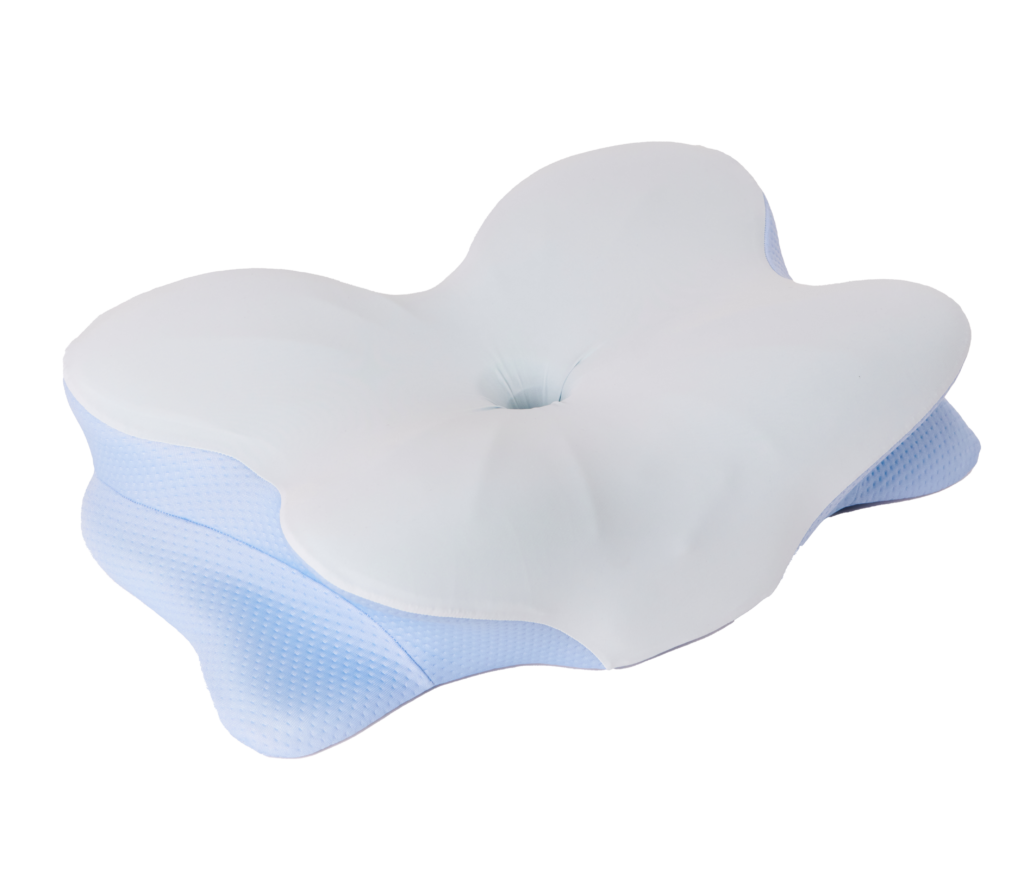
Our tested pick: the Derila Ergo pillow
After 30 nights of testing, the pillow we point people to first is the Derila Ergo — a contoured memory-foam design that holds its shape through the night and supports the neck in both side and back positions. Morning stiffness noticeably dropped by about week two of testing. Read the full 30-night Derila Ergo review for the complete breakdown.
Check price and availability →
A short stretch before bed helps too

A tight, tense neck going into sleep tends to stay tight overnight. Two or three minutes of slow, gentle mobility before bed can make a real difference:
- Slow neck rolls, both directions, no forcing.
- Ear-to-shoulder stretch, holding each side for 20-30 seconds.
- Shoulder rolls, since neck stiffness is often tangled up with tight shoulders and upper back.
For the mornings it’s already bad
Even with the right pillow, some mornings you’ll still wake up sore — a rough night, an odd sleeping position, or just an off day. For that, fast, localized relief matters more than a long-term fix.
We tested a range of topicals and the one that penetrated deepest was ArcticBlast — DMSO-based drops that carry the active ingredients into the tissue rather than just cooling the skin surface. Relief is typically noticeable within 5-10 minutes, which matters when you need to function that morning, not in an hour. See our full ArcticBlast review for scores and side-by-side comparisons.
Check price and availability →

A one-week plan to break the pattern
- Days 1-2: Fix your pillow height for your actual sleep position — the single highest-leverage change.
- Days 2-4: Add 2-3 minutes of gentle neck and shoulder stretching before bed.
- Days 3-7: Keep a topical on hand for the mornings it’s still tight while your neck adapts to the new support.
Give the pillow change a full week before judging it — your neck muscles need a few nights to adapt to a new position, even a correct one.
Related reading: The Complete Guide to Pain-Free Sleep and The Perfect Evening Wind-Down Routine.
Your stiff-neck toolkit
| The problem | The tool | |
|---|---|---|
| Wrong pillow height causing nightly strain | Derila Ergo Pillow | Check price → |
| Already stiff and sore this morning | ArcticBlast Drops | Check price → |
Frequently asked questions
How do I know if my pillow is the problem?
If your neck feels fine before bed and stiff on waking, and there’s no other injury, an ill-fitting pillow is the most common cause.
How long until a new pillow actually helps?
Most people notice a difference within 3-7 nights as their neck adapts to correct alignment.
Heat or cold for a stiff morning neck?
Heat is generally better for stiffness and muscle tightness; cold is better for fresh, inflamed pain. A stiff morning neck usually responds better to heat or a warming topical.
Should I see a doctor?
If stiffness is severe, doesn’t improve with these changes, or comes with numbness, tingling, or radiating pain, get it checked out — that’s outside what a pillow or topical can fix.
Disclosure: Sleep Align is reader-supported and independent. Some links are affiliate links, and if you buy through them we may earn a commission at no extra cost to you. We only recommend products we have researched and tested ourselves. This article is general information, not medical advice; talk to your doctor about persistent pain or sleep problems.