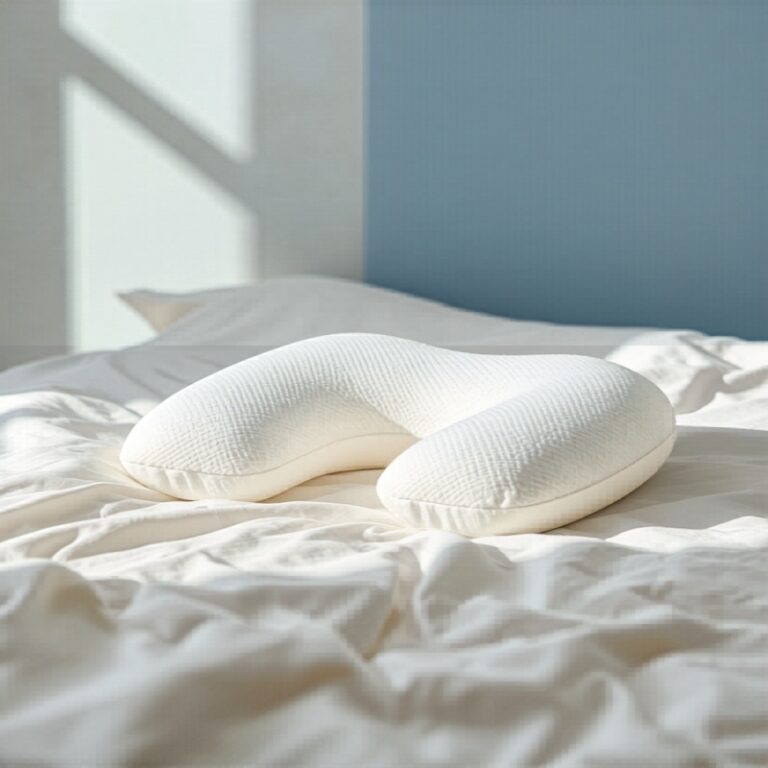
Side Sleeper Pillow Guide: The Right Height, Shape, and Material

Side sleeping is the most popular sleep position — preferred by around 60% of adults. It is also the position where pillow choice has the most dramatic impact on neck health. Get it right and side sleeping is excellent for spinal alignment. Get it wrong and you are creating a slow-burn neck and shoulder injury that compounds nightly.
The Core Problem With Side Sleeping
When you lie on your side, your head is elevated by the width of your shoulder above the mattress. Your pillow needs to fill exactly that space — no more, no less. If it is too thin, your head drops toward the mattress and the neck bends laterally downward. If it is too thick, your head is pushed upward and the neck bends away from the mattress. Both positions create the same problem: sustained lateral cervical stress for hours.
The shoulder-to-ear distance varies between individuals, which is why a single “recommended pillow height” does not exist. Broad-shouldered people need a higher-loft pillow. Narrower-framed people need less. The test: lying on your side, your nose should be level with the centre of your sternum — if it points toward the ceiling or the mattress, the pillow height is wrong.
What to Look For: Height, Firmness, and Shape

- Height (loft): Medium-high to high. Most side sleepers need 4–6 inches of loft to fill the shoulder-to-ear gap. Standard pillows compress to 2–3 inches under the weight of the head — far too low for most side sleepers.
- Firmness: Medium-firm to firm. A pillow that compresses fully under the weight of your head provides no height support. You need a pillow with enough resistance to maintain its loft while your head is resting on it.
- Shape: A pillow with a raised edge or contoured profile provides built-in support for the neck’s natural curve during side sleeping. Flat pillows require more loft to compensate and often create pressure points.
- Material: Memory foam outperforms polyester fill and down for side sleepers because it maintains consistent loft throughout the night. Polyester pillows shift and compress unevenly; memory foam does not.
Designed for Side Sleepers
🛏 Derila Ergonomic Pillow — Contoured Memory Foam
Raised side support profile + memory foam that holds its loft. Supports cervical neutral for both side and back sleeping.
Read the Full Review →The Pillow-Between-the-Knees Rule
A head pillow that is perfect for side sleeping is only half the equation. Without a pillow between the knees, the top hip rotates forward, twisting the lumbar spine and creating lower back strain that compounds through the night. A standard pillow or dedicated knee pillow placed between the knees keeps the hips stacked and the spine aligned from head to pelvis.
This is particularly important for side sleepers who wake with lower back pain in addition to neck stiffness — two symptoms that share a common cause in spinal misalignment during sleep.
Testing Your Current Pillow
Take a photo of yourself lying on your side (or ask someone to check). Your spine should form a straight horizontal line from your tailbone to the crown of your head. If your head is angled downward or the neck is visibly bent upward, your pillow height is wrong. This one observation is more diagnostic than any pillow quiz or chart.
The Derila pillow was specifically designed with side sleepers in mind — the raised edge profile provides consistent loft support, and the memory foam maintains it through the night without the flattening and shifting that polyester fill produces. If you have been through multiple pillows without finding one that holds its shape, the material choice is likely the issue.

About the Author
Certified Health & Wellness Coach · Pain Relief Specialist
Sarah Brennan spent 11 years managing chronic neck and shoulder pain after a rear-end collision left her with cervical disc damage. She tried physical therapy, prescription muscle relaxants, cortisone injections, and a dozen over-the-counter creams before discovering that topical DMSO formulations worked where everything else failed. That personal experience turned into a side project: testing and documenting pain relief products with honest, skeptical reviews grounded in how they actually feel to use. She now writes for Sleep Align, focusing on topical analgesics and sleep ergonomics, and has reviewed more than 40 pain relief products over the past four years. She holds a certificate in Health and Wellness Coaching from the National Board for Health and Wellness Coaching (NBHWC).
More Pillow Guides
Recommended for Pain-Free Sleep
🛌 Derila Ergonomic Memory Foam Pillow
Contoured design that holds your cervical spine in neutral for the full night. Works for side and back sleepers. Backed by a 30-night trial.
- ✓ Memory foam contour
- ✓ Side & back sleeper design
- ✓ 30-night trial