
Our verdict
Our pick: Derila Ergo Pillow
Worth trying if you sleep on your side or back and wake with a stiff neck. Not worth it for anything else.
| Best for | Side and back sleepers who wake with neck stiffness or a headache at the base of the skull |
|---|---|
| Not for you if |
|
| Main drawback | One fixed loft and one firmness. If 9 cm (back) or 12 cm (side) is not your number, there is nothing to adjust |
| Price | $59.99 for one, $99.98 for two ($49.99 each) at the time of writing — the seller sets the price |
| Guarantee | 60-day money-back |
Verdict: Buy it for morning neck stiffness, give it ten nights, and use the 60 days honestly — that is long enough to know.
Affiliate link — we may earn a commission at no cost to you. Nothing on this page is medical advice.
Wake up without neck pain. The pillow that holds your neck level all night.
Most morning neck pain has one cause: your neck spent seven hours bent, because the pillow didn’t fill the gap. The Derila Ergo is a dual-zone contoured memory-foam pillow built to fix exactly that for side and back sleepers — and it’s the wrong buy for stomach sleepers, which we say plainly.
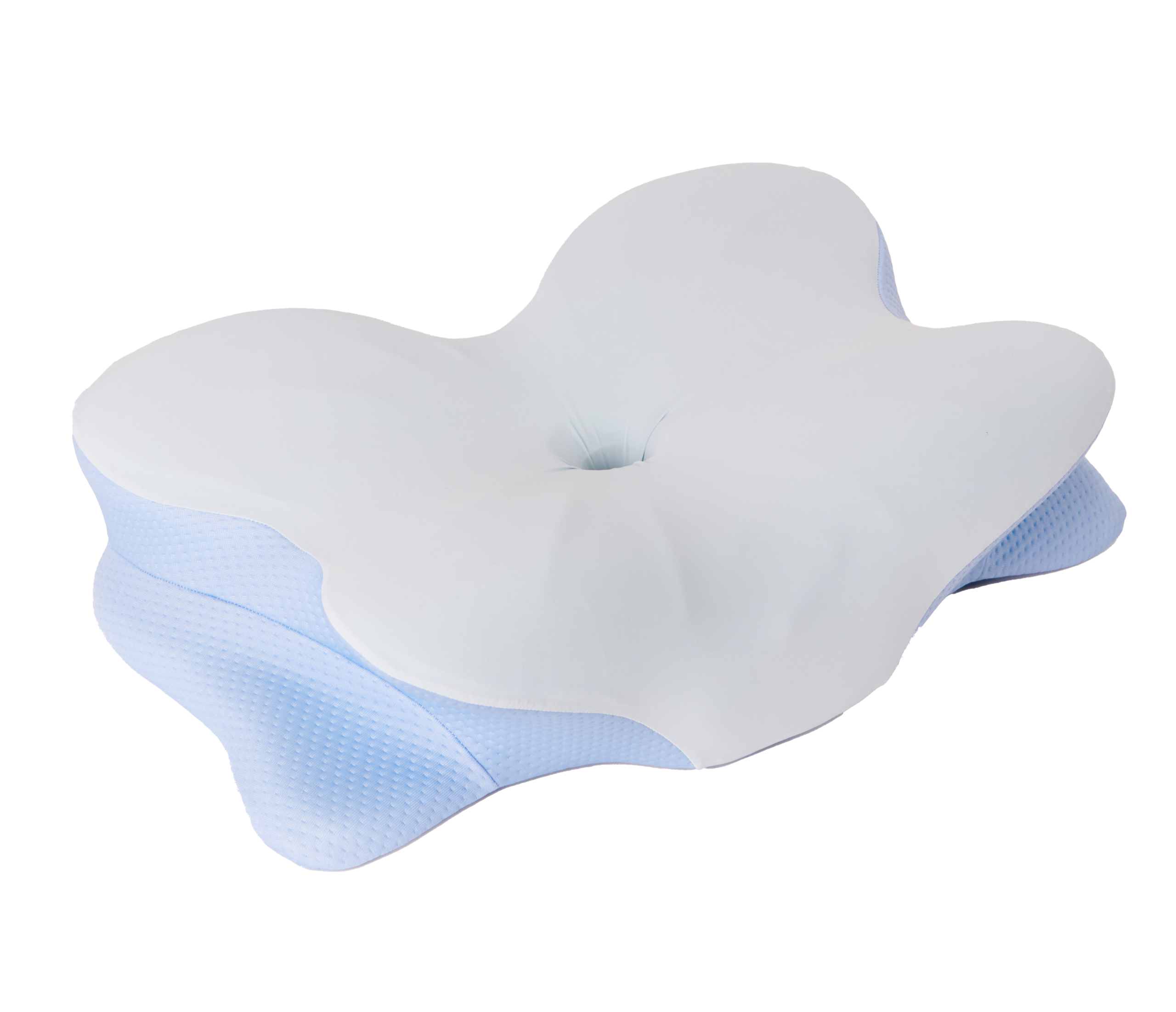
One pillow, two heights — because your neck needs a different number on your side than on your back.
A flat pillow is the wrong height in at least one position. The Derila’s butterfly shape gives each position its own zone.
Bridges the shoulder gap
Your shoulder lifts your head off the mattress. A pillow that doesn’t fill that gap bends the neck sideways for hours — stretching one side, compressing the other. The raised edges are dimensioned to fill it.
Holds the curve, not the chin
Back sleepers need less height. The recessed centre supports the natural cervical curve without pushing the chin toward the chest, which is what an over-tall pillow does.
Shapes to you, doesn’t cook you
Slow-rebound memory foam moulds to your head over the first few nights. The ventilated core lets air move, so it runs cooler than solid memory foam — though not as cool as latex. Washable hypoallergenic cover, one medium-firm feel.
Great fit, wrong buy, or not sure yet.
- Wake up with neck or shoulder stiffness
- Sleep on your side or back
- Run hot and need something that breathes
- Want a one-time purchase, not a subscription
- Have latex allergies — it’s hypoallergenic
- Sleep on your stomach
- Prefer very flat, thin pillows
- Need it fixed by tomorrow morning — it takes 7–14 nights
- Have hip pain — that needs a knee pillow, not this
- Have a diagnosed neck condition your clinician hasn’t cleared
Check your height first
Broad shoulders on a very soft mattress can need more loft than a fixed contour gives. Thirty seconds with the calculator tells you whether the Derila’s numbers match yours.
It gets better by the second week, not the first night.
Memory foam has to shape to you, and your neck has to stop bracing. Buyers most often report the change between night 7 and 14.
Feels different
Firmer and more shaped than a bag of fill. Perfectly normal — your neck muscles are starting to release tension they’ve held for years.
Stiffness starts easing
The foam has shaped to your head. Morning neck pain begins to fade and you stay in one position longer because the head stays supported.
The contour feels natural
Most buyers report noticeably less neck and shoulder tension by now. If nothing has changed by night 14, it’s probably not the pillow — and the guarantee still has 46 days on it.
The themes that keep repeating.
Summarised from the public buyer reviews we analysed — patterns, not cherry-picked quotes.
Long-term neck-pain sufferers who had already tried several pillows most often say the Derila was the first to noticeably reduce morning stiffness — typically from around the second week.
Side sleepers who were sceptical of the contour shape frequently report that it holds spinal alignment well — once they push through the first few nights of adjustment.
Value comes up repeatedly: buyers compare it favourably to pricier clinical or orthopaedic pillows, and many note the foam still holds its shape after several months of use.
- Butterfly contour supports side and back sleepers
- Responsive memory foam without the heat trap
- Hypoallergenic, machine-washable cover
- Foam holds its height night after night
- 60-day money-back guarantee
- Takes 1–2 weeks to fully adjust
- Not for stomach sleepers
- Costs more than a standard pillow
- One firmness only (medium-firm)
- Sold direct only — no trying it in a shop
One is fine. Two is the value.
Bundle pricing is the only discount there is — there’s no working coupon code. If you share a bed, the two-pack is considerably cheaper than buying twice.
Prices from the official site at the time of writing; the seller sets them and they change with promotions. Bundle selection happens on the seller’s page. Our best-price guide shows the cheapest configuration before you order.
Who the Derila is — and isn’t — for.
The Derila is a head-and-neck pillow. That determines which problems it can realistically affect and which it can’t. If you are not sure the pillow is the problem at all, our night-time symptom reference maps 50 night symptoms to what published sources say to change — and is straight about the 13 where no source describes any bedding change at all.
Side sleepers — the best fit
Around 60% of adults sleep on their side, and it’s the position most exposed to pillow height error. Your shoulder creates a gap between the mattress and your head; a flat pillow either fails to fill it (bending the neck downward) or collapses overnight. The result is cervical lateral flexion — the neck held sideways for hours, stretching the muscles on the upper side and compressing the lower. The Derila’s raised side sections are dimensioned specifically to bridge that shoulder gap, which is why side sleepers report the clearest results.
Back sleepers — also well suited
Back sleepers need considerably less loft than side sleepers — roughly 3–5 inches versus 4–6. The Derila’s lower central section is designed to support the natural cervical curve without pushing the chin toward the chest, which is the failure mode of an over-lofted pillow on your back.
Stomach sleepers — not what it’s built for
Being straight about it: the Derila is contoured for back and side sleeping, and stomach sleeping is the position most likely to cause neck pain regardless of pillow. Lying face-down forces the neck to rotate to one side for four to six hours, loading the cervical facet joints asymmetrically. Any pillow under the head adds height that makes that rotation worse. If you sleep on your stomach, a contoured pillow is the wrong purchase — you need the thinnest pillow you can tolerate, or a transition to side sleeping.
Shoulder pain — helps indirectly
Correct pillow height keeps the shoulder from being crushed under the head’s weight and stops the neck dragging the upper trapezius out of position all night. That relieves the referred tension component of shoulder pain. It does not treat rotator cuff injury, impingement, or bursitis — for those, position change and clinical treatment matter more than the pillow.
Morning headaches — sometimes, if they’re cervicogenic
Headaches that begin at the base of the skull and radiate forward, and are present on waking, are often cervicogenic — driven by the suboccipital muscles being held in a strained position overnight. Correcting cervical alignment can reduce those. Migraines, tension headaches with daytime triggers, and headaches unrelated to neck position won’t respond, and shouldn’t be expected to.
Hip pain — realistically, no
A head pillow does not fix hip pain. Overall spinal alignment has some influence on hip positioning, so it isn’t entirely unrelated, but if hip pain is your primary complaint the item that matters is a pillow between your knees to stop the top leg dropping and rotating the pelvis. Buying a neck pillow for hip pain will disappoint you.
Sleep on it for two weeks. If your mornings haven’t changed, send it back.
That’s the seller’s guarantee, in writing. Give it the 7–14 nights the foam needs, and judge it on how your neck feels at breakfast — not on night one.
See today’s price →Before you buy.
How long until I see results? +
Is it suitable for all sleep positions? +
Does memory foam get hot? +
Can I wash it? +
Is it good for recliner sleeping? +
What’s the return policy? +
More Derila guides
Disclosure: this page contains affiliate links. If you buy through them we may earn a small commission at no extra cost to you. Based on independent research and public buyer feedback; we have not tested this product in-house. Prices are the seller’s at the time of writing.