

Best Pillow for Military Neck (2026): What the Evidence Actually Says
Quick answer: No pillow can restore a lost cervical curve, and no published study has ever tested a pillow in people selected for having one. What the evidence does show is that around a third of people with no neck pain at all have a straight or kyphotic cervical spine, and that studies comparing people with and without neck pain repeatedly find no difference in cervical curvature. So choose a pillow for comfort and morning stiffness, not for correction: match the height to your sleeping position and shoulder width, pick something that holds its loft all night, and treat any figure promising to “restore lordosis” as marketing. For most people that means roughly 3.5–4.5 in (9–11 cm) on the back and 5–6.5 in (13–17 cm) on the side. If you also have hand clumsiness, an unsteady walk, or bladder changes, stop shopping and see a doctor — those are cord signs, not pillow problems.
Most people arrive at this topic the same way. A radiology report says “straightening of the normal cervical lordosis” or “reversal of the cervical curve”, nobody explains what that means, and the internet fills the gap within about ninety seconds.
What the internet will tell you is that your neck has lost its curve, that this is why it hurts, that your phone did it, and that the right pillow will help put it back. We went through the published research on all four of those claims. Three of them are not supported, and the fourth has never been tested.
That is an unusual thing for a pillow site to write, so this article is built the other way round from most: the evidence first, the recommendation last, and every number linked to where it came from.
How do you sleep? Find your pillow height.
Pick the position you spend most of the night in. Figures come from our pillow height calculator, for an average build on a medium mattress. Your condition can change which position is best; the guide below covers that.
You need 4.5–5.5 in of loft
That is 11.4–14 cm. On your side the pillow has to fill the gap between your ear and the mattress, so your shoulder width sets most of it.
- Broad shoulders or a firm mattress: go higher, up to 5.75–6.75 in
- Narrow frame or a soft mattress: go lower, down to 3–4 in
Derila fit: its 12 cm (4.7 in) wings sit inside this range. With broad shoulders on a soft mattress, check the calculator first.
You need 3.25–4.25 in of loft
That is 8.3–10.8 cm. Back sleeping needs less height than side sleeping, because the gap between your head and the mattress is much smaller.
- Broad build or a firm mattress: go higher, up to 4–5 in
- Narrow frame or a soft mattress: go lower, down to 2.25–3.25 in
Derila fit: its 9 cm (3.5 in) centre sits inside this range.
You need 3.75–4.75 in of loft
That is 9.5–12.1 cm. One height cannot serve both positions perfectly, so a single-height pillow is always a compromise between the two.
- Set the height for the position you spend most of the night in
- Broad build or a firm mattress: go higher, up to 4.75–5.75 in
Derila fit: its two zones cover both: the 9 cm centre when you are on your back, the 12 cm wings when you turn onto your side.
1–2 in of loft, or none at all
That is 2.5–5.1 cm. No pillow height makes stomach sleeping good for your neck, because it holds your head turned to one side all night.
- Use the flattest pillow you have, or none
- If you can, work towards side sleeping; the calculator shows the height you would need
Derila fit: not for stomach sleepers. Even its 9 cm centre is too high for this position.
Sleep in a recliner? The rules are different: see the recliner guide.
What “Military Neck” Actually Means
The cervical spine normally curves gently forward — a lordosis. Military neck is the informal name for that curve being flattened (hypolordosis) or reversed (kyphosis). The name comes from the upright, chin-tucked bearing of someone standing to attention — it has nothing to do with military service, and you do not need to have served to have one.
The trouble starts as soon as anyone tries to put a number on it.
Four measurement methods that disagree with each other
Cervical curvature is measured at least four different ways: the Cobb angle from C2 to C7, Jackson’s physiological stress lines, the Harrison posterior tangent method, and Borden’s depth measurement — which returns millimetres rather than degrees.
They do not agree. In a meta-analysis of 21 studies covering 15,364 asymptomatic people, Guo et al. (2018) found a pooled mean lordosis of 12.71° by Cobb C2–C7 but 18.55° by Harrison posterior tangent. A normative study measuring the same cohort three ways reported 18.37° (Cobb), 18.92° (Jackson) and 22.91° (Harrison).
The same neck reads roughly 4 to 6 degrees straighter on Cobb than on Harrison. A degree figure quoted without its method is uninterpretable, and almost every consumer page quotes one without its method.
Sign conventions flip too. Some papers report lordosis as a positive number; others define kyphosis as an angle greater than or equal to zero, making normal lordosis negative. Readers comparing their report against a blog post are frequently comparing across conventions without knowing it.
There is no agreed threshold for “abnormal”
| Source | Proposed “straight” / abnormal range |
|---|---|
| Kim et al. 2021 | Cobb −10° to 0° = straight; > 0° = kyphosis |
| Kumagai et al. 2014 | Posterior tangent −4° to +4° = straight |
| McAviney et al. 2005 | 31°–40° proposed as “clinically normal” |
| Oakley, Sanchez & Harrison 2021 | 29°–42° proposed as “contemporary normal” |
| Healthline (most-linked consumer source) | Under 20° or over 40° — stated with no citation |
Look at the last two rows against the first paragraph of this section. The widely repeated “under 20° = military neck” threshold classifies the average asymptomatic person as abnormal, since the pooled asymptomatic mean is 12.71° by Cobb and 16.43° across methods. Guo and colleagues make this rebuttal explicitly.
The clearest illustration of how contested this is: one study applied a 29–42° “normal” band to 100 consecutive cervical radiographs and concluded that 83% of patients lacked a normal curve. The authors read that as radiologists under-reporting. The equally available reading is that a definition making 83% of consecutive patients abnormal is not a useful definition of disease. Both of that paper’s senior authors declared commercial interests in the correction methods being advocated.
How the scan was taken changes the answer
Three things worth knowing before you take a number too seriously:
- Supine MRI under-reads lordosis compared with standing X-ray, by a reported 2–6°. Correlations between radiographic and MRI measurements run only about 0.48 to 0.54 — the authors conclude MRI “cannot completely replace radiographic measurements”.
- Whatever your head was resting on changes the measurement. Ren et al. (2016) showed the supine cervical angle moving from 16.62° to 27.65° — a 66% change — purely by raising pillow height from 110 mm to 170 mm.
- The minimum detectable change is larger than most claimed effects. Shilton et al. (2015) calculated it at 13.5° under standardised fluoroscopic positioning. Any reported “improvement” smaller than that is inside the noise floor of the measurement.
About a Third of People With No Neck Pain Have a Straight Neck
This is the single most decision-relevant fact on the subject, and not one of the pages currently ranking for this term mentions it.
| Study | Population | Finding |
|---|---|---|
| Guo et al. 2018 | 12,455 asymptomatic people, 11 studies | 64% had a lordotic curve — so ~36% did not |
| Ao et al. 2019 | 235 asymptomatic volunteers | Cervical kyphosis in 38.3% |
| Helliwell et al. 1994 | 80 normal-population radiographs | 42% had straight cervical spines |
Worth noting honestly: the confidence interval on the Guo figure is enormous (44.9% to 83.0% lordotic), which itself tells you how much the underlying studies disagree. Treat “about a third” as a rough order of magnitude, not a precise rate.
There is also a sex difference larger than several of the published abnormality thresholds: men average 4.4° more lordosis than women. A single cut-off applied to everyone will label more women abnormal than men, for reasons that have nothing to do with symptoms.
Does It Explain Your Pain? Mostly, No
We found five independent studies comparing cervical curvature in people with and without neck pain. All five found no meaningful difference.
| Study | Design | Result |
|---|---|---|
| Guo et al. 2018 | Meta-analysis | Symptomatic vs asymptomatic: mean difference 1.79°, p = 0.55 |
| Grob et al. 2007 | 107 volunteers, 54 with neck pain | No difference in global curvature or any segmental angle. Kyphotic deformity in 23% of the pain group vs 17% of controls |
| Kumagai et al. 2014 | 762 community participants | “No association between the sagittal alignment of C2–C7 and neck symptoms in males or females” |
| Singh et al. 2025 | 255 neck-pain patients in 3 severity groups | No difference across groups (Cobb p = 0.969) |
| Shilton et al. 2015 | 29 patients vs 30 matched controls | “No difference in cervical lordosis between patients with mild non-specific neck pain and matched healthy volunteers” |
Grob and colleagues put the conclusion about as plainly as a journal allows: “The presence of such structural abnormalities in the patient with neck pain must be considered coincidental, i.e. not necessarily indicative of the cause of pain.”
The one study that found the opposite
In fairness, there is a positive finding, and it is the study the whole “military neck causes your pain” content industry rests on. McAviney et al. (2005) reviewed 277 cervical X-rays and reported that patients with cervical complaints were far more likely to have a lordosis of 0° or less.
Its limitations are worth stating rather than hiding, because they are substantial. The entire sample — including the comparison group — came from chiropractic clinic attendees, so it is not a general population. It was retrospective, and the authors state they could not verify standardised X-ray positioning, which matters a great deal given Helliwell attributed a third of “straight” spines to positioning artefact. No pain intensity or disability scores were analysed. The paper itself concedes there is “no direct evidence documenting symptom effects when introducing lordosis into kyphotic necks.” And one co-author is the principal of a company selling the traction devices marketed for exactly this purpose.
One positive finding with those design problems, against five nulls including a meta-analysis of 15,000 people, is not a close call.
What Actually Causes It
Well established
The surgical literature is clear on the causes of clinically significant cervical kyphosis: post-surgical (21% of adults after cervical laminectomy, and 37–100% of children), degenerative change, ankylosing spondylitis, congenital anomalies, infection, tumour and trauma. Notably, 53% of adults with thoracolumbar deformity also have a cervical one — neck alignment is downstream of the whole spine, not an isolated neck problem.
Contested: muscle spasm
“Loss of lordosis, likely secondary to muscle spasm” is boilerplate on radiology reports and the standard explanation on clinic blogs. The one study that directly tested it found the opposite of what you would expect. Helliwell et al. (1994) compared acute neck-pain patients, chronic neck patients and normal-population radiographs:
- Straight cervical spines: 19% acute, 26% chronic, 42% normal population
The pain groups had fewer straight necks than the pain-free group. The authors concluded the study failed to support the muscle-spasm hypothesis. That was published in 1994 and consumer content has simply never absorbed it.
Not established: “text neck”
This one deserves being blunt about, because it is the most common explanation you will be given and the evidence runs against it.
- Damasceno et al. (2018), 150 young adults, posture assessed by physiotherapists during texting: no association with neck pain on any of four models. The authors write that the findings “challenge the belief that neck posture during mobile phone texting is associated to the growing prevalence of neck pain.”
- Richards et al. (2016), 1,108 seventeen-year-olds sorted into posture subgroups including “slumped thorax / forward head”: no significant difference in the odds of neck pain or headache across the clusters.
- The International Association for the Study of Pain summarises a longitudinal study that “found no association between the amount of time texting on a mobile phone and new episodes of neck pain.”
And the deeper gap: all of those test posture against pain. We could not find a single study testing device use or habitual forward head posture against measured change in cervical curvature over time. So “your phone flattened your neck” is not merely unsupported — the specific causal chain appears never to have been tested at all.
There is also a fact that runs directly against the story. If modern device use flattened necks, young people would be the flattest. Zhang et al. (2024) measured 632 asymptomatic volunteers and found mean lordosis of 7.8° in 20–30 year-olds rising to 17.1° in the over-70s. Lordosis increases with age. It always has.
None of this makes a forward head harmless; it only makes it a separate question from the curve on your scan. If the forward head is what you actually want to deal with, our forward head posture pillow guide looks at that evidence, which is stronger in adults than in teenagers, and explains why a too-high pillow is the error to avoid.
When to Stop Reading This and See Someone
This is the section the competing pages skip, and it is the one that actually matters. The following are not pillow problems. Drawing on guidance in the British Journal of General Practice:
Possible cord compression (cervical myelopathy) — seek help promptly:
- Clumsiness in the hands — buttons, keys, handwriting getting harder
- Unsteadiness on your feet or a change in how you walk
- Brisk reflexes, or ankle clonus beating more than three times
- Difficulty with heel-to-toe walking
Red flags warranting investigation:
- New symptoms starting before age 20 or after age 55
- Weakness across more than one muscle group, or numbness across more than one nerve territory
- Fever, malaise or unexplained weight loss
- Pain that is increasing, unremitting, or waking you from sleep rather than being there when you wake
- Any change in bladder or bowel control — this needs same-day assessment
One more, specific to this topic: if loss of lordosis appeared on imaging after an accident, that is a different clinical situation from a routine finding, and it belongs with a clinician rather than a shopping guide.
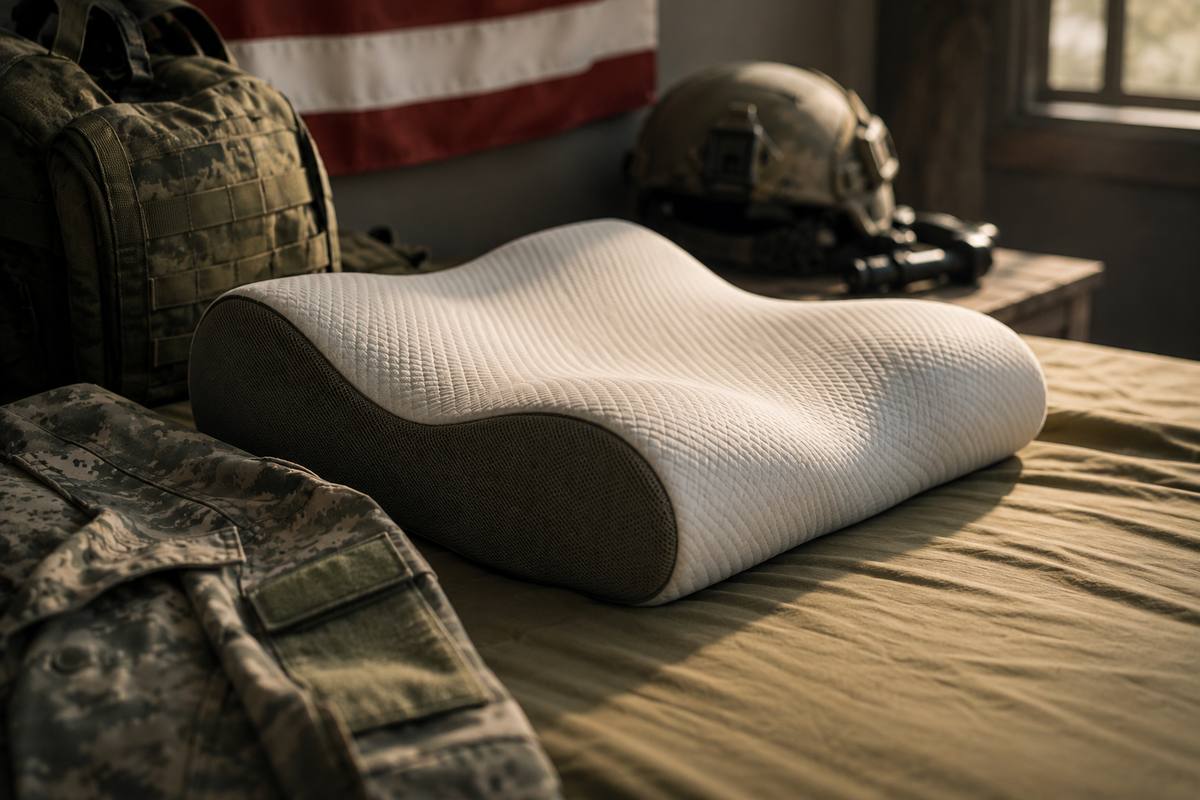
So What Can a Pillow Actually Do?
The best available synthesis is Pang, Tsang & Fu (2021) in Clinical Biomechanics — 35 articles screened, 9 high-quality studies, 555 participants.
| Outcome | Effect size (SMD) | p |
|---|---|---|
| Neck pain | −0.263 | < 0.001 |
| Waking pain | −0.228 | < 0.001 |
| Neck disability | −0.506 | 0.020 |
| Satisfaction with the pillow | +1.144 | < 0.001 |
| Sleep quality | +0.047 | 0.703 — no effect |
Read that honestly and it says something quite specific. A better pillow produces a small reduction in neck pain — about a quarter of a standard deviation — a large increase in how much people say they like their pillow, and no measurable change in sleep quality at all.
Note which effect is biggest. Satisfaction, by a distance — and satisfaction is the outcome most vulnerable to the fact that pillow trials cannot blind participants to which pillow they are sleeping on. If you see a page claiming a pillow will give you “45 minutes more deep sleep”, that is the exact claim this meta-analysis tested and found nothing for.
The same review found that pillow shape and height, rather than material, drove cervical alignment changes in side-lying. Which is worth remembering the next time a product page sells you on its foam.
What the Research Says About Height
Height is the one variable with real biomechanical data behind it — though almost all of it is measured lying on your back, which is a limitation nobody mentions.
Two things come out of that chart. Height does reliably change the cervical angle while you are lying on it — a 66% increase across a 60 mm range. And the pressure cost rises alongside it and then stops paying off: the tallest pillow produced more pressure than the 110 mm one for no additional benefit over 150 mm. Ren and colleagues explicitly declined to name an optimal height, and reported that optimal height does not correlate with body measurements.
Other height findings, none of them decisive:
- Kim et al. (2015) concluded “the most suitable pillow height is 10 cm” — from 16 asymptomatic 20–30 year-olds, supine, with no clinical outcome measured. This is the origin of an enormous amount of “10 cm is correct” content that the study cannot support.
- Jiao et al. (2025) found neck muscle activity lowest and comfort highest at a height equal to 1.0× shoulder width — 15 participants, explicitly a pilot.
- A 2024 review of how pillow height is prescribed found 14 distinct measurement approaches in the literature recommending heights anywhere from 4 cm to 20 cm, and concluded there is no standardised method.
If you want the arithmetic done for your own build rather than an average, our pillow height calculator works from sleep position, shoulder width and mattress firmness — including how much a soft mattress lets your shoulder sink, which changes the answer more than most people expect.
The Gap Nobody Mentions
We searched specifically for trials that recruited participants on the basis of reduced cervical lordosis and then tested a pillow. There are none.
Pillow trials recruit on symptoms — chronic neck pain, waking pain — or occasionally on degenerative change. Never on measured curvature. The closest study is Gordon, Grimmer & Buttner (2019), which recruited people with radiologically confirmed cervical spondylosis and found that “overall no pillow significantly altered any outcome measure.”
So every page recommending a “best pillow for military neck” — including this one — is extrapolating from general neck-pain pillow research. The difference is that we are telling you that is what is happening.
One more finding that sits awkwardly with the consensus recommendation: a field study of 106 habitual side sleepers across six pillow types found that “foam contour pillows offered no advantages over regular-shaped alternatives.” Every page ranking for this term recommends a contour pillow.
What We’d Actually Suggest
Given all of the above, here is the honest version of pillow advice for someone with this finding.
1. Choose for comfort and morning stiffness, not for correction
No pillow will change the shape of your cervical spine. The measured effects of pillows on cervical angle are positional — they last exactly as long as you are lying on the thing. That is not a failure; it is simply what a pillow is. Seven or eight hours a night in a less-strained position is worth having on its own terms.
2. Get the height roughly right for how you sleep
The usable starting points from our own calculator, which are supported ranges rather than corrective targets:
- Back sleeping: roughly 3.5–4.5 in (9–11 cm) depending on build
- Side sleeping: roughly 5–6.5 in (13–17 cm), because you are filling the gap between ear and shoulder
- Stomach sleeping: 1–2 in or nothing at all — no loft makes this position good for the neck
Subtract height if your mattress is soft: a soft mattress lets the shoulder sink, which does part of the job the pillow would otherwise do. Roughly 1.5 in on soft, 0.75 in on medium, 0.25 in on firm, halved for back sleeping.
3. Buy something that holds its loft
The most common failure is invisible in a shop. Low-density foam feels supportive for half an hour, then compresses under head weight until you are effectively flat for the remaining seven hours. If a pillow felt right when you bought it and stopped working by month two, that is what happened. Our pillow specification database records the published loft and firmness figures for 32 pillows, sourced to the manufacturers’ own pages — and shows that only about half of them publish a loft measurement at all.
4. On the rolled towel
You will be told to put a rolled towel under your neck. The honest position: a roll does measurably change the supine cervical angle for as long as you lie on it — one study moved it from −3.83° to 7.70°. Whether that helps anyone sleep better or hurt less has not been studied. And note that the research group most associated with cervical curve correction uses a rolled towel as their placebo. It is free and harmless, so try it. Just do not expect it to be doing what a product page says it does.
5. Give it three to four weeks, then judge
A different height feels wrong for the first few nights regardless of whether it is better. If there is no improvement in morning stiffness after four weeks, the height is probably wrong for your build rather than the pillow being wrong in principle.
If you want a specific recommendation: for people in this situation who sleep on their back and side and move between the two, the pillow we end up suggesting most often is the Derila ergonomic pillow — a dual-zone contour with a higher side-sleeping edge and a lower recessed centre, in a foam density that holds through the night.
To be explicit about what that is and is not: it is a comfort choice, not a treatment. It will not change your cervical curve, and nothing you can buy will.
→ Check current Derila pricing — 60-day money-back guarantee, so the four-week test costs you nothing but the postage back.
Not sure that fits your build? Take the 2-minute sleep quiz →
Claims You’ll See Elsewhere, and What the Evidence Says
We read the pages currently ranking for this term. Between them they cite one peer-reviewed study, and it is a finite element model whose authors declined to draw the conclusion it is used for.
| Common claim | What the evidence shows |
|---|---|
| “Your straight neck is why it hurts” | Five studies comparing people with and without neck pain found no difference in curvature |
| “Phone use caused it” | No association between texting posture and neck pain in three studies; lordosis increases with age |
| “It’s caused by muscle spasm” | The one study testing this found straight necks were more common in the pain-free group |
| “This pillow restores cervical lordosis” | No pillow trial has ever recruited on curvature. Measured effects are positional only |
| “Adds 45 minutes of deep sleep” | Pooled sleep-quality effect across 9 studies: SMD 0.047, p = 0.703. No effect |
| “A contour pillow is essential” | A 106-person field study found contour pillows offered no advantage over regular shapes |
| “Under 20° means military neck” | That threshold is below the mean of asymptomatic people in most studies |
| “15-minute daily traction restores the curve” | Every positive trial we found comes from one research group, n=30–80, with declared commercial interests. None involve pillows |
Frequently Asked Questions
Can a pillow fix military neck?
No. No pillow has been shown to produce lasting change in cervical curvature, and no trial has ever recruited participants on the basis of reduced lordosis to test one. Pillows change the angle of your neck for as long as you are lying on them. That can reduce morning stiffness; it is not correction.
How many degrees is military neck?
There is no agreed threshold. Published definitions of “straight” include −10° to 0° by Cobb, −4° to +4° by posterior tangent, and consumer sources commonly state “under 20°” with no citation. That last figure sits below the average of people with no symptoms at all. The measurement method matters too — the same neck reads 4–6° straighter on Cobb C2–C7 than on Harrison posterior tangent.
Is military neck serious?
Usually not, on its own. Around a third of people with no neck symptoms whatsoever have a straight or kyphotic cervical spine. It becomes clinically significant in the context of surgery, ankylosing spondylitis, trauma or progressive deformity — and when there are neurological signs. Hand clumsiness, unsteady walking or bladder changes need medical assessment regardless of what your curve measures.
Does military neck cause headaches?
It is frequently claimed. We could not find good evidence for it specifically. Given that the association between cervical curvature and neck pain itself does not hold up across five studies, we would treat the headache claim as unproven rather than established.
Should I sleep without a pillow if my neck is straight?
There is no evidence supporting this for people with reduced lordosis. Sleeping flat on your back with no pillow lets the head drop into extension; on your side it side-bends the neck for hours. If your current pillow is too high, the fix is a lower one rather than none.
Should I put a rolled towel under my neck?
It measurably changes the supine cervical angle while you are on it, and it is free, so it is a reasonable thing to try. Two caveats worth knowing: the effect is positional only, and the research group most associated with cervical curve correction uses a rolled towel as their placebo condition.
Is it better to sleep on my back or my side with military neck?
There is no study answering this for cervical curvature specifically — almost all the biomechanical work is supine only. The broader sleep-posture literature offers a weak signal favouring side lying and symmetry, drawn from four studies mostly about the lower back. Practically: use whichever position you sleep in, and match the pillow height to it.
Can loss of cervical lordosis be reversed?
Extension traction trials do report increases in measured lordosis, but every positive trial we located comes from a single research group, has 30 to 80 participants, and involves an author who teaches and sells the method. Against that, a study of four weeks of cervical manipulation found a mean change of 2.1° — well below the 13.5° minimum detectable change for the measurement itself. None of this involves pillows.
Why does my MRI say my neck is straight when my X-ray didn’t?
Because MRI is taken lying down and under-reads lordosis compared with a standing X-ray, by a reported 2–6°. Correlations between the two run at only about 0.48 to 0.54. Whatever your head was resting on during the scan also changes the number.
What pillow height should I use for military neck?
The same height that suits your build and sleeping position, because there is no evidence supporting a different target for this finding. Roughly 3.5–4.5 in on the back and 5–6.5 in on the side, less on a soft mattress. Published recommendations across the literature range from 4 cm to 20 cm using 14 different measurement methods, which tells you how settled this is.
Does military neck get worse over time?
The population data points the other way: measured lordosis increases with age, from a mean of 7.8° in 20–30 year-olds to 17.1° in the over-70s. Progressive deformity does happen in specific clinical contexts — after cervical surgery, in ankylosing spondylitis — and those are managed by a clinician.
The Bottom Line
A straight cervical spine is a common anatomical variant. About a third of people with no neck pain at all have one. When researchers have compared people with and without neck pain, they have repeatedly found no difference in cervical curvature. A finding of “straightening of the cervical lordosis” on your report does not, on the evidence available, explain your pain.
That is good news dressed as bad news. It means you are not carrying a structural problem that a pillow must somehow fix. It means the ordinary rules apply: a supported height for the way you sleep, foam that lasts the night, and a mattress that is not undoing the pillow’s work.
What a pillow can do is modest and real — a small reduction in neck pain, a decent chance of easier mornings. What it cannot do is change the shape of your spine. Anyone telling you otherwise is selling something, and so, for what it is worth, are we — which is exactly why the sources are all linked above.
Sources
Guo GM et al. Cervical lordosis in asymptomatic individuals: a meta-analysis. J Orthop Surg Res 2018;13:147.
Grob D, Frauenfelder H, Mannion AF. The association between cervical spine curvature and neck pain. Eur Spine J 2007;16(5):669–678.
Kumagai G et al. Association between roentgenographic findings of the cervical spine and neck symptoms in a Japanese community population. J Orthop Sci 2014;19:390–397.
Singh A et al. Alterations of cervical lordosis in neck pain patients. J Orthop Case Rep 2025;15(10):266–273.
Shilton M et al. Does cervical lordosis change after spinal manipulation? Chiropr Man Therap 2015;23:33.
Helliwell PS, Evans PF, Wright V. The straight cervical spine: does it indicate muscle spasm? J Bone Joint Surg Br 1994;76-B(1):103–106.
Ao S et al. Cervical kyphosis in asymptomatic populations. J Orthop Surg Res 2019;14:322.
Zhang J et al. Normative values of cervical sagittal alignment in asymptomatic adults. Eur Spine J 2024;33:155–165.
McAviney J et al. Determining the relationship between cervical lordosis and neck complaints. J Manipulative Physiol Ther 2005;28(3):187–193.
Pang JCY, Tsang SMH, Fu ACL. The effects of pillow designs on neck pain, waking symptoms, neck disability, sleep quality and spinal alignment in adults: a systematic review and meta-analysis. Clin Biomech 2021;85:105353.
Ren S et al. Effects of pillow height on the biomechanics of the head-neck complex. PeerJ 2016;4:e2397.
Kim HC et al. The effect of pillow height on cervical alignment. Korean J Spine 2015;12(3):135–138.
Jeon MY et al. Improving the quality of sleep with an optimal pillow. Tohoku J Exp Med 2014;233(3):183–188.
Jiao J et al. Effect of pillow height on neck muscle activity and comfort. Sleep Breath 2025;29(1):40.
Gordon SJ, Grimmer-Somers K, Trott P. Pillow use: the behaviour of cervical pain, sleep quality and pillow comfort in side sleepers. Man Ther 2009;14(6):671–678.
Gordon SJ, Grimmer KA, Buttner P. Pillow preferences of people with neck pain and known spinal degeneration. Eur J Phys Rehabil Med 2019;55(6):783–791.
Damasceno GM et al. Text neck and neck pain in 18–21-year-old young adults. Eur Spine J 2018;27:1249–1254.
Richards KV et al. Neck posture clusters and their association with biopsychosocial factors and neck pain in Australian adolescents. Phys Ther 2016.
Kim SH et al. Comparison of cervical alignment on radiographs and MRI. Int J Environ Res Public Health 2021;18:13033.
McCartney S et al. Cervical radiculopathy and cervical myelopathy: diagnosis and management in primary care. Br J Gen Pract 2018;68(666):44–46.
Parveen S, Kumar S, Saravanan K. Methods of cervical pillow height measurement: a review. Int J Med Sci Res 2024;6(2):5–10.
International Association for the Study of Pain. Text neck is not a pain in the neck.
Ogura Y et al. Etiology and treatment of cervical kyphosis: state of the art review. J Spine Surg 2021.
This article reflects Sleep Align’s independent research. We do not test products in-house and we have no clinician on staff; every clinical claim above is linked to its published source, and where evidence is absent we say so. Vendors have no input on our content and never see it before publication. General information, not medical advice.
Related: cervical spondylosis pillow guide, pinched nerve in the neck, after cervical fusion (ACDF), and the pillow firmness guide.
More Pillow Guides
Recommended for Pain-Free Sleep
🛌 Derila Ergonomic Memory Foam Pillow
Contoured design that holds your cervical spine in neutral for the full night. Works for side and back sleepers. Backed by a 60-day money-back guarantee on the official store.
- ✓ Memory foam contour
- ✓ Side & back sleeper design
- ✓ 60-day money-back guarantee