
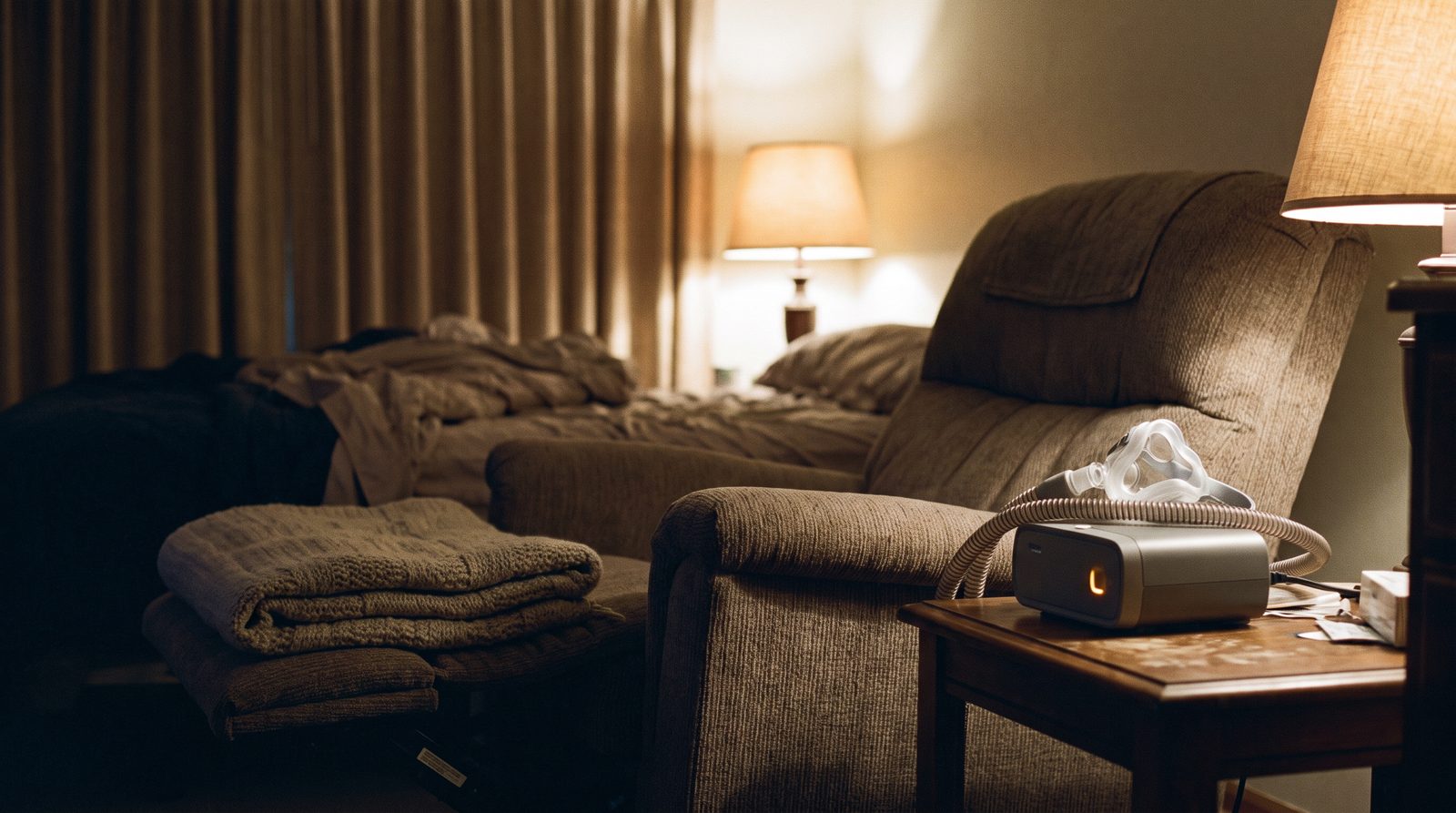
Sleeping in a Recliner for Sleep Apnea: What the Evidence Shows
The short version: there is real measured evidence that elevating the head and trunk reduces the severity of obstructive sleep apnea, and a recliner is one way to achieve that elevation. The effect is meaningful but partial — it lowers the event rate, it does not abolish it. It is most useful for people whose apnea is strongly positional, and it is not a replacement for CPAP or for getting diagnosed in the first place. The actual figures from the studies are below.
A lot of people work this out for themselves. They fall asleep in a chair, wake up feeling noticeably better than they do after a night in bed, and start wondering whether it is a coincidence. Often it is not.
This page is not a diagnosis and not a treatment plan. Untreated obstructive sleep apnea carries cardiovascular and daytime-safety consequences that a chair does not solve. If you snore heavily, stop breathing in your sleep, or fall asleep during the day, that warrants a sleep study.
Why Elevation Changes Anything
Obstructive sleep apnea happens when the soft tissues of the upper airway collapse during sleep and block airflow. Lying flat on your back makes that easier for gravity to do: the tongue and soft palate fall backward toward the rear wall of the throat, and fluid that sat in your legs during the day redistributes upward toward the neck.
Raising the head and trunk works against both mechanisms at once. It reduces the backward gravitational pull on the airway tissues, and it keeps some of that fluid where it was. Hence the interest in head-of-bed elevation as a low-cost positional therapy.
The Numbers
Apnea severity is measured by the apnea-hypopnea index (AHI) — the number of breathing events per hour of sleep. Under 5 is normal, 5 to 15 mild, 15 to 30 moderate, above 30 severe.
| Study | Condition | AHI change |
|---|---|---|
| J Clin Med, 2022 | 30° head-and-trunk elevation vs flat supine | 23.8 → 17.7 (p = 0.03) |
| Multicentre observational | Head-of-bed elevation vs baseline | 15.7 → 10.7 events/hour |
| Earlier trial, 14 patients | Shoulder–head elevation pillow | 22% reduction |
Read those honestly and two things stand out. The direction is consistent — elevation reduced apnea severity in every case. And the size is partial. In the first study the average participant went from moderate apnea to slightly less moderate apnea. Nobody was cured by a chair.
Researchers describe head-of-bed elevation as a low-cost, well-tolerated positional therapy and a non-CPAP option for selected positional phenotypes. That qualifier matters, and it leads to the next question.
Who It Helps Most
Positional obstructive sleep apnea means apnea that is substantially worse in one sleeping position — usually flat on the back — than in others. For that group, changing position changes a lot. For someone whose apnea is just as bad on their side as on their back, elevation has less to work with.
You will not know which you are without a sleep study that reports position-specific data. That is a genuine argument for getting tested rather than experimenting with chairs: the test tells you whether positional therapy is worth pursuing at all.
Elevation tends to be most worth trying if you already know your apnea is much worse on your back, if your snoring largely disappears when you sleep propped up, if you also have reflux or breathlessness when flat, or if you cannot tolerate CPAP and your clinician is looking at alternatives with you.
What a Recliner Adds, and What It Costs
A recliner achieves elevation without a wedge pillow that slides or a bed frame that tilts. It also holds the position, which an adjustable pillow arrangement generally does not once you are asleep.
The costs are the ordinary costs of sleeping in a chair, and they are covered in full in our recliner setup guide: the unsupported gap behind the neck, and the circulation issue from keeping your legs below heart level all night. Both are manageable, neither is automatic. Use the footrest and fill the neck gap with something thin — a bed pillow in a recliner pushes your chin toward your chest, which narrows the airway you were trying to open.
That last point is worth stating plainly. Chin-to-chest is the wrong shape for an airway. If you take one thing from this page, make it that the pillow you use in the chair should be thinner than the one you use in bed.
Choosing the pillow
A recliner pillow that keeps your chin off your chest
For breathing, the pillow in the chair matters as much as the angle. We compared the shapes that fill the neck gap without pushing the head forward, and picked the one we would use.
See our recliner pillow pick →What It Does Not Do
- It does not replace CPAP. CPAP holds the airway open pneumatically and, used consistently, brings AHI close to normal. Elevation produces a partial reduction. If you have been prescribed CPAP and find it difficult, the productive conversation is about mask fit and pressure settings, not about abandoning it for a chair.
- It does not replace a diagnosis. Feeling better in a recliner tells you position matters. It does not tell you how severe your apnea is or whether your oxygen is dropping at night.
- It does not treat central sleep apnea, which is a different mechanism entirely — a signalling problem rather than a blockage.
Frequently Asked Questions
Is sleeping in a recliner good for sleep apnea?
It helps some people measurably. Studies of head-of-bed elevation have shown AHI falling from 23.8 to 17.7 at 30 degrees, and from 15.7 to 10.7 events per hour in another. The benefit is a reduction in severity rather than a resolution, and it is largest in people whose apnea is strongly positional.
What angle is best for sleep apnea?
The elevation studied most directly is around 30 degrees of head-and-trunk elevation. In recliner terms that is a moderately reclined position rather than nearly flat. Our recliner angle guide covers how that translates to the positions an actual chair holds.
Can I stop using CPAP if I sleep in a recliner?
No, not on your own. Elevation reduces apnea severity partially; CPAP is far more effective. If CPAP is difficult to tolerate, raise that with the clinician who prescribed it — mask type and pressure settings are usually adjustable.
Does sleeping upright help snoring?
Often yes, since snoring shares the mechanism of partial airway narrowing that elevation works against. Snoring that improves markedly when you sleep propped up is a hint that your breathing is position-sensitive, which is worth mentioning if you are being assessed.
Sources
- Head-Of-Bed Elevation (HOBE) for Improving Positional Obstructive Sleep Apnea: An Experimental Study: J Clin Med, 2022
- The influence of head-of-bed elevation in patients with obstructive sleep apnea: Sleep and Breathing, 2017
- Head-of-bed elevation outcomes on apnea severity and nasal resistance, multicentre observational study: PubMed