
How to Sleep After Lumbar Spinal Fusion: Bed, Recliner and the BLT Rule
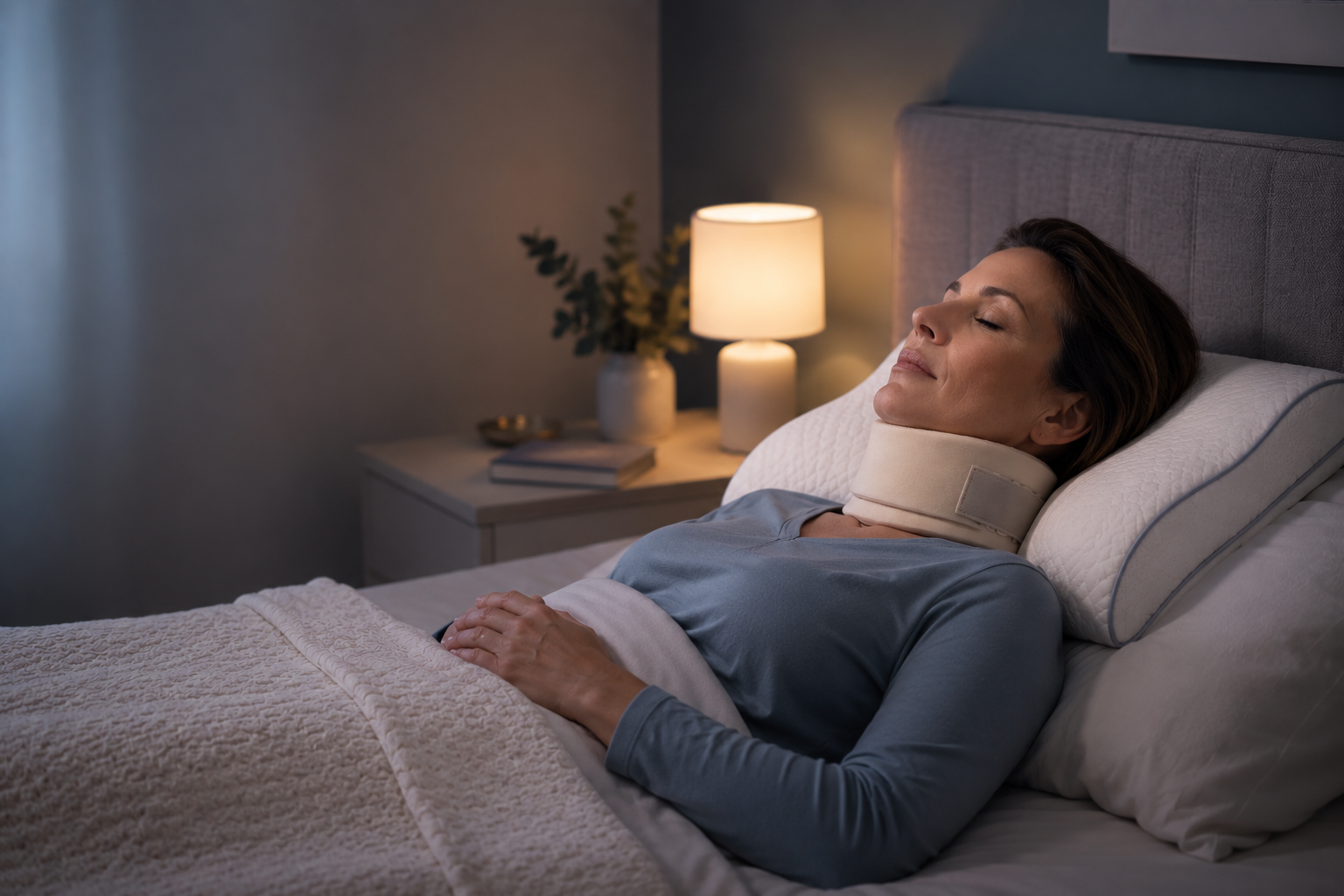
The short version: after lumbar (lower back) spinal fusion you can usually sleep on your back or your side. On your back, put a pillow under your knees. On your side, put one between your knees so your pelvis does not twist. A recliner is fine for many people in the early weeks if it keeps you reclined rather than sitting upright. The real risk at night is not the position you lie in but the way you get into and out of it, because that is where people bend and twist without noticing. Below is the setup for bed and for a recliner, and the log roll that keeps you inside the no bending, lifting, twisting rule.
A spinal fusion joins two or more vertebrae so they heal into one solid piece of bone. That takes months, and for the first weeks the hardware is doing most of the holding. Your surgical team will give you movement restrictions, almost always some version of the BLT rule: no Bending, no Lifting, no Twisting.
Most people can keep to BLT during the day, because they are thinking about it. At night they are half asleep, in pain and trying to reach a glass of water. That is when the twist happens.
Follow your own surgeon’s instructions. Restrictions differ between surgeons, between the number of levels fused and between surgical approaches. Some people are fitted with a brace and given specific rules for when to wear it, including at night.
If your fusion was in the neck rather than the lower back, see our guides to the best pillow after cervical fusion and how to sleep after cervical fusion instead. The rules are different.
On Your Back
Back sleeping keeps the spine in a neutral line and spreads your weight evenly, which is why it is often the most comfortable position in the first weeks. Put a pillow, or two stacked, under your knees. Bending the knees slightly flattens the arch in the lower back and takes tension off the operated segment. Lying with your legs straight out tends to pull the lower back into an arch for hours.
On Your Side
Usually allowed and many people prefer it. The key is a firm pillow between the knees, ideally running from knee to ankle. Without it, your top leg drops forward across your body and drags the pelvis into rotation, a slow twist at the level of the fusion that lasts all night. A soft pillow collapses and stops doing the job by the early hours. Our knee-pillow setup guide covers height and firmness.
Keep your head pillow at a height that holds your neck level with your spine, so you are not tempted to curl forward. Our pillow height calculator gives you the number for your build and mattress.
Avoid
- Your stomach. It arches the lower back and twists your neck at the same time.
- Curling into a tight ball. Deep forward bending counts as bending.
- A very soft mattress. If your hips sink lower than your shoulders, your lower back sags into a curve all night. Medium-firm is the usual advice.
Getting In and Out of Bed: the Log Roll
This is the single most important thing on this page. To get out of bed:
- On your back, bend both knees up.
- Roll onto your side as one piece, with shoulders and hips moving together, as if your spine were a rolling pin.
- Let your lower legs slide off the edge of the bed.
- At the same moment, push up sideways with your lower elbow and your top hand, so your legs going down lift your body up.
- Sit on the edge, feet flat, and stand by pushing through your legs.
Getting in is the same in reverse: sit on the edge, lower yourself onto your side while bringing your legs up, then roll onto your back as one piece. To turn over in the night, bend your knees and roll as one unit rather than twisting from the waist.
Practise it in the day before you need it half asleep. And keep a water glass, phone and medication on a table at the height of the mattress on the side you get out, because reaching across or down for them is the most common twist of all.
What About a Recliner?
A recliner suits many people after lumbar fusion, especially in the first couple of weeks. A semi-reclined position with the upper body raised around 20 to 30 degrees and the knees bent takes load off the lower back, and it avoids the whole business of lying down and sitting up in bed.
Two cautions specific to spinal fusion:
- Reclined, not sitting. Many surgeons limit how long you sit upright in the early weeks, because sitting loads the lumbar spine more than lying down. A recliner used for sleeping should be well back, not upright with the footrest down.
- The chair has to let you out without bending. A deep, low, soft recliner forces you to fold forward and push hard to stand, which is bending under load. A firm seat at a sensible height, or a power-lift recliner that tilts you forward onto your feet, is much safer. Rocking recliners that move as you try to stand are the worst choice.
Whichever you use, support the gap behind your neck. Weeks of sleeping in a chair with the head dropping forward is how a back recovery picks up a neck problem. See our full recliner setup guide for the angle, the legs and the rest of the chair.
If you recover in a recliner
A recliner pillow that keeps your neck out of it
A chair needs a thinner pillow than a bed. We compared the shapes that hold up in a reclined chair and picked the one we would use.
See our recliner pillow pick →Change Position, and Keep Your Legs Moving
Lying in one position for hours stiffens the back and slows the circulation in your legs, and the risk of blood clots is raised after major spinal surgery. Changing position every so often through the night, using the log roll, helps both. So do slow ankle pumps when you settle and whenever you wake, and whatever walking your team has cleared you for during the day.
Call Your Surgical Team If
- You develop new numbness, weakness or tingling in your legs, or it gets worse
- You have any change in bladder or bowel control, or numbness around the groin or buttocks. Treat this as an emergency.
- The wound becomes redder, hotter, leaks, or you develop a fever
- Pain gets steadily worse rather than better
- One calf becomes painful, swollen or warm. Chest pain or sudden breathlessness is an emergency.
Frequently Asked Questions
What is the best sleeping position after lumbar spinal fusion?
On your back with a pillow under your knees, or on your side with a firm pillow between your knees so your pelvis does not twist. Avoid sleeping on your stomach. Your surgeon’s instructions take priority.
Can I sleep in a recliner after lumbar fusion?
Many people can, especially in the first weeks, as long as it keeps you reclined rather than sitting upright and lets you stand without folding forward. A firm seat at a sensible height or a power-lift recliner is safer than a deep, low, soft chair.
How do I get out of bed after spinal fusion?
Use the log roll: bend your knees, roll onto your side as one unit, let your legs slide off the edge of the bed and push up sideways with your arms at the same time, then stand by pushing through your legs. It avoids bending and twisting at the fusion.
When can I sleep on my stomach after back fusion?
Not until your surgeon clears it, which is usually after the fusion has had months to heal. Stomach sleeping arches the lower back and twists the neck, so many people find they are better off not returning to it.
Sources
- How to sleep after spinal fusion: Hinge Health
- Spinal surgery precautions and activity (patient handout): Trinity Health Michigan
More Pillow Guides
Recommended for Pain-Free Sleep
🛌 Derila Ergonomic Memory Foam Pillow
Contoured design that holds your cervical spine in neutral for the full night. Works for side and back sleepers. Backed by a 60-day money-back guarantee on the official store.
- ✓ Memory foam contour
- ✓ Side & back sleeper design
- ✓ 60-day money-back guarantee