
How Often Should You Replace Your Pillow? (The Honest Answer)
Quick answer: Every 1–2 years for most pillows, but the fill sets the real timeline: polyester fibrefill 6 months to 2 years, down alternative 1–2 years, down and feather 1–3 years, memory foam and polyfoam 2–3 years, latex 2–4 years, and buckwheat indefinitely if you top up the hulls. Those intervals are the Sleep Foundation’s. The fastest check is the fold test: fold the pillow in half and let go. If it stays folded instead of springing back, the fill has lost its support and no amount of washing brings it back. The reason to replace it is mechanical, not hygienic — a collapsed pillow is a shorter pillow, and your neck spends the night at the end of its range.

Most people keep a pillow for years past the point where it does anything useful, because a pillow fails slowly and silently. It does not tear or break. It gets a few millimeters shorter every month, your neck adapts a little each night, and one morning you have stiffness you cannot account for. The guideline you will see everywhere is every 1–2 years. That is roughly right, but the fill material and how you have treated it move the number a long way in both directions. Here is how to tell where yours actually sits.
The 30-second check: the fold test
Take the pillowcase off. Fold the pillow in half, hold it for three seconds, and let go. A pillow with life left in it springs back to its original shape straight away. If it stays folded, or unfolds slowly and sulkily, the fill has lost its structure and the pillow is finished. This works for fibrefill, down, down alternative and shredded foam.
Two fills need a different test. Solid memory foam does not fold, so press your palm hard into the center for five seconds and watch the dent: healthy foam refills within a few seconds, tired foam holds the hollow or takes half a minute. Latex and buckwheat both resist the fold test by design, so judge latex by whether it has developed a permanent dip where your head goes, and buckwheat by whether the hulls have crushed to a powdery fraction of their original volume.
The fold test tells you about support. It tells you nothing about hygiene, and that is the right way round, because support is the part you cannot wash back in.
Score your pillow
Tick everything that is true of the pillow you slept on last night.
Nothing ticked yet — work down the list.
Lifespan by fill type
The intervals below are the Sleep Foundation's. Treat them as the point at which you should start testing monthly rather than as an expiry date — a well-protected pillow that is washed on schedule routinely beats them, and one slept on by a hot sleeper with no protector routinely does not.
| Fill | Typical lifespan | What fails first | Machine washable? |
|---|---|---|---|
| Polyester fibrefill | 6 months – 2 years | Fibres clump into ropes and the loft collapses unevenly | Yes, gentle cycle |
| Down alternative | 1 – 2 years | Loses springiness; goes flat under the head and bunches at the edges | Yes, gentle cycle |
| Down and feather | 1 – 3 years | Clusters break down and the pillow stops holding air | Usually, front-loader, dried thoroughly |
| Memory foam (solid) | 2 – 3 years | Compression set — the foam stops rebounding to full height | No. Spot clean and air |
| Memory foam (shredded) | 2 – 3 years | Pieces crumble and settle; needs refluffing more and more often | Cover yes, fill no |
| Latex | 2 – 4 years | Slow softening, then a permanent dip where the head sits | No. Spot clean and air |
| Buckwheat | Indefinite with topping up | Hulls crush to powder and the volume drops | Cover yes, hulls no |
Notice that every entry in the third column is a different route to the same destination: a pillow that is shorter than it was. That is the thing that matters, and it is why the lifespan column is a prompt to check rather than an answer in itself.
Why pillows die: three failure modes
Compression set. Foam is a structure of thin walls around air pockets. Every night it is squashed under roughly five kilograms of head, warmed to body temperature, and held there for hours. Those walls gradually stop springing back to their original position. The foam has not worn away — weigh it and it is the same pillow — but it now rests a centimeter or two lower than it did when it was new.
Fibre migration. Polyester strands are slippery and curled, and loft is simply the air they trap between them. Every compression cycle and every wash nudges them into tighter bundles. Eventually they rope together into dense clumps with empty gaps between, which is why an old fibrefill pillow is simultaneously lumpy and flat.
Cluster breakdown. Down works because each cluster is a three-dimensional filament structure that springs apart. Sweat, oils and repeated crushing snap those filaments. Dead down lies flat and no amount of fluffing persuades it otherwise.
Three different materials, three different mechanisms, one outcome. Your pillow is quietly getting shorter, and your head is dropping further every month.
What washing fixes, and what it does not
Wash your pillows. Most synthetic and down pillows can go in a machine every three to six months, and doing it removes the sweat, skin oils and moisture that accelerate every one of the failure modes above. A pillow protector under the case is the single cheapest thing you can do for longevity: it costs a few pounds and takes the soaking that would otherwise go into the fill.
What washing cannot do is add height back. Once the foam has taken a set or the fibres have roped, the pillow is permanently lower, and a clean flat pillow holds your neck exactly as badly as a dirty one did. This is worth being blunt about, because the usual argument for binning an old pillow is a hygiene scare — the claim that a large fraction of an old pillow's weight is dust mites and dead skin. We went looking for the study behind that number and there isn't one. If hygiene genuinely were the problem, the honest answer would be a wash and a cheap protector, not a new pillow. The reason to replace is support.
Washing guidance by fill, briefly: polyester and down alternative go in on a gentle cycle, two at a time to balance the drum, with a low-heat tumble dry and a couple of clean tennis balls to break up clumps. Down and feather are the same but need a much longer dry — damp down develops the musty smell that never leaves. Solid memory foam and latex must never go in a machine; the agitation tears the cell structure. Spot clean those with a cloth and mild detergent, and air them somewhere shaded for a few hours.
The replacement mistake almost everyone makes
Here is the pattern we see constantly. Someone correctly works out that their pillow is dead, goes to a supermarket, and buys the same flat polyester rectangle they have been folding in half for two years. Six weeks later the neck stiffness is back and they conclude pillows do not make any difference.
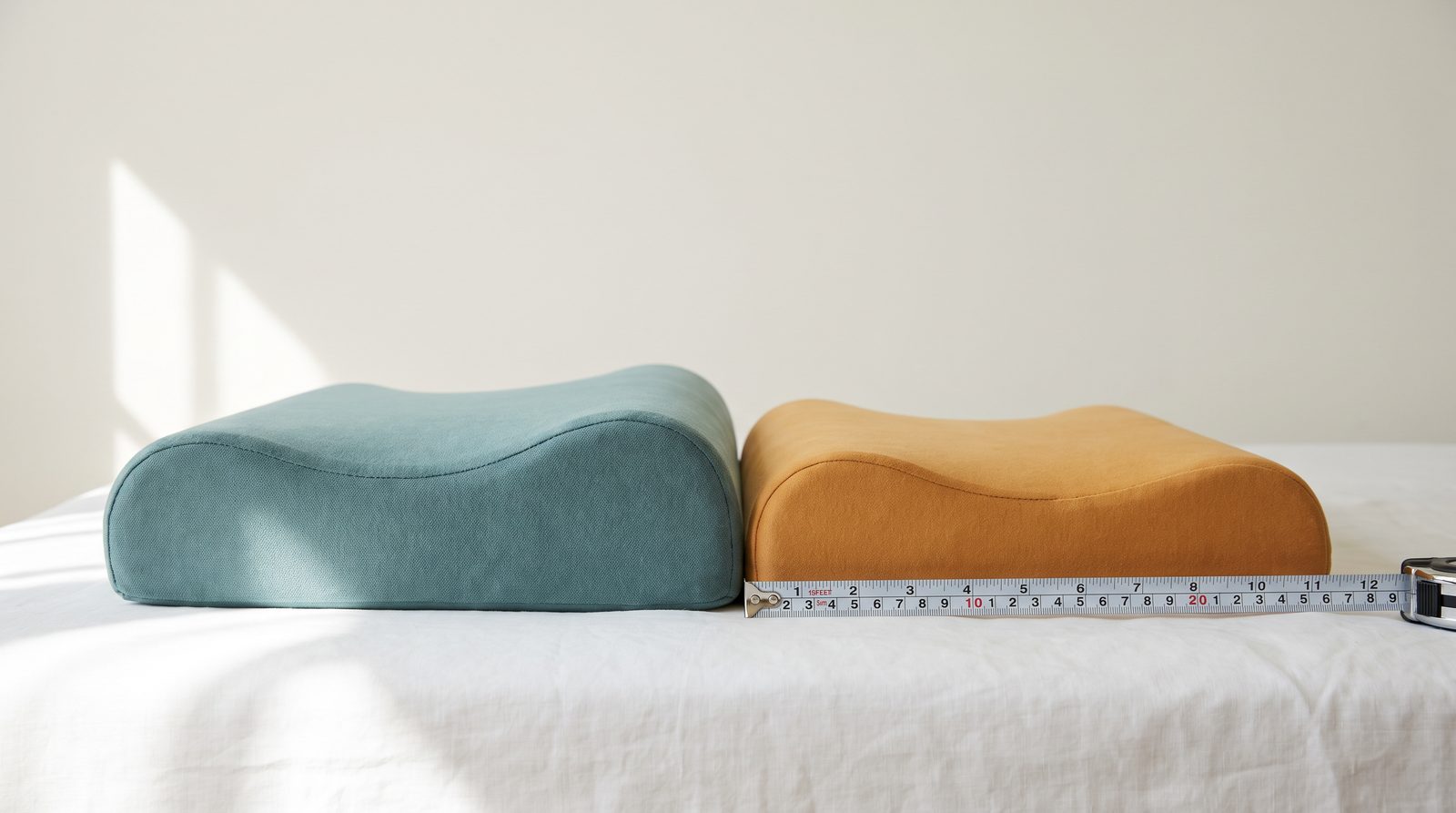
They were folding it in half because the pillow was too low for them — that is what folding is, an improvised attempt to double the height. Replacing it like for like buys a brand-new pillow of the wrong height. The variable that decides whether a pillow works is how much vertical gap it has to fill between your mattress and your head, and that depends on your sleeping position and the width of your shoulders, not on the brand or the price.
Before you buy anything, work out what height you need. Then look at which type suits your position and what firmness holds that height for a whole night.
Free · 30 seconds
Work out the height you need before you spend anything. Our calculator takes your sleeping position and build and gives you a centimeter range to shop against, so you are not guessing in a shop aisle.
What keeping the old one actually costs
The reason pillows get kept too long is that replacing one feels like an unnecessary expense, so it is worth putting a number on both sides. A $59.99 pillow used for two years costs about 8 cents a night. Bought as a two-pack at $99.98, which works out at $49.99 each, it is closer to 7 cents. You will spend more than that on the electricity to boil a kettle.
Against that, a pillow that holds your neck at the end of its range for seven hours a night is doing it 2,500 times over two years. The cost of keeping it is not the pillow. It is the stiff mornings, the painkillers, and in a fair number of cases a physio appointment that costs more than a decade of pillows.
Signs it is time to replace
- It fails the fold test, or holds a palm dent for more than a few seconds
- You wake with neck stiffness or headaches that ease within an hour of getting up
- You fold, punch or double the pillow over during the night
- There are visible lumps, a permanent hollow, or a flat patch where your head sits
- A musty smell survives a proper wash and a full dry
- You genuinely cannot remember when you bought it
One sign on its own is usually worth a wash and a re-test. Three or more and you are sleeping on a pillow that has stopped doing its job.
How to make the next one last longer
Use a pillow protector under the pillowcase and wash the protector monthly — this is the highest-return habit on the list. Wash the pillow itself every three to six months if the fill allows it, and dry it completely before it goes back on the bed. Fluff fibre and down pillows daily, which takes five seconds and redistributes the fill before it ropes. Rotate between two pillows if you have them, so each gets a night off to recover its loft. And do not sleep on a pillow folded in half: if you need to do that, the pillow is the wrong height and the fold is accelerating its death.
Frequently asked questions
Is it worth replacing a pillow that still looks fine? Looks are the weakest signal. A pillow can be clean and unstained while having lost two or three centimeters of height, which is enough to change the angle of your neck all night. Judge it by the fold test and by how the first hour after waking feels.
My pillow is yellow. Is that dangerous? It is sweat and skin oil oxidising in the fabric, and it is cosmetic rather than hazardous. If the pillow still passes the fold test, wash it, add a protector and keep it.
Do expensive pillows last longer? Sometimes, but the fill type predicts lifespan far better than the price does. A mid-priced latex pillow will outlast a premium fibrefill one comfortably.
Can I just add a towel under a flat pillow? As a one-night fix in a hotel, yes. As a long-term arrangement, no — a folded towel is firm and uneven, so it holds the height in one spot and lets your head roll off it as you move.
Should both pillows on the bed be replaced at once? Only if both are being slept on. A decorative pillow that nothing rests on ages very slowly.
Further reading
- Is It Worth Replacing an Old Pillow? The Honest Case (and the Scare Statistic That Isn't True)
- Signs Your Pillow Is Destroying Your Sleep
- How to Choose the Right Pillow for Your Sleep Position
- Pillow Firmness Guide
- New Year Sleep Reset: A 14-Day Plan
- Pillow Height Calculator
- Our top pillow recommendations →
Sleep Align is reader-supported. Links to Derila are affiliate links and we earn a commission if you buy through them, at no extra cost to you. Prices and guarantee terms are set by the seller and were correct at the time of writing — check the current figures before you order. This article is general information, not medical advice.