
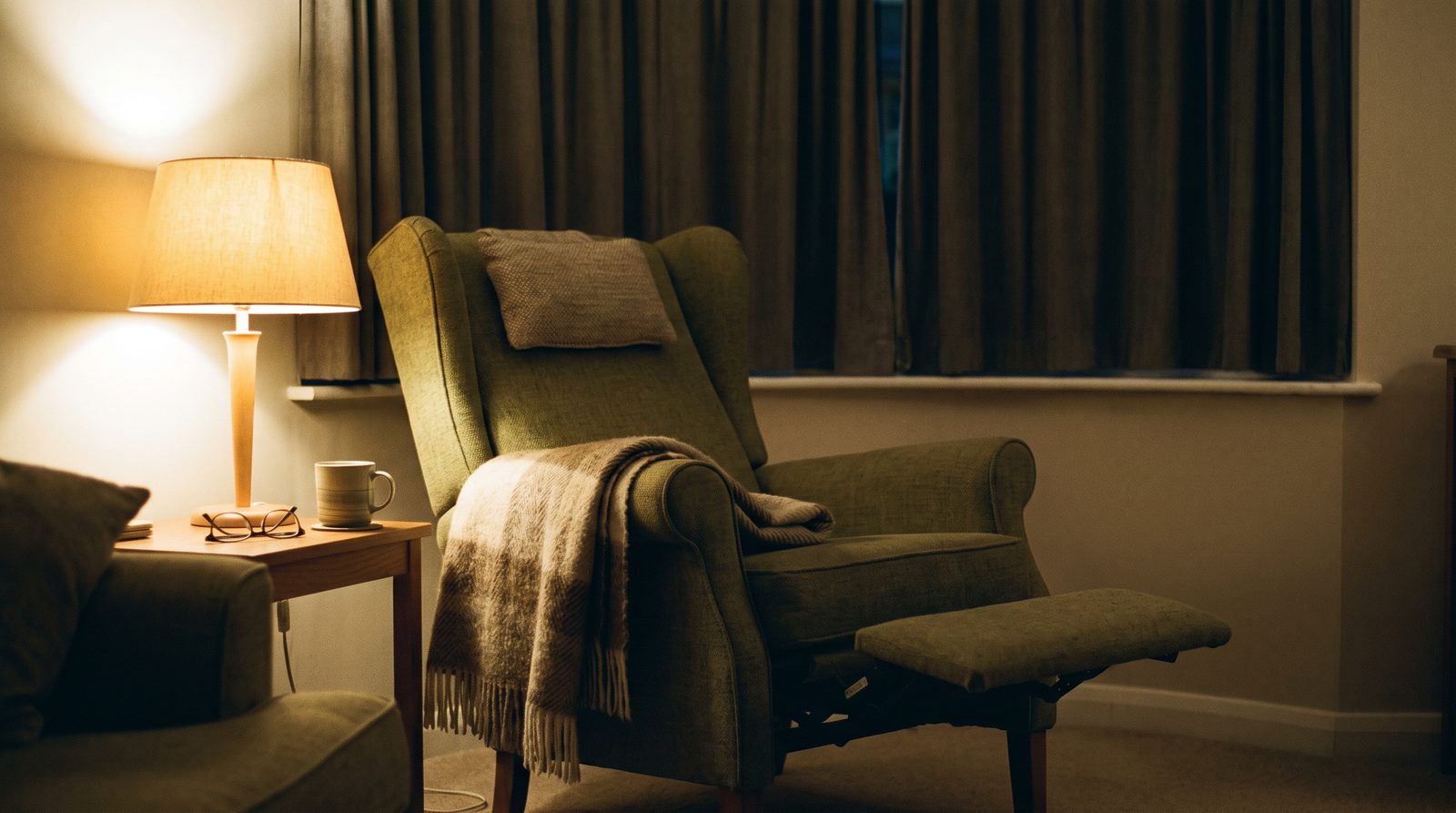
Sleeping in a Chair: What Works in Every Kind of Seat
The short version: every chair fails in the same place — the neck — and how far the seat reclines decides what you can do about it. Under about 120 degrees your head has nowhere to rest, so it falls forward or sideways the moment you fall asleep, and no pillow fixes that. Past 120 degrees the seat back takes your head’s weight and you are only filling a gap of one to three inches behind the neck, which a small contoured pillow does well. An office chair, a plane seat and a car seat are all in the first group. A recliner and a zero-gravity chair are in the second. Which chair you are in matters far less than which of those two groups it falls into.
People sleep in chairs far more often than anyone admits. Night-shift workers on a break. A parent in a hospital chair beside a child. Someone with reflux who found they breathe better upright. A person on a twelve-hour flight. Someone who fell asleep in the armchair at nine and woke at two with a neck that will not turn.
These look like different problems. Mechanically they are one problem wearing different upholstery.
Every Chair Fails at the Neck
When you are awake and sitting, your neck muscles hold your head up. That is roughly five kilograms balanced on top of a flexible column, and keeping it there is continuous low-level muscular work you never notice.
Falling asleep switches that work off. Muscle tone drops, and whatever the chair is not holding, gravity takes. In an upright seat the head pitches forward into deep flexion, or sideways until something stops it. In a reclined seat the head is caught by the backrest, but the natural curve of the cervical spine leaves an air pocket behind the neck, and the head settles back into extension across that gap.
Both positions are held for hours without the shifting and micro-adjustment that happens in a bed. That is why chair sleep produces a specific kind of morning: not general stiffness, but one wrenched structure that announces itself when you turn your head.
The Recline Angle Decides Everything
Before you think about the chair, find its angle. Everything else follows from it.
To find your chair’s angle, sit in it as you would to sleep and look at the line from your hip to your shoulder against the vertical. If your torso is barely tilted, you are near 90. If you feel like you are lying down but could still drink from a glass, you are near 135. Most people overestimate by ten to fifteen degrees, so if you think you are at 130, you are probably at 115.
Chair by Chair
The office chair
Almost always 90 to 105 degrees, and usually no headrest. This is the least forgiving seat there is. Whatever you put behind your head will push it further forward, because there is nothing behind you at head height to push against.
What actually works is a wrap that holds the head to the body rather than to the chair — a horseshoe travel pillow worn with the opening at the front, or a soft collar. It stops the sideways drop, which is the one that wrenches. Recline as far as the chair will go and get your feet up on something. If the chair tilts past 115, you are into better territory.
We go into this seat properly in how to sleep in an office chair. If this is a regular part of your working life rather than an occasional accident, the nap length matters more than the chair. Twenty minutes leaves you clear-headed; ninety minutes completes a cycle. The forty-five minute nap is the one that wrecks the next hour. Our pieces on how firefighters sleep on shift and how solo sailors sleep cover sleeping in short blocks in far more detail, because both do it professionally.
The armchair and the sofa
Typically 105 to 120 degrees — the worst band on the chart. The back is raked enough to feel restful and not enough to hold your head, so it drops to one side and stays there. This is the classic fell-asleep-watching-television neck.
The fix is usually the corner rather than the middle. Sitting into the angle where the back meets the arm gives your head two surfaces instead of one, and a cushion in that corner turns it into something that holds you. If the sofa is deep enough, lying along it properly with a normal pillow beats sitting up in it by a wide margin.
Worth checking
If you moved to the armchair because lying flat makes you breathless, that is a different matter from preferring the chair. Breathlessness on lying down is called orthopnea and is a recognised symptom in heart failure, caused by fluid redistributing toward the lungs when you go horizontal. Needing to prop yourself up on more pillows over weeks or months is worth a doctor’s appointment, not a better cushion.
The plane, train or coach seat
Economy recline is around 10 to 15 degrees of travel, so you land near 105 — still the bad band, with the added problem that you cannot bring anything large. A bed pillow is not an option, and would be the wrong shape anyway.
The horseshoe pillow is genuinely the right tool here, and most people wear it wrong. Worn with the gap at the back it does nothing, because the back of your head is the one part the seat already supports. Turn it around so the opening sits at the front of your throat and the bulk is under your jaw and both ears. That is what stops the sideways drop. A window seat gives you a second surface to lean on, which is worth more than any pillow. Our full guide to sleeping on a plane covers seat choice, cabin conditions and why the direction you are flying decides whether you should sleep at all.
The car
A car seat has a real headrest and often reclines to 130 or more, which puts it in the usable band — better than most furniture people own. Recline it properly rather than dozing at the wheel angle, and use the headrest.
Our full guide to sleeping in a car covers the setup, ventilation and where it is legal. The cautions here are not about your neck. Never sleep with the engine running in an enclosed or partly enclosed space, because exhaust gases contain carbon monoxide and it is colourless and odourless. Leave a window open a little for ventilation. Check that where you have parked permits it.
The hospital chair
Nobody plans for this one. A ward recliner or visitor chair is usually adequate and the problem is rarely the furniture — it is interruption, light, and being too wound up to let go.
Practical things that help more than they sound like they should: ask whether a proper reclining chair is available, because many wards keep a few and do not offer them unless asked. Bring an eye mask. Take the footrest up. Accept broken sleep as the shape of the night rather than fighting for a continuous block, because in a hospital you will not get one. If you are there for someone recovering from an operation, our post-surgical sleep guides cover what they will need when they get home.
The zero-gravity chair
These open to roughly 125 to 135 degrees with the knees raised above the hips, which is the best geometry on this page. Legs above heart level deals with the circulation problem discussed below, and the angle is squarely in the sleeping range.
The weakness is the headrest. Most come with a small sliding pad sized for lounging rather than a whole night, and it usually sits wrong, leaving exactly the gap described at the top of this article. This is the chair most improved by a proper pillow — see zero-gravity chairs for sleeping for what the position does and what to look for when buying one.
The recliner
The only chair on this list designed to be slept in, and the one we have written most about. Start with the full setup guide, then the angle guide if you are unsure where to put it. Everything else is collected in our recliner sleeping hub, including guides for recovery from specific operations and what the evidence shows for sleep apnea.
The Pillow, and Where It Genuinely Helps
Here is the part most articles get wrong, including ones selling pillows. A chair does not need more pillow than a bed. It needs less.
In bed, a side sleeper fills the distance from mattress to ear, often four to six inches. Reclined in a chair on your back, the seat is already carrying most of your head’s weight and the gap behind your neck is one to three inches. Bring a bed pillow to a chair and you push your chin toward your chest for the whole night, which produces exactly the stiffness you were trying to prevent. If you want your bed number for comparison, our pillow height calculator gives it in about thirty seconds.
For chairs in the 120–150° band only
A contoured pillow, used behind the neck rather than under the head
The Derila Ergo is a fixed contour with a recessed 9 cm centre and raised 12 cm sides. In a recliner or a zero-gravity chair that shape does two useful things at once: the recess fills the gap behind the neck without pushing the head forward, and the raised sides stop it rolling. Slide it down so it sits behind your neck, not under the back of your skull.
Where it works, and where you will improvise. Anything with a headrest that opens past about 120° — recliner, zero-gravity chair, car seat, reclining coach or train seat — is where the shape does its job properly. In an upright economy seat you will end up wedging it beside your head rather than behind it, and a horseshoe is easier to carry for that. But the place a contour really earns its space in a bag is the bed at the other end: hotel pillows are a lottery, and people who have found the one that settles their neck tend to stop gambling.
See today’s Derila price →$59.99 for one at the time of writing, 60-day money-back guarantee, and the seller sets the price. Affiliate link — we may earn a commission at no cost to you. Read the full review first if you have not.
Worth knowing your own number, and it takes five minutes. Sit in the chair at your sleeping angle, have someone slide a rolled towel behind your neck, and add or remove turns until your head sits level and your throat feels open. Then measure the towel. That number is what you are shopping for, and it is often smaller than people expect.
Taking your own pillow with you
Far more people travel with their own pillow than will admit to it, and it is a more sensible habit than it sounds. Once you have worked out the loft that keeps your neck neutral, every bed you do not own becomes a gamble. Hotels stock one or two generic pillows chosen for laundry cost. Spare rooms stock whatever was going spare. A week of the wrong one undoes a lot of careful setup at home, and you arrive back worse than you left.
This is also the honest answer to the question this article keeps circling. The chairs are the hard part. The beds at the other end of the journey are the easy win, and they are where a contoured pillow earns its place in the boot: the motorway services nap, the spare room at your sister’s, the hotel, the holiday rental. One pillow covers all of them. For the flight itself, a horseshoe is still the thing that fits in a seat pocket.
How Long Is It Safe?
The neck is the complaint. Circulation is the actual risk, and it is the same mechanism wherever you are sitting.
Sitting still for hours with the legs below heart level slows blood flow in the deep veins, and bent hips and knees compress the veins behind the knee. Reduced flow plus venous compression is the mechanism behind deep vein thrombosis. It is why long-haul flights carry a warning, and a chair slept in night after night reproduces a fair amount of the same picture.
- Get your legs up. Footrest, ottoman, suitcase, spare chair. This is the single biggest thing you can do, and it is why the zero-gravity chair does well.
- Ankle pumps. Twenty slow flexes of each foot before you settle, and again if you wake. The calf muscle acts as a pump that returns venous blood toward the heart, and it only works if the ankle moves. This is standard post-operative advice for exactly this reason.
- Do not freeze. If you wake, shift and move your feet rather than lying rigid trying to drop off again.
Pain, swelling or warmth in one calf is not something to sleep on. If you have had a clot before, are on hormone therapy, or have recently had surgery, raise chair sleeping with your doctor rather than managing it with ankle pumps.
Frequently Asked Questions
Is sleeping in a chair bad for you?
For a defined reason and a defined period, no. Occasional chair sleep is normal and harmless. The two things that make it worse than a bed are circulation, because the legs sit below the heart for hours, and neck position, because an unsupported head is held at an awkward angle without the shifting that happens in bed. Both are manageable. Indefinite nightly chair sleeping with no particular reason is worth working back from.
What pillow should I use in a chair?
It depends entirely on the angle. Past about 120 degrees, a small contoured pillow or rolled towel filling one to three inches behind the neck. Under 120 degrees, a horseshoe wrap worn with the opening at the front, because there is nothing behind your head to work against. A bed pillow is wrong in both cases.
Why do I wake with a wrenched neck after sleeping in a chair?
Because muscle tone drops when you fall asleep and the chair was not holding your head. Under 120 degrees it falls forward or sideways; past 120 it settles back across the unsupported gap behind your neck. Either way it is held there for hours without the micro-adjustments you make in bed.
Which chair is best for sleeping in?
A recliner or a zero-gravity chair, because both reach the 120 to 150 degree range and both raise the legs. A car seat is often better than an armchair for the same reason. Office chairs and dining chairs are the worst, because they are upright and have no headrest.
Sources
- Head-Of-Bed Elevation for Improving Positional Obstructive Sleep Apnea: J Clin Med, 2022
- The influence of head-of-bed elevation in patients with obstructive sleep apnea: Sleep and Breathing, 2017
Nothing here is medical advice. If you are sleeping upright because you cannot breathe lying down, or because of pain that is not improving, that is a conversation to have with a clinician rather than a furniture problem to solve.