
How Do Firefighters Sleep on Shift? Eighty Seconds From Deep Sleep to the Truck
Most jobs that ruin sleep do it by taking hours away. Firefighting and ambulance work are stranger than that, because a shift can contain a perfectly reasonable amount of sleep and still be brutal. What matters is not how long you slept but what you were asked to do ninety seconds after being torn out of it.
The eighty-second problem
Fire departments work to measurable response benchmarks. Under the NFPA 1710 standard, turnout time — from the alert sounding to the crew being dressed and in the apparatus — is 80 seconds for a fire call and 60 seconds for an EMS call, achieved at the 90th percentile, with arrival on scene inside four minutes. These are not aspirations; departments are measured against them.
Now put that next to what is known about waking up. Sleep inertia is the period of impaired performance immediately after waking, and it is not merely a feeling of grogginess. It degrades processing speed, working memory and decision-making, along with orientation, postural stability and motor coordination. Attention and vigilance are measurably impaired for around thirty minutes after waking, with fifteen to thirty minutes being the usual range.
And it resists fixing. Researchers have tried a range of countermeasures, and the blunt summary of that literature is that none has succeeded in dissipating sleep inertia within the first 15 minutes after waking. Which is precisely the window in which a fire crew drives a heavy vehicle through traffic and starts making decisions.
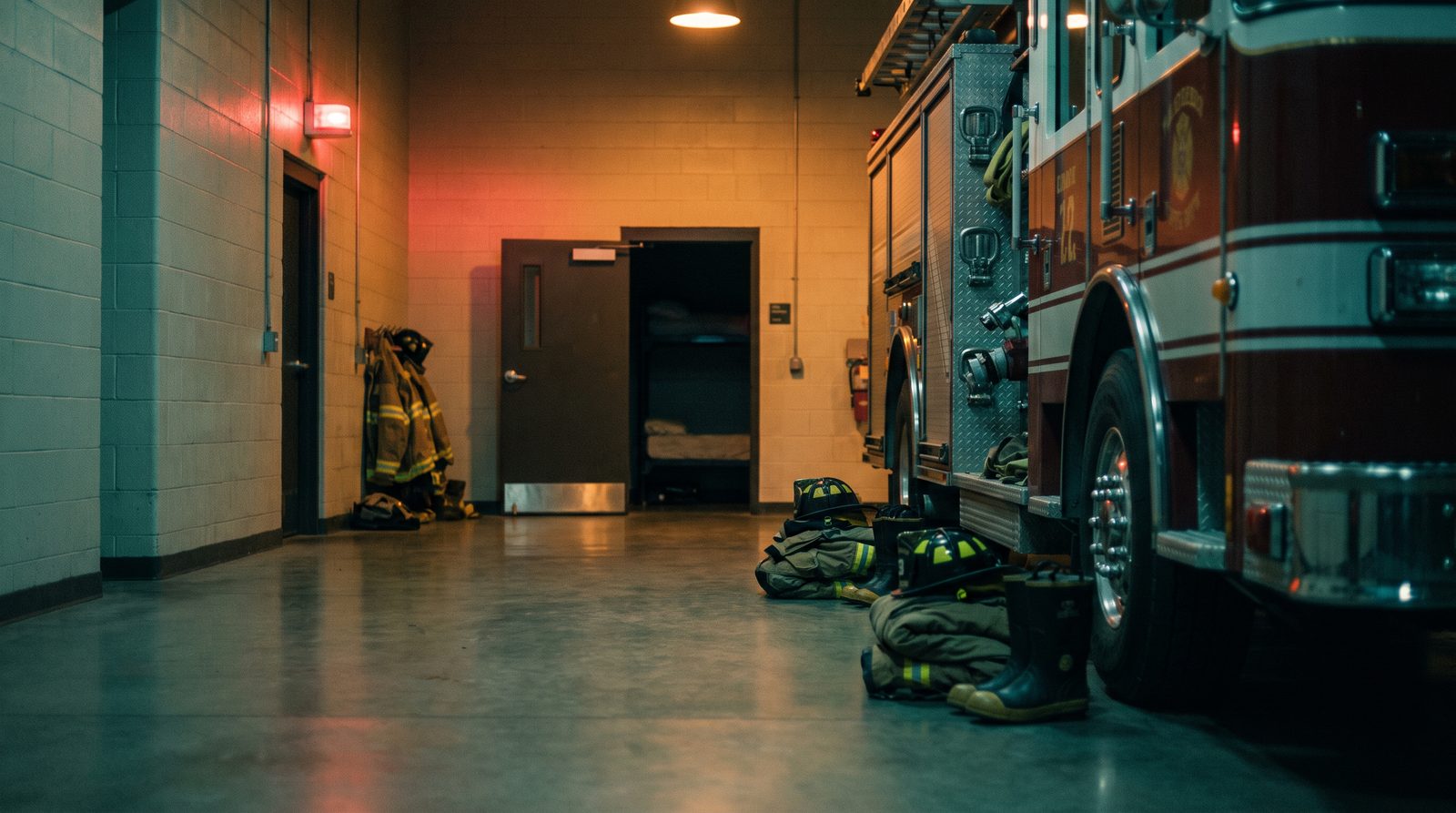
This is why so much of fire-station practice looks like ritual. Gear laid out in the same configuration every night, boots with the trousers already folded down over them, the same route to the same seat on the same appliance. It is not machismo. It is the deliberate offloading of tasks onto procedural memory, because procedural memory survives sleep inertia considerably better than judgement does.
The problem underneath the problem
Sleep inertia is unavoidable in the job. What is not unavoidable is the state of the people going to sleep in the first place, and this is where the research becomes genuinely uncomfortable.
A study led by Laura Barger at Brigham and Women’s Hospital screened roughly 7,000 firefighters for common sleep disorders. More than a third came back positive.
| Screened positive for | Share of firefighters |
|---|---|
| Any sleep disorder | 37.2% |
| Obstructive sleep apnoea | 28.4% |
| Shift work disorder | 9.1% |
| Insomnia | 6.0% |
| Restless legs syndrome | 3.4% |
The figure that matters most is not in the table. More than 80% of those who screened positive were undiagnosed and untreated. These are people who pass regular occupational medicals. Obstructive sleep apnoea in particular is easy to miss, because the person who stops breathing forty times an hour does not remember any of it; the symptom they report is simply that they are tired, which in this job sounds like the weather rather than a diagnosis.
The consequences showed up in the same study. Firefighters who screened positive were twice as likely to report a motor vehicle crash (odds ratio 2.00), and around two and a half times as likely to report having fallen asleep while driving (2.41).
Worth being precise about one thing, because it is often blurred. Heart disease accounts for roughly 45% of on-duty deaths among US firefighters, and a landmark analysis in the New England Journal of Medicine found those deaths concentrated dramatically in emergency duties — cardiac deaths were between ten and more than a hundred times more likely during fire suppression than during non-emergency work. That study attributes the pattern to the extreme physical strain of the tasks themselves, not to sleep. Poor sleep is a well-established contributor to cardiovascular risk in general, but the NEJM finding is about exertion, and it would be sloppy to present it as a sleep result. It belongs here as context for why the margins in this job are thin.
What the guidelines actually recommend
In 2018 a panel published evidence-based guidelines for fatigue risk management in emergency medical services, and the recommendations are refreshingly concrete. Five of them:
- Measure fatigue rather than assume it. Use validated sleepiness and fatigue survey instruments on personnel, so the conversation is about data instead of stoicism.
- Keep shifts under 24 hours. The panel recommends limiting EMS shifts to less than a full day.
- Give people access to caffeine. Unglamorous, effective, and explicitly endorsed.
- Allow on-duty napping. Not tolerate it quietly — permit it as policy. Some services use short naps, others longer ones, sometimes combined with extra staffing.
- Train people in fatigue risk management, so crews can recognise impairment in themselves and each other.
Notice that four of the five are permissions rather than techniques. The barrier in emergency services has rarely been ignorance of what helps. It has been a culture in which sleeping on shift looked like weakness — which is exactly the culture that leaves 80% of sleep apnoea undiagnosed.
If you are on call, in any job
- Build a fixed pre-sleep layout. Clothes, keys, phone, notes, in the same place every night. You are not organising; you are buying back the fifteen minutes when your judgement is not available.
- Protect the first fifteen minutes after a call-out. If you can put the hardest decision a little later, do. Light and movement help somewhat; nothing clears inertia quickly.
- Nap before, not after, where the choice exists. A planned nap ahead of a night on call is worth more than trying to recover afterwards.
- Take the snoring seriously. If someone has told you that you stop breathing, or you wake unrefreshed however long you sleep, that is a screening conversation, not a lifestyle problem. On these numbers it is the single highest-yield thing an emergency worker can do about their sleep.
- Driving home is the dangerous part. The crash risk in the data is on the commute, not the call.
Start with the two things that pay off fastest
If you snore or wake unrefreshed, read the apnoea material first — on these numbers it is the highest-yield check an emergency worker can make. If the problem is the rota rather than the airway, the shift-work guide covers the protocols, and a week of diary data tells you which of the two you are dealing with.
Sleep apnoea and position → · The shift worker’s guide → · Free sleep diary →
This is the fourth in a series on how people sleep in jobs and places that make it difficult — alongside submariners, solo ocean sailors and Antarctic winterers. The common thread is that none of them can fix their schedule, so all of them are forced to be precise about everything else.
Common questions
Do firefighters sleep at the station?
Yes, on shifts that run overnight, in station bunk rooms. Sleep is taken in blocks between calls rather than in one continuous night, and the number and timing of calls decides how much anyone actually gets.
How long does sleep inertia last?
Impaired attention and vigilance persist for about 30 minutes after waking, most commonly in the 15 to 30 minute range. No countermeasure has been shown to dissipate it within the first 15 minutes, which is why it matters so much for on-call roles.
How common is sleep apnoea in firefighters?
In a study of around 7,000 firefighters, 28.4% screened positive for obstructive sleep apnoea and 37.2% for any sleep disorder. More than 80% of those who screened positive were undiagnosed and untreated.
Are firefighters allowed to nap on duty?
Policies vary by service, but the evidence-based guidelines for fatigue risk management in emergency medical services explicitly recommend that personnel be given the opportunity to nap while on duty, alongside shifts of under 24 hours and access to caffeine.
Sources
- Barger LK, et al. Common sleep disorders increase risk of motor vehicle crashes and adverse health outcomes in firefighters. Journal of Clinical Sleep Medicine, 2015.
- Patterson PD, et al. Evidence-based guidelines for fatigue risk management in emergency medical services. Prehospital Emergency Care, 2018.
- Kales SN, et al. Emergency duties and deaths from heart disease among firefighters in the United States. New England Journal of Medicine, 2007.
- The experience and management of sleep inertia in Australian volunteer firefighters. Applied Ergonomics.
- National Fire Protection Association. NFPA 1710 standard summary.