
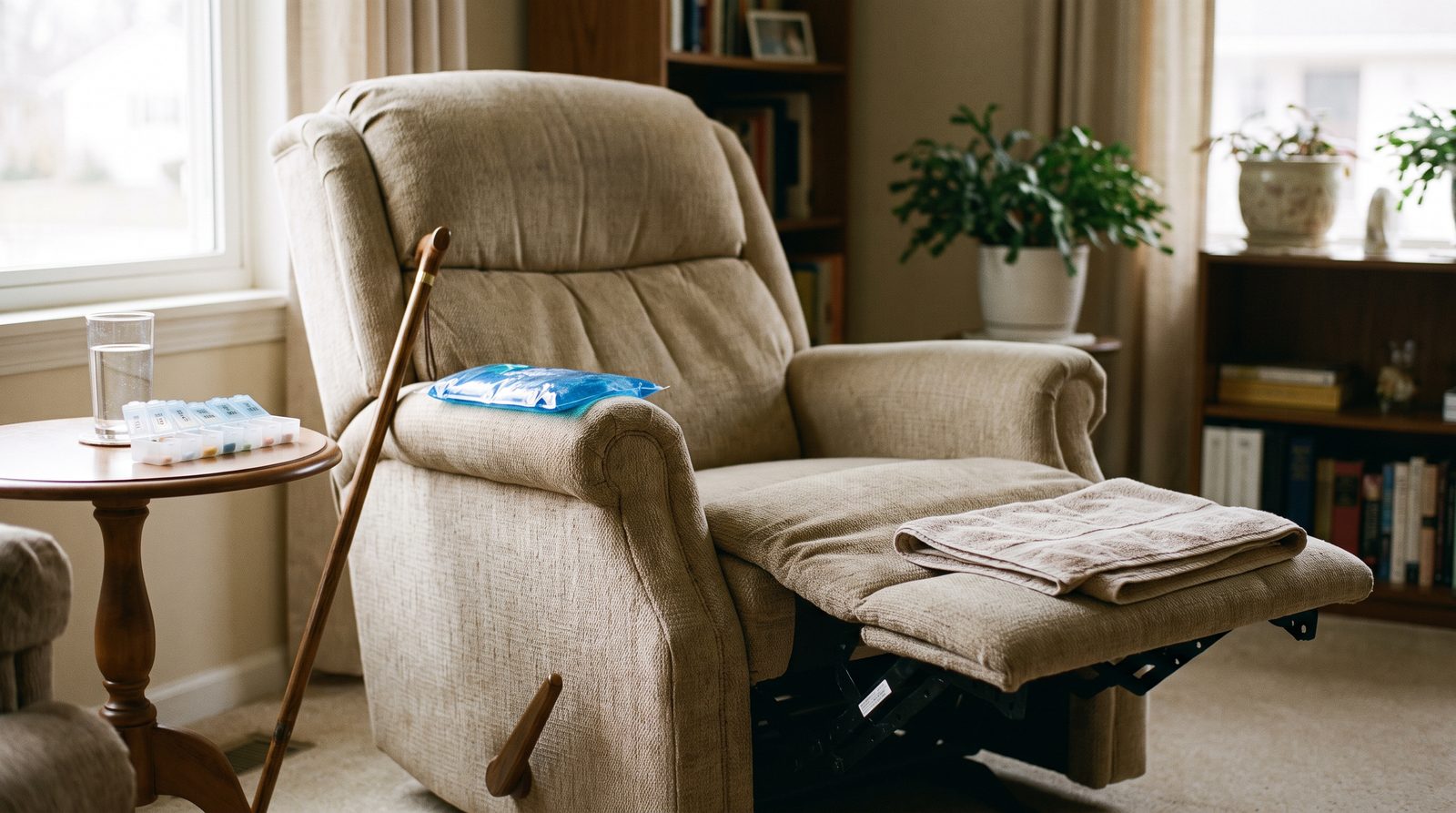
Sleeping in a Recliner After Knee or Hip Replacement
The short version: a recliner is a reasonable place to sleep in the first weeks after a knee or hip replacement — it elevates the limb, it reduces swelling, and it is far easier to get out of than a low bed. But it carries a specific trap that catches a lot of knee patients: a reclined chair holds the knee slightly bent all night, and regaining full extension is one of the main things your physiotherapy is trying to achieve. Below is how to get the benefits without losing the extension, plus the leg-circulation routine that matters most in these first weeks.
Ask around after a joint replacement and you will hear the same thing from a lot of people: they slept in the recliner for the first few weeks and it was the only way they got any rest. That advice is broadly sound. It is also incomplete in a way that matters, particularly after a knee.
Nothing here replaces the instructions from your own surgeon or physiotherapist. Joint replacement protocols differ by surgeon, by approach, and by whether you had a knee or a hip. Where this guide and your surgeon disagree, follow your surgeon.
Why the Recliner Helps
- Elevation reduces swelling. Getting the operated limb up toward heart level is one of the few things that reliably brings post-operative swelling down, and a recliner does it without a stack of pillows that slide apart overnight.
- Getting up is far easier. A powered recliner will push you most of the way to standing. Rising from a low bed in the first fortnight after a hip replacement is genuinely difficult and, depending on your surgical approach, may involve movements you have been told to avoid.
- You can change position without a full roll. Turning over in bed with a fresh joint is unpleasant. Adjusting a recliner is a button.
- It suits broken sleep. Early recovery sleep comes in short blocks around painkiller timing. A chair you can get in and out of easily fits that better than a bed.
The Knee Extension Problem
This is the part that is usually missing from the advice.
After a total knee replacement, one of the primary goals of rehabilitation is regaining full extension — the ability to straighten the leg completely. Losing it produces a flexion contracture, which is difficult to reverse once established and affects how you walk. Research on post-operative positioning has found that sleeping supine, with the knee held in extension rather than flexion, is associated with fewer flexion contractures after total knee arthroplasty.
A reclined chair does the opposite. Even with the footrest fully up, most recliners hold the knee at a slight bend — that is the shape of the chair. Sleep eight hours a night in that position for three weeks, while spending your physio sessions fighting to straighten the same knee, and you are working against yourself for two-thirds of every day.
This does not mean avoid the recliner. It means set it up so the knee is actually straight:
- Footrest fully extended, not partially. A half-raised footrest is the worst of both worlds.
- Put support under the ankle, not under the knee. This is the key move. A rolled towel under the ankle lets gravity pull the knee down into extension. A pillow under the knee does the exact opposite and is the most common self-inflicted cause of a flexion contracture.
- Check the actual angle. Look at the leg when it is settled. If there is a visible bend at the knee, add height under the ankle until there is not.
- Do not let the chair become the default. Move back toward the bed as soon as you reasonably can, and ask your physiotherapist when that should be.
After a hip replacement the extension issue is less pressing, but the hip precautions given by your surgeon — often limits on how far the hip may bend — do apply to a chair. A deeply reclined position is usually fine; a chair that folds you into a deep hip bend when you sit down into it may not be. Check the seat height before you commit to it as a bed.
Circulation: The Thing to Take Seriously
Deep vein thrombosis risk is already elevated after joint replacement surgery. The recognised contributors are vessel wall damage during the operation itself, the hypercoagulable state that follows surgery, and venous stasis from reduced movement. You cannot do much about the first two. Venous stasis is the one within your control, and sleeping in a chair is a situation where it needs attention.
Ankle pumping exercises are standard advice after joint replacement precisely for this reason: the calf muscle acts as a pump returning venous blood toward the heart, and it only works when the ankle moves. In a recliner:
- Twenty slow ankle pumps on each leg before you settle for the night
- The same again any time you wake
- Footrest up for the entire night, every night
- Take any prescribed anticoagulant exactly as directed — this matters more than any positioning
- Wear compression stockings if you have been given them, including in the chair
Call your surgical team, not us, if you develop calf pain or tenderness on one side, swelling in one leg that is noticeably worse than the other, warmth or redness over the calf, or any shortness of breath or chest pain. Those are not things to watch overnight.
The Neck, Which Nobody Warns You About
A recurring pattern after joint surgery: the knee or hip recovers on schedule, and the patient ends up with a neck problem they did not have before. The cause is straightforward. Weeks of sleeping in a chair with an unsupported gap behind the neck leaves the head either tipped back into extension or dropped forward onto the chest.
The fix is a thin pillow filling the gap behind the neck — roughly one to three inches, considerably less than you would use in bed. Our recliner pillow guide covers how to measure your own gap, and the full recliner setup guide covers the rest of the chair.
Recovering in a recliner
The pillow that keeps your neck out of the picture
Weeks in a chair is how a knee or hip recovery turns into a neck problem. We compared the pillow shapes that hold up in a recliner and picked the one we would use.
See our recliner pillow pick →A Realistic Timeline
- Week 1–2. The recliner is doing real work. Swelling is at its worst, getting up is hardest, sleep is broken. Elevation and easy transfers matter more than anything else here.
- Week 3–4. Start testing the bed again, even for part of the night. If you have had a knee, this is the point where sustained flexion starts to cost you.
- Week 6 onward. Most people should be back in a bed for most of the night. If you are not, and particularly if the reason is pain rather than convenience, raise it at your next review rather than adapting around it.
Frequently Asked Questions
How long should I sleep in a recliner after knee replacement?
Commonly the first two to four weeks, then a transition back to bed. Your surgeon’s guidance takes priority. The longer you stay in the chair after a knee replacement, the more attention the extension setup needs — support under the ankle, never under the knee.
Should I put a pillow under my knee for comfort?
After a knee replacement, no. It is comfortable in the moment and it holds the knee in flexion, which works against regaining full extension. Put the support under your ankle instead, which lets the knee settle straight.
Is a recliner safe after a hip replacement?
Usually yes, and it makes getting up considerably easier. The thing to check is the seat height and how deeply the chair folds your hip when you sit down into it, because many surgeons give specific limits on hip flexion after certain surgical approaches. Ask your team about your specific precautions.
Does sleeping in a recliner increase clot risk after surgery?
Venous stasis from immobility is one of the recognised contributors to DVT after joint replacement, and sleeping in a chair with the legs down is a stasis-prone position. Raising the footrest for the whole night, doing ankle pumps, wearing prescribed compression stockings and taking prescribed anticoagulants all address it. Report one-sided calf pain or swelling to your surgical team immediately.
Sources
- Postoperative Supine Sleeping Position Following Total Knee Arthroplasty Decreases Knee Flexion Contractures: PMC
- Risk of deep vein thrombosis in the lower extremity after total knee arthroplasty in patients over 60: PMC, 2023
- The Effect of Obstructive Sleep Apnea on Venous Thromboembolism Risk in Total Joint Arthroplasty: PMC
More Pillow Guides
Recommended for Pain-Free Sleep
🛌 Derila Ergonomic Memory Foam Pillow
Contoured design that holds your cervical spine in neutral for the full night. Works for side and back sleepers. Backed by a 60-day money-back guarantee on the official store.
- ✓ Memory foam contour
- ✓ Side & back sleeper design
- ✓ 60-day money-back guarantee