
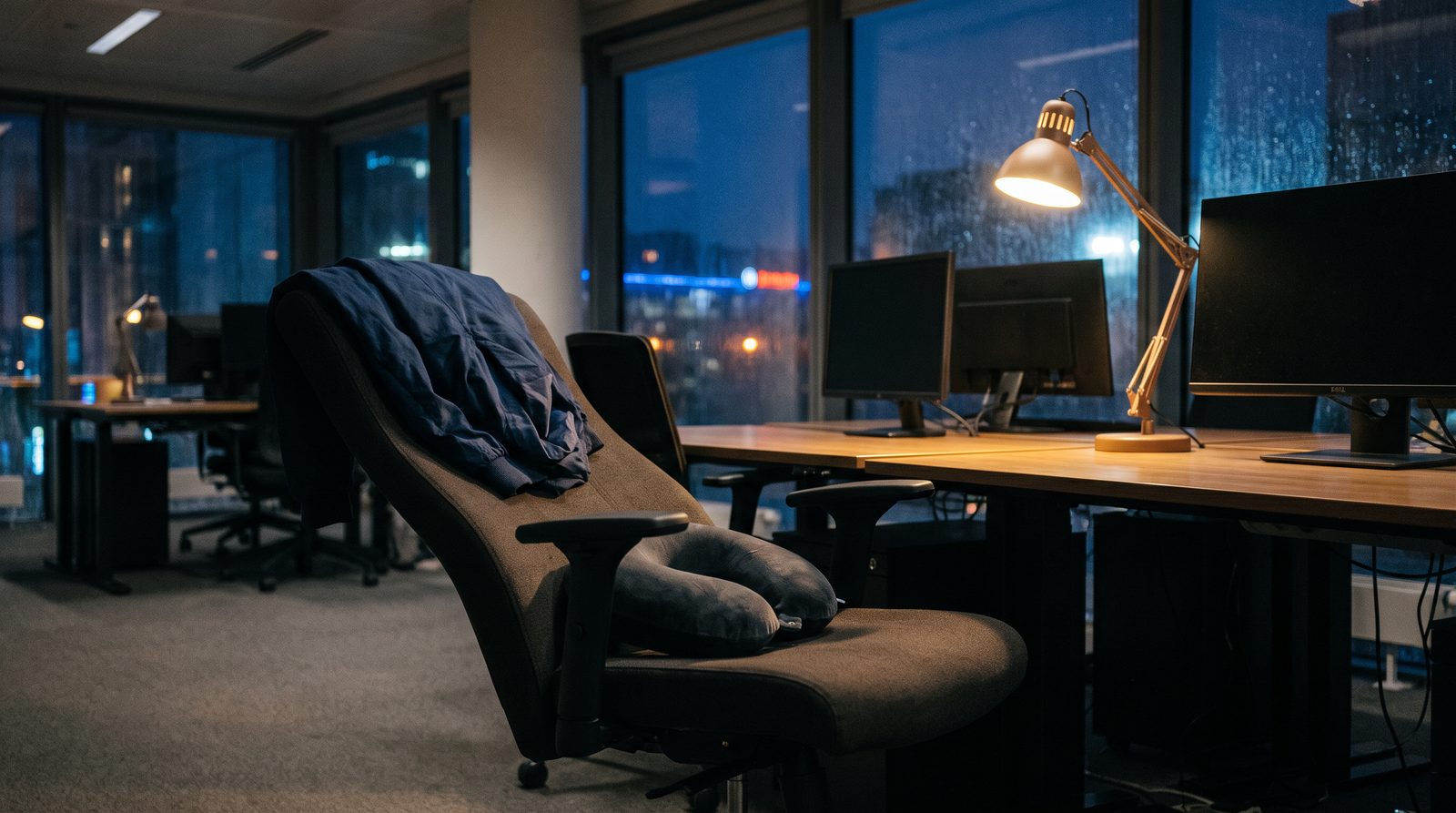
How to Sleep in an Office Chair: What Actually Works on a Night Shift
The short version: an office chair is the hardest seat there is to sleep in, because it sits at 90 to 105 degrees and has nothing behind your head. You cannot fix that with a pillow — anything thick pushes your head further forward. What works is a wrap that ties your head to your body rather than to the chair, reclining as far as the mechanism allows, and getting your feet up. But the thing that decides how you feel afterwards is not the chair at all. It is how long you sleep. Twenty minutes leaves you clear. Forty-five leaves you worse than if you had stayed awake.
This is not a niche problem. Night-shift staff take their break in one. On-call engineers doze between pages. Students fall asleep over a library desk at two in the morning. Hospital staff grab twenty minutes in an office because the on-call room is three floors away. Drivers pull into services and put the seat back, which is a different and much better chair — more on that below.
Almost everything written about it is about buying a better chair. That is rarely the option available at three in the morning. This is about the one you are sitting in.
Why the Office Chair Is the Worst Seat in the Building
When you are awake, your neck muscles hold your head up — roughly five kilograms balanced on a flexible column, kept there by continuous low-level effort you never notice. Falling asleep switches that effort off. Whatever the chair is not holding, gravity takes.
In a reclined chair the backrest catches your head and you are only left with a small gap behind the neck to fill. In an office chair there is nothing at head height at all. Your head pitches forward into deep flexion, or drops sideways until something stops it, and then stays there for however long you are out. That sideways drop is the one that produces a neck that will not turn the next morning.
Our guide to sleeping in a chair sets out the four recline bands in full. An office chair sits squarely in the worst of them, and no amount of cushion changes the geometry. Adding a pillow behind an unsupported head simply pushes it further forward.
The Thing That Matters More Than the Chair
Here is what almost nobody optimises, and it makes more difference than any piece of equipment: how long you sleep for.
Sleep runs in cycles of roughly ninety minutes, moving from light sleep down into slow-wave sleep and back up. Wake from the light stages and you come round quickly. Wake out of slow-wave sleep and you get sleep inertia — that thick, disoriented state where your reaction time and judgement are measurably impaired for the next fifteen to thirty minutes. If you are waking up to do something that matters, that window is the whole problem.
So: set an alarm for twenty minutes, or for ninety if you genuinely have ninety. The forty-five minute nap is the one that ruins the hour after it. This is not theoretical — it is why fire services have thought hard about the problem. Our piece on how firefighters sleep on shift covers the same inertia window in people who have eighty seconds to get from deep sleep into a moving vehicle, and carries the sourcing for these figures. Solo ocean racers take the opposite approach and sleep almost entirely in short blocks.
One trick worth knowing if you have coffee to hand: drink it immediately before a twenty-minute nap rather than after. Caffeine takes about twenty to thirty minutes to take effect, so it arrives as you are waking rather than keeping you from dropping off.
Setting Up the Chair You Actually Have
- Recline it to the stop. Most task chairs have a tilt lock most people never touch. Find the lever, release the tension, and take it as far back as it goes. Going from 95 to 115 degrees will not get you into the comfortable band, but it meaningfully reduces how far your head has to fall.
- Get your feet up. A second chair, an open drawer, a bin, a box of paper. Legs below heart level for an hour is the part with an actual circulatory consequence, not just a sore neck.
- Tie your head to your body. A travel horseshoe worn backwards — opening at the front, bulk under the jaw and both ears — or a scarf or hoodie bunched around the neck. This is the single most effective thing for an upright chair.
- Find a corner. If there is a wall or a partition beside the chair, put yourself against it. A second surface to lean on is worth more than anything you can buy.
- Cross your arms over your chest. Arms draped over hard armrests compress the ulnar nerve at the elbow, which is why people wake from desk naps with a numb little finger and ring finger. We cover that pattern in why those two fingers go numb.
- Deal with light and noise. An eye mask beats anything else in an office that cannot be darkened. A hood works. Earplugs matter more on a night shift than people expect, because daytime building noise is what usually ends the nap early.
- Set two alarms. One on the phone, one somewhere you have to reach for. Sleeping through is the actual risk of the ninety-minute version.
The Desk Slump Is Worse Than It Feels
The instinctive alternative is to fold forward onto the desk, head on folded arms. It feels like relief because your neck finally stops working. It creates three separate problems.
Your neck is held in full flexion for the duration, which is the position most likely to leave the joints at the base of your skull sore. Your arms take your head’s weight, which compresses nerves at the elbow and the wrist — the numb hand you wake with is not circulation, it is pressure on a nerve. And your face and one eye take direct pressure, which is why people sometimes surface with blurred vision in one eye for a few minutes.
If you are going to do it anyway — and most people do — build the pile higher so your neck bends less. A jumper, a bag and a folded coat under your forearms raises the surface toward your head instead of dropping your head to the desk. Turn your head to one side rather than face down, and swap sides if you do this regularly.
Better Options in the Same Building
Before you optimise the office chair, check whether you have to use it.
- Your car. If it is in the car park, it is a far better chair: a real headrest, and most seats recline past 130 degrees into the usable band. Never with the engine running.
- A sofa or soft chair in a break room. Even a bad sofa gives you a corner to wedge into, which an office chair cannot.
- The floor. Genuinely. Twenty minutes flat on a coat with a jumper under your head is better sleep than an hour upright, if you have somewhere you will not be walked over.
- A rest facility you have not been told about. Plenty of hospitals, control rooms and depots have one that nobody mentions to new staff. Ask.
If sleeping at work is a regular part of the job rather than an occasional bad night, the chair is not really the problem — the schedule is. Our guide to sleeping better, in the order the evidence supports covers what to protect at home, which matters far more for shift workers than anything about the chair.
Frequently Asked Questions
Is it bad to sleep in an office chair?
Occasionally, no. It is uncomfortable rather than dangerous. The two things worth managing are neck position, because an unsupported head is held at an extreme angle for the whole nap, and circulation, because sitting still with your legs down slows blood flow in the deep veins. Keep naps short, get your feet up, and it is fine. As a nightly arrangement it is a poor substitute for a bed.
How long should I nap in an office chair?
Twenty minutes, or ninety if you have the time. Twenty keeps you in light sleep so you wake clearly. Ninety completes a full cycle. Between roughly thirty and seventy minutes you are likely to be woken out of slow-wave sleep, which leaves fifteen to thirty minutes of impaired attention and can feel worse than not having slept.
What kind of pillow works in an office chair?
A horseshoe travel pillow worn with the opening at the front, so the bulk sits under your jaw and both ears. That holds your head to your body, which is what stops the sideways drop. A contoured or standard bed pillow is the wrong shape, because there is nothing behind your head at that angle for it to press against, so it pushes your head forward instead.
Why do I wake up with a numb hand after sleeping at my desk?
Usually pressure on a nerve rather than circulation. Resting your head on your arms compresses the ulnar nerve at the elbow, which supplies the little finger and half the ring finger, and can also compress the median nerve at the wrist. It normally settles within minutes of moving. Numbness that persists, or that keeps happening, is worth mentioning to a doctor.
Nothing here is medical advice. If you are falling asleep at work despite sleeping normally at home, that is worth raising with a doctor rather than solving with a better chair.