
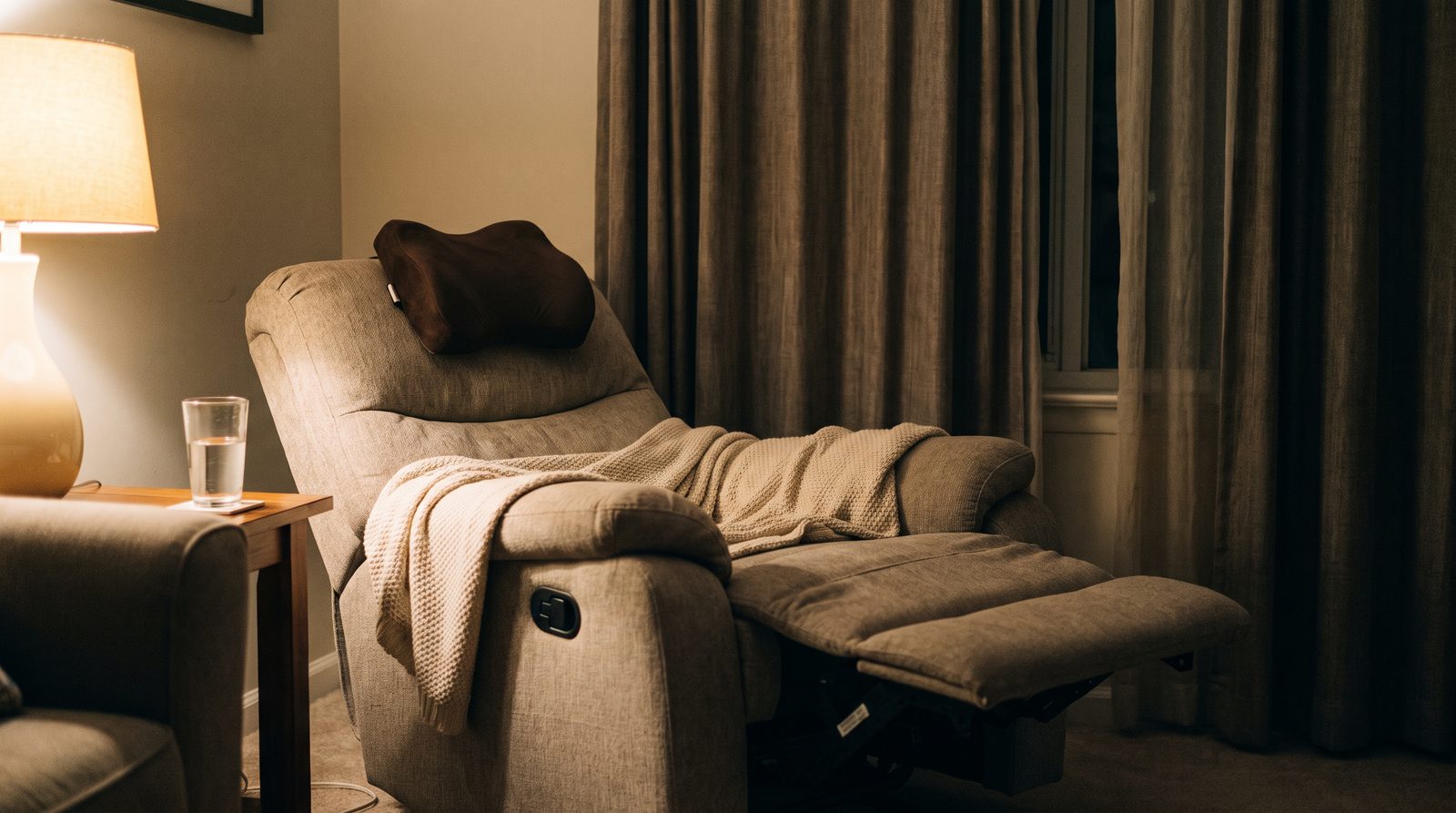
How to Sleep in a Recliner Comfortably: The Full Setup
The short version: a recliner can be a genuinely good place to sleep, but almost everyone sets it up wrong in the same two ways. They recline too shallow, which leaves a gap behind the neck that nothing fills, and they leave their legs below heart level for eight hours. Fix the angle, fill the gap, raise the footrest, and a recliner stops being a compromise. Each of those is covered in full below, along with the point at which nightly recliner sleeping stops being a good idea.
People end up sleeping in a recliner for very different reasons. Some are recovering from surgery and cannot lie flat. Some have reflux, or breathing that gets worse the moment they are horizontal. Some fell asleep in the chair one night, woke up feeling better than they had in months, and never went back to the bed.
All of them run into the same mechanical problems, because a recliner is a chair being asked to do a bed’s job. This guide covers the setup that works, in the order that matters.
Step One: Get the Angle Right
The single most common mistake is sleeping at what we call TV posture — somewhere around 100 to 110 degrees. It feels like reclining. It is not. At that angle your head still needs active muscular effort to stay upright, and the moment you fall asleep and that effort stops, your head drops forward or sideways. That is why people wake at 3am with a neck that feels wrenched rather than merely stiff.
For sleeping, you want a minimum of roughly 120 degrees, and most people do best somewhere around 135. Our guide to recliner angles breaks down 120, 135 and 150 degrees in detail, including which one suits breathing problems versus back pain. If your chair will not hold a position past about 115 degrees, it is a TV chair, not a sleeping chair, and no pillow will rescue it.
Step Two: Fill the Neck Gap
Here is the part almost nobody accounts for. When you recline, your head does not move back as far as your torso does. Your upper back meets the chair, but the natural curve of your cervical spine leaves an air gap behind your neck. Unsupported, your head tips back into extension and stays there all night.
The gap is smaller than the one you fill in a bed. This is the most important number in recliner sleeping and the one that catches people out: a recliner needs less pillow loft than a bed, not more. In bed, a side sleeper is filling the distance from mattress to ear — often four to six inches. Reclined on your back, the chair is already supporting most of your head’s weight, and you are typically filling somewhere between one and three inches.
Bring a bed pillow to a recliner and you will push your chin toward your chest for eight hours, which produces exactly the morning stiffness you were trying to avoid. Our recliner pillow guide covers the three shapes that work, and how to check your own gap with a rolled towel in a single evening.
Choosing the pillow
Which pillow actually works in a recliner
We compared the pillow shapes that hold up in a reclined chair, how much loft each gives, and the one we would buy.
See our recliner pillow pick →Step Three: Deal With Your Legs
This is the step people skip, and it is the one with an actual medical consequence rather than just a sore neck.
Sitting still for long periods with the legs below heart level slows blood flow in the deep veins of the legs. Bent hips and knees compress the veins behind the knee, and that combination of reduced flow and venous compression is the mechanism behind deep vein thrombosis. It is the same reason long-haul flights carry a DVT warning. A recliner used as a bed, night after night, reproduces a fair amount of that picture.
Three things reduce the risk substantially, and none of them are difficult:
- Use the footrest, every time. Getting the legs up toward heart level is the single biggest change. A recliner slept in with the footrest down is a chair you passed out in.
- Do ankle pumps before you settle and when you wake in the night. Twenty slow flexes of each foot. This is standard post-operative advice for exactly this reason — the calf muscle acts as a pump that pushes venous blood back toward the heart, and it only works if the ankle moves.
- Do not stay completely still all night. If you wake, shift position and move your feet rather than freezing in place trying to get back to sleep.
If you have had a clot before, are on hormone therapy, have recently had surgery, or have any other DVT risk factor, this is worth raising with your doctor rather than managing with ankle pumps alone. Swelling, warmth, or pain in one calf is not something to sleep on.
Step Four: The Rest of the Setup
- Stop yourself sliding. Many people wake having slid halfway down the chair, which flattens the recline angle and wrecks the neck support. A small cushion or rolled towel in the crease where the seat meets the backrest holds your hips back where they belong.
- Support the lower back. A recliner’s lumbar curve is designed for sitting, not sleeping. A thin cushion behind the lower back fills that gap.
- Manage your arms. Arms draped over hard armrests all night compress the ulnar nerve at the elbow, which is why some people wake with a numb little finger. A pillow on each armrest, or arms resting on your chest, solves it.
- Cover up properly. Body temperature drops in sleep and a reclined body has more exposed surface area than one under a duvet. People often blame the chair for waking them at 4am when the actual cause is being cold.
When a Recliner Is the Right Answer
For some people the recliner is not a compromise at all — it is better than the bed, for reasons that hold up:
- Reflux. Keeping the head above the stomach makes it mechanically harder for acid to travel up the oesophagus. Head-of-bed elevation is a long-standing first-line lifestyle measure for night-time reflux, and a recliner achieves the same thing.
- Breathing that worsens when flat. Difficulty breathing when lying down is a recognised symptom in heart failure, caused by fluid redistributing toward the lungs. Sleeping upright is often what people find on their own before anyone tells them to.
- Sleep apnea. Elevating the head and trunk measurably reduces apnea severity in some people — see our dedicated guide for the numbers.
- Post-surgical recovery. After many operations a recliner offers elevation and makes getting up far easier than a low bed, but each surgery has its own catch. See open-heart surgery, C-section, hernia or gallbladder surgery, lumbar spinal fusion, shoulder surgery and knee or hip replacement.
When to Stop
A recliner is a reasonable place to sleep for a defined reason and a defined period. It is a poorer long-term default than a properly set up bed, mainly because of the circulation issue above and because sustained hip and knee flexion tightens the muscles that cross those joints.
Worth a conversation with your doctor if: you cannot lie flat without breathlessness, you have been in the chair for months without a clear medical reason, you are waking with calf pain or swelling, or the reason you moved to the chair was pain that has not improved. Our guide to whether recliner sleeping is bad for you goes through the trade-offs properly.
Frequently Asked Questions
Is it OK to sleep in a recliner every night?
For a defined medical reason — reflux, breathing that worsens when flat, post-surgical recovery — yes, and often it is the better option. As an indefinite default with no particular reason, it is worth working back toward a bed, because of circulation and joint stiffness over time. The footrest and ankle pumps matter more the longer you do it.
What pillow should I use in a recliner?
A thinner one than you use in bed. You are filling a one-to-three-inch gap behind the neck, not the four-to-six inches a side sleeper fills on a mattress. A small contoured pillow, a rolled towel, or a wrap-style neck pillow all work. A standard bed pillow pushes the chin down and causes the problem it is meant to fix.
Why does my neck hurt after sleeping in a recliner?
Almost always one of three things: the recline angle is too shallow so your head tips forward once you fall asleep, the gap behind your neck is unsupported so your head falls back into extension, or you slid down the chair during the night and flattened the angle. Fix the angle first, then the gap.
Should the footrest be up?
Yes, always, for the whole night. Legs below heart level for eight hours is the main circulatory risk of sleeping in a chair, and the footrest is the simplest thing that addresses it.
Sources
- Head-Of-Bed Elevation (HOBE) for Improving Positional Obstructive Sleep Apnea: J Clin Med, 2022
- The influence of head-of-bed elevation in patients with obstructive sleep apnea: Sleep and Breathing, 2017
- Risk of deep vein thrombosis in the lower extremity after total knee arthroplasty: PMC, 2023
More Pillow Guides
Recommended for Pain-Free Sleep
🛌 Derila Ergonomic Memory Foam Pillow
Contoured design that holds your cervical spine in neutral for the full night. Works for side and back sleepers. Backed by a 60-day money-back guarantee on the official store.
- ✓ Memory foam contour
- ✓ Side & back sleeper design
- ✓ 60-day money-back guarantee