
How Do Submariners Sleep? Hot Racks, 18-Hour Days and a Clock That Would Not Bend
A submarine is the closest thing we have to a laboratory for sleeping without the sun. No windows. No dawn. No weather. Nothing outside the hull that tells a body what time it is. If the human sleep-wake cycle were really just a habit — something you could reschedule by deciding to — a submarine is where that would show.
It did not show. The navy tried for decades, measured what happened, and changed the rules. What it found is worth knowing if you have ever worked nights, flown east, or simply gone to bed at a different time every day of the week.
Where a submariner actually sleeps
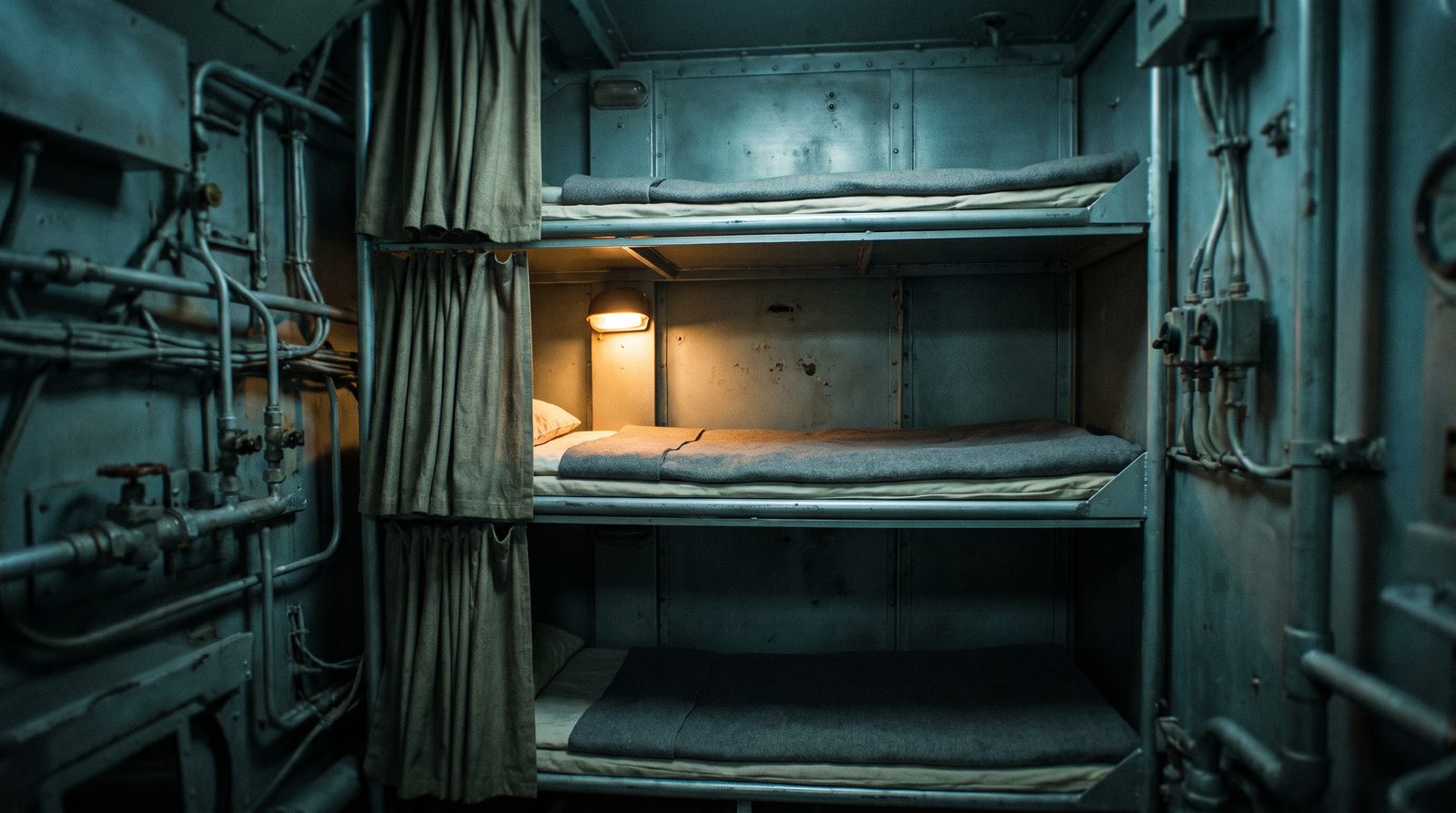
Bunks are stacked three or four high with roughly two and a half to three feet between them — enough to lie down and roll over, not enough to sit up. They are spread through the boat rather than gathered in one dormitory: on a Cold War-era fleet boat, ten bunks in the forward torpedo room, ten more aft among the torpedoes, thirty-odd in the crew’s quarters, and a handful for officers. Each rack has a curtain, a small reading light, and a shallow locker underneath the mattress that holds everything the sailor owns for the patrol.
On boats where the crew outnumbers the bunks, sailors hot rack: three men on three different watch sections share one bed, so it is occupied almost continuously and rarely cold. Hence the name. Your sheets are yours; the mattress is communal.
Two features of that environment are worth flagging now, because they come back later. The noise is constant — machinery, ventilation, pumps — which is easier to sleep through than intermittent noise, and is essentially industrial-scale white noise. And the light is extraordinarily dim, dimmer than any room in your house. Both of those turn out to matter more than the size of the bed.
The 18-hour day
Here is the part that surprises people. For most of the nuclear era, American submariners did not live on a 24-hour day at all. The standard watch rotation was six hours on watch followed by twelve hours off: an 18-hour cycle.
Four of those cycles fit neatly into three calendar days, which is exactly the problem. Your watch — and therefore your sleep — starts six hours earlier each time round, and laps the entire clock every three days. You sleep at midnight, then at six in the evening, then at noon, then at six in the morning, then back to midnight. Forever, for the length of the patrol.
Notice what that is. It is not night shift, which at least is consistent. It is a permanent westward flight, every single day, with no arrival.
What the body did about it
In 2022 a team published results from a 67-day patrol on which the crew ran an even tighter routine: strict six hours on, six hours off. Half the crew stood watch from midnight to 6am and again from noon to 6pm; the other half took the opposite blocks. Researchers tracked their sleep and, crucially, two hormones that report on the body clock — melatonin and cortisol.
Three findings came out of it, and the third is the one that changed minds.
- Sleep split in two, unevenly. With only six hours off at a time, sleep became biphasic — two bouts per cycle rather than one. The two were not equal: one long bout and one short one, with meaningfully different sleep efficiency between them.
- Cortisol went along with it. The stress-and-wakefulness hormone reshaped itself to match the biphasic work-rest pattern. That part was adaptable.
- Melatonin refused. At the end of more than two months on the schedule, melatonin secretion had not adjusted to the watch blocks. It carried on following its own internal near-24-hour rhythm, independent of everything the schedule was telling it, with signs of drifting freely.
The authors’ conclusion is unusually blunt for a physiology journal: human physiology does not fully obey operational needs. Two months of perfect compliance, total isolation from natural light, and complete control of the environment, and the central clock still would not move where it was told.
Interestingly, that stubbornness cuts both ways. A study of French nuclear submariners found that crews largely held on to their sleep and wake patterns across an entire undersea mission despite total isolation. The internal clock is not fragile. It is inflexible, which is a different thing — and a much bigger problem if your roster assumes otherwise.
The navy changed its mind
This was not an academic exercise. Fatigue on a submarine is a safety problem, and the work that proved it came largely from the Naval Postgraduate School’s crew endurance team under Nita Shattuck, working with Panagiotis Matsangas and, in the surface fleet, retired Captain John Cordle. Their measurements of reaction time on the old rotations were bad enough to move policy.
The surface navy’s equivalent was the “five and dimes” — five hours on watch, ten off, a 15-hour cycle with the same drift built in. Ships began replacing it with circadian rotations, protected sleep time, and small cultural changes that sound trivial and are not: no reveille blaring through the boat, meetings kept out of the early morning and late afternoon.
In 2016 the US submarine force made the 24-hour day the expected standard for watchstanding under normal operations. A 2024 field study of sailors on that circadian-aligned schedule measured what they actually got: an average of 6.62 hours of sleep.
Which is the honest footnote to this whole story. Fixing the schedule fixed the drift. It did not manufacture more hours. Six and a half is still short, and the submarine is still a noisy steel tube. A schedule aligned to your biology is a precondition for decent sleep, not a replacement for enough of it.
Light is the lever
If you cannot change the hours, the next most powerful thing you can change is light — and submarines are an extreme case, because they have almost none.
Measurements taken to replicate a submarine lighting environment give a sense of the scale: control rooms around 7 lux at a warm 2400 K, recreational spaces 15–20 lux, and sleeping areas below 1 lux. For comparison, an ordinary living room is 50–500 lux and an overcast day outdoors is 1,000–10,000. A submarine control room is roughly as bright as deep dusk, permanently.
In 2024 a randomised cross-over trial put 19 adults through simulated night shifts under that lighting, then repeated it with a circadian-informed version: blue-enriched light at around 200 lux during the working shift, dropping to dim, blue-depleted light below 10 lux before the predicted low point of core body temperature. The comparison was not close. Circadian adjustment ran roughly two to three times faster — about 1.4 to 1.7 hours per day, against 0.4 to 0.7 hours per day under the standard lighting.
Two things are doing the work there, and both are copyable. Bright and blue-rich early in your waking period. Dim and blue-poor before your body’s low point. The timing is not decoration; light at the wrong hour pushes the clock the wrong way.
Your bedroom is a submarine
Almost nobody reading this stands a watch three hundred feet down. But the navy spent decades and a great deal of money learning things that transfer directly to anyone whose schedule is not their own.
- Anchor to 24 hours, whatever those hours are. A consistently unsociable schedule beats a drifting reasonable one. The submarine force did not move everyone onto nights — it just stopped the rotation from sliding.
- Treat light as a tool with a timetable. Bright at the start of your waking period, dim for the couple of hours before you sleep. If you wake in the dark, that means a lamp on purpose; if you sleep in daylight, blackout and a mask.
- Steady noise beats silence. Submariners sleep through a machine room. What wakes people is change in sound, not volume. A fan is a legitimate intervention.
- Split sleep counts, if it is planned. Two bouts is a real strategy, not a failure. What hurt the crews was the unequal, unplanned version.
- Expect about an hour and a half a day, at best. Even with optimised lighting, the clock moved 1.4–1.7 hours per day. If you flip your schedule every weekend, you are asking for something your body cannot deliver.
If your own schedule fights back
The submarine version of this problem is extreme, but rotating shifts, on-call nights and long-haul travel are the same mechanism at a smaller scale. Our shift-work guide covers the practical protocols for nights, rotations and early starts — and the sleep diary is the quickest way to find out whether your schedule or something else is the real culprit.
The shift worker’s guide → · Free sleep diary → · How solo sailors sleep → · Sleeping through the polar night → · How firefighters sleep on shift →
Common questions
Do submariners sleep at night?
There is no night to sleep at. A submerged boat has no natural light at all, so “night” is whatever the watch bill says it is. Since 2016 the US submarine force has run a 24-hour day, so a sailor’s sleep at least falls at the same clock time each day, even if that time is the middle of the afternoon.
What is hot racking?
Sharing one bunk between sailors on different watch sections, typically three to a rack. As one comes off watch, another goes on, so the bunk is almost never empty — or cold, which is where the name comes from. Each sailor keeps their own bedding.
How many hours do submariners sleep?
A 2024 field study of sailors on the circadian-aligned 24-hour watch schedule found an average of about 6.6 hours. That is better than the drifting schedules it replaced, and still below what most adults need.
Is a six-on, six-off schedule bad for you?
It forces sleep into two short bouts and, on the evidence from a 67-day patrol, your melatonin rhythm will not adapt to it even after two months. Cortisol adapts; the central clock does not. It is workable in the short term and costly over a long one.
Sources
- The submariners’ sleep study: a field investigation of sleep and circadian hormones during a 67-day submarine mission with a strict 6-h-on/6-h-off watch routine. Journal of Applied Physiology, 2022.
- Life onboard a submarine: sleep, fatigue, and lifestyle behaviors of sailors on a circadian-aligned watchstanding schedule. Applied Ergonomics, 2024.
- Guyett A, et al. A circadian-informed lighting intervention accelerates circadian adjustment to a night work schedule in a submarine lighting environment. SLEEP, 2024.
- Sleeping under the ocean: despite total isolation, nuclear submariners maintain their sleep and wake patterns throughout their undersea mission. PLOS ONE.
- Naval Postgraduate School. Navy’s use of sleep-optimized watchbill continues to rise.