
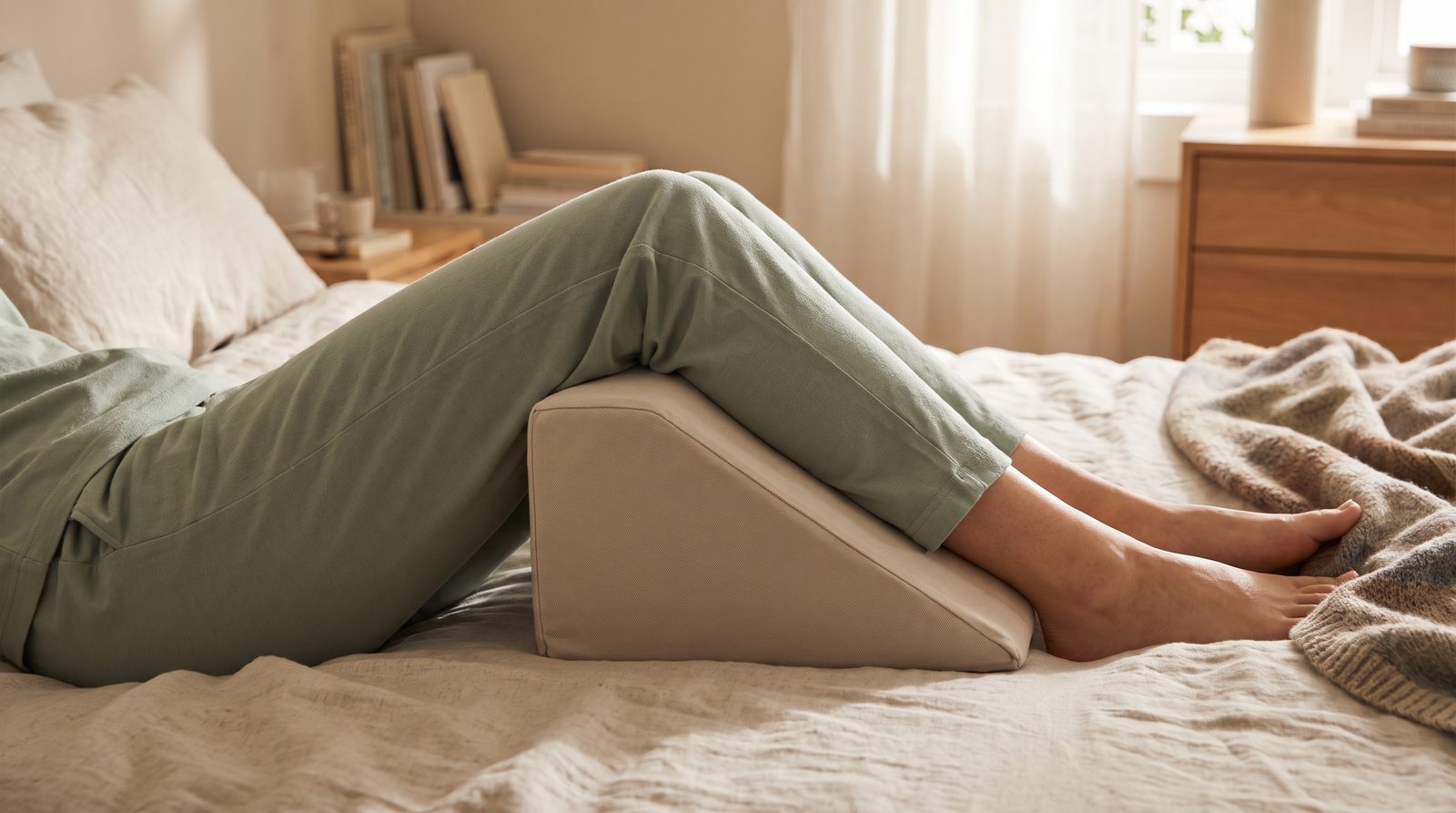
Best Pillow After Hip Replacement (2026): The One Between Your Legs Matters More
Quick answer: a hip replacement needs two pillows doing completely different jobs, and most guides only ever discuss one of them. The one between your legs depends on something they rarely mention: which way the surgeon went in. After a posterior approach, the job of that pillow is to stop the operated leg crossing the midline while you sleep, because that movement is part of what can dislocate a new hip. After an anterior approach, many surgeons give no such restriction at all. Find out which you had before you buy anything. Whatever the approach, it needs to be firm enough not to squash flat, and it should go between your knees and ankles — not under your knee. The second pillow, the one under your head, is the one nobody warns you about: if you are a lifelong side sleeper now confined to your back for six weeks, the pillow you already own is almost certainly too tall for the job, and that is how people finish this recovery with a neck problem they did not arrive with.
Your surgeon’s instructions override everything below. Precautions after hip replacement have changed a good deal in recent years, and they differ by surgical approach, by implant, by how your own operation went, and by surgeon preference. Use this to understand why you were told what you were told, and to ask better questions at your follow-up.
Anterior or posterior? It decides everything
A total hip replacement can be done from the back of the hip or the front, and the difference is not cosmetic. It determines which muscles and soft tissues were divided, and therefore which directions the new joint is least stable in afterwards.
- Posterior approach. The classic three precautions usually apply: do not bend the hip much past a right angle, do not let the operated leg cross the midline of your body, and do not rotate it inward. Those three combined are roughly the position a hip dislocates in. The pillow between your legs exists to prevent the middle one of those while you are asleep and cannot police it.
- Anterior approach. The vulnerable directions are different, and many surgeons give few or no classic precautions at all. Some ask you to avoid a combination of extending the leg behind you and rotating it outward instead. A leg pillow may still be used for plain comfort, but the reason for it is not the same.
This matters because most of what is written about sleeping after a hip replacement silently assumes the posterior approach. If you had an anterior one and you are following posterior rules, you may be making recovery more uncomfortable than it needs to be. If it is the other way round, that is the more serious error. If you are not sure which you had, ask — it is a reasonable question and the answer is on your operation record.
What the leg pillow is actually doing
If you are under posterior precautions and lying on your side, gravity pulls the upper leg down and forward across the body. That is adduction and internal rotation together — two of the three movements you were told to avoid, held for hours, while you are unconscious and cannot feel it happening.
The pillow is a physical block. Its only job is to keep the operated leg out to the side, roughly in line with your hip, so the joint stays in a safe position no matter what you do in your sleep. Understood that way, the requirements become obvious:
- It must be firm enough not to compress. This is the failure that actually happens. A soft bed pillow squashes to a couple of centimetres under the weight of a leg within an hour, and then the leg simply rests across the midline with a flat pillow underneath it. Dense foam or a purpose-made abduction wedge holds.
- It must be long enough to reach the ankles. A pillow only between the knees lets the lower leg swing across below it, which rotates the hip anyway.
- Lie on the non-operated side, if side lying is permitted at all. Many people are told to stay on their back for the first weeks regardless.
- It needs to still be there at 4am. Anything that works loose is not doing the job for most of the night.
Do not put a pillow under your knee
It is the most natural thing in the world to prop a sore leg up on a pillow, and it is usually the wrong move. Propping under the knee holds both the knee and the hip in a bent position for hours. Held long enough and often enough, soft tissue adapts to that shortened position and straightening out again becomes genuinely hard work — a problem that takes far longer to fix than it took to create.
If you want elevation for swelling, the usual advice is to raise the whole leg, supported along its length from calf to ankle, so the knee stays straight. Check with your own physiotherapist before changing anything.
The problem nobody warns side sleepers about
Here is something that catches a lot of people out, and it has nothing to do with the hip.
If you have slept on your side your whole life and you are now told to sleep on your back for six weeks, you will be doing it on a pillow chosen for side sleeping. A side sleeper’s pillow has to be tall enough to fill the gap between ear and shoulder — often 11 to 14 cm. Put that same pillow under your head on your back and it pushes your chin toward your chest for the entire night.
Six weeks of that is how people come out of a hip replacement with a neck problem they did not go in with, and then blame the surgery. On your back you want noticeably less height — usually 7 to 10 cm depending on your build. Our pillow height calculator gives both numbers for your frame, and the gap between them is usually bigger than people expect.
Got both numbers? One pillow covers the whole recovery
That is the awkward part of this: you need a lower pillow now and a taller one in six weeks, which normally means buying twice. The Derila Ergo has both in one — a 9 cm recessed centre for the weeks on your back, and 12 cm lobes for when you are allowed onto your side again. Firm enough that it still holds those heights at 4 am, which a soft pillow does not.
See today’s Derila price → 60-day money-back guaranteeWhat to avoid
- A soft pillow between the legs. It compresses and stops doing its job while you believe it still is.
- Sleeping on the operated side early on, unless your surgeon has specifically cleared it.
- A pillow under the knee. See above.
- Assuming the advice you read applies to your approach. Most of it is written for posterior precautions.
- Low, soft beds and deep sofas, which force the hip past a right angle just getting out of them. Our guide to the best recliner angle for sleeping covers the geometry.
- Dropping the precautions early because you feel fine. Feeling fine is not the same as healed.
The pillow most people overlook
There are two pillows in this recovery, and the leg wedge is the simpler one: dense foam that resists compression, long enough to reach your ankles. Get those two things right and it will do its job.
The head pillow is the one that catches people out, because weeks of enforced back sleeping on a side sleeper’s loft is how this recovery turns into a neck complaint you did not start with. The Derila Ergo has a 9 cm recessed centre, which sits in the right range for back sleeping, and 12 cm lobes for when you are allowed back onto your side — so it covers both halves of the recovery rather than needing replacing halfway. $59.99 for one, $99.98 for two ($49.99 each) at the time of writing, with a 60-day money-back guarantee.
Medical disclaimer: This article is general information, not medical advice. Hip precautions, sleeping positions and equipment after joint replacement must be confirmed with your surgical and physiotherapy team.
This page contains affiliate links. If you buy through a link we may earn a commission at no extra cost to you. We have not tested any product after this operation and nothing here is a recovery protocol. Our content is based on published guidance and public buyer feedback; vendors have no input.
Related guides
Many people find a chair easier than a bed in the first weeks — see sleeping in a recliner after knee or hip replacement. For the leg-pillow technique generally, sleeping with a pillow between your knees. If hip pain at night is your ongoing problem rather than surgery, see best pillow for hip pain.
More Pillow Guides
Recommended for Pain-Free Sleep
🛌 Derila Ergonomic Memory Foam Pillow
Contoured design that holds your cervical spine in neutral for the full night. Works for side and back sleepers. Backed by a 60-day money-back guarantee on the official store.
- ✓ Memory foam contour
- ✓ Side & back sleeper design
- ✓ 60-day money-back guarantee