
Best Pillow for Osteoporosis (2026): Support the Spine You Actually Have
Quick answer: osteoporosis on its own is painless. What hurts is a fracture, and in the spine those can happen without a fall — sometimes from an ordinary bend or twist. So the pillow questions that matter at night are narrower than you would think: a pillow under your knees on your back, or between your knees on your side, to keep the spine from being pulled or twisted; a head pillow that supports the shape your upper back has now rather than the one it used to have; and — the part most guides leave out — a way of getting in and out of bed that does not twist your spine, because that transition loads it more than anything you do while asleep.
This page is about comfort and positioning only. It is not a substitute for treatment, and no pillow slows bone loss. If you have been diagnosed, the medication, the underlying risk factors and the exercise plan are what change your outcome. A pillow just stops you making the nights harder than they need to be.
The riskiest moment is getting out of bed
Most advice about sleeping with osteoporosis goes straight to mattresses and pillows and never mentions the transition. That is backwards. Lying still is a low-load activity. Levering yourself upright by twisting your shoulders one way and swinging your legs the other is not — and in a spine with reduced bone density, that combination of bending and twisting under load is precisely the pattern that worries clinicians.
The standard alternative is usually called log-rolling: keep your shoulders, ribs and hips turning as one unit, roll onto your side first, then push up with your arms while your legs swing down together. The spine never twists against itself. The Royal Osteoporosis Society covers this kind of day-to-day movement advice in detail, and it is worth learning properly from a physiotherapist rather than from a diagram.
It is worth saying plainly: if you only change one thing after reading this page, change that, not your pillow.
What each pillow is for
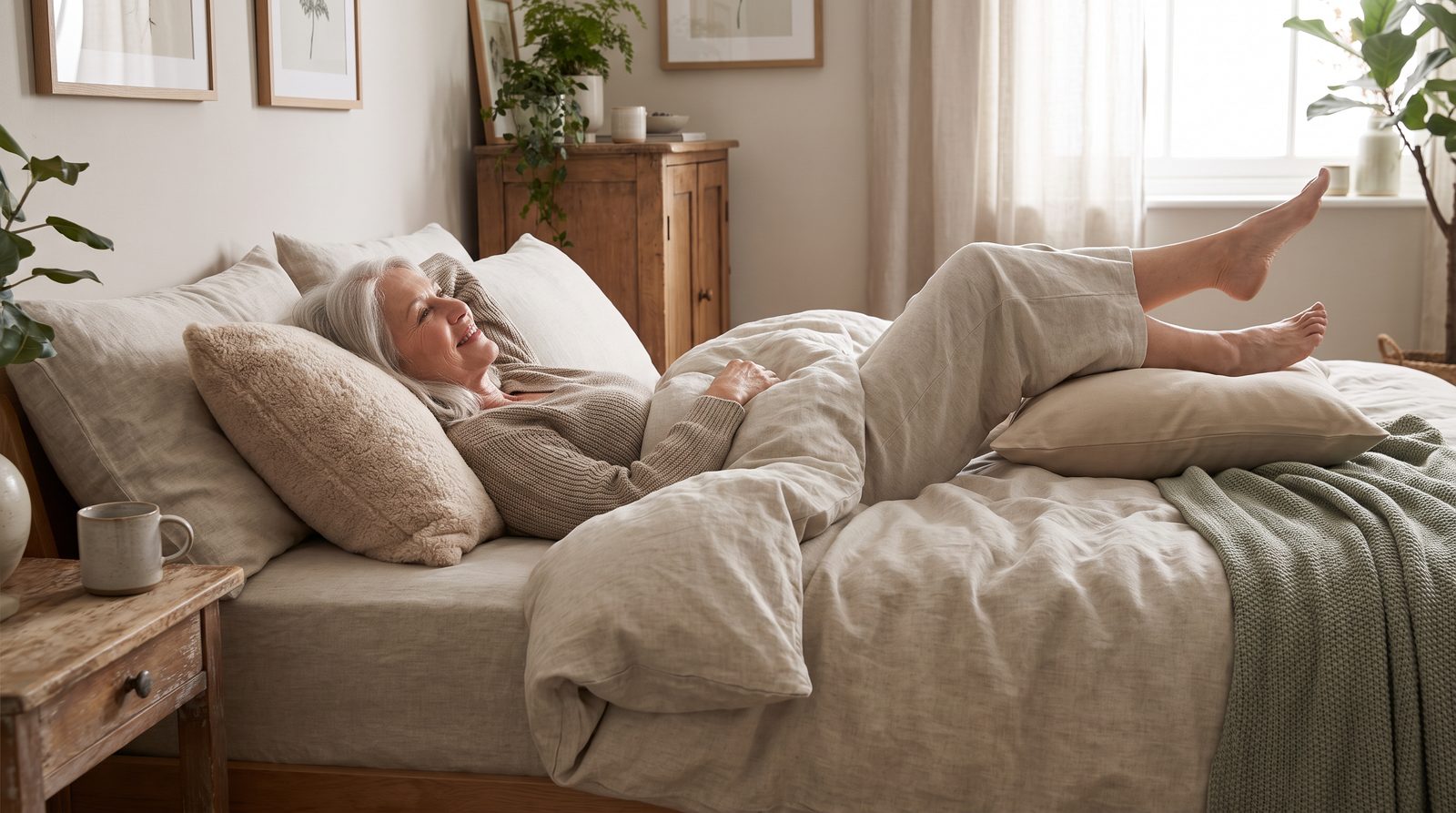
- Under the knees, on your back. Lying flat with legs straight pulls on the lower back for anyone with a stiff or tender spine. A pillow under the knees lets the lower back settle. This is the single most useful addition for most people.
- Between the knees, on your side. Without it, the upper leg drops forward, the pelvis tips, and the lower spine twists — held for hours. A firm pillow keeps the pelvis level and the spine in one line. Our guide to sleeping with a pillow between your knees covers the technique.
- Under the head. The job here is to match the shape your upper back has now. More on that below.
- Behind the back, on your side. A rolled pillow tucked behind you stops you drifting onto your back and twisting halfway through the night.
If your upper back has started to round
Compression fractures tend to collapse the front of a vertebra more than the back, so the bone ends up slightly wedge-shaped. Several of those and the upper back carries a permanent forward curve, with the head sitting further forward than it used to. This is why people lose height.
The consequence at bedtime is geometric. If your upper back no longer flattens against the mattress, then lying on a thin pillow leaves your head hanging below the level of your spine, with your neck levered backwards to reach the bed. That is uncomfortable, it is bad for the neck, and it loads the very region you are trying to protect.
So the pillow has to meet your head where it is, not where you would like it to be. For a pronounced curve that may mean more height than feels normal, and that is correct rather than a failure of posture. We go through the same geometry in more detail, including a simple self-test, in our guide to the best pillow for ankylosing spondylitis — a different condition that produces the same problem at the head of the bed.
Get checked promptly if you develop sudden severe back pain, especially after a minor movement like bending, lifting or a cough, or if you notice you have lost height or your posture has changed over a short period. New vertebral compression fractures can happen without any fall and are often missed. That is a medical matter, not a bedding one.
What to look for
- Firmness that lasts. A pillow that compresses to nothing by the small hours gives you support for the first part of the night and none for the rest. This applies to the knee pillow as much as the head one.
- A mattress that does not sag. A hollow in the middle curls the whole spine into flexion all night. Firm, not rock hard — an unforgiving surface makes bony hips and shoulders ache.
- Adjustability, or at least returnability. If your spine’s shape is changing, the right height this year may not be the right height in three.
- Something you can move without strain. A very heavy pillow is one more thing to twist for at night.
Our pillow height calculator gives a starting range for your frame and mattress. If your upper back is rounded, treat its number as a floor rather than a target.
What to avoid
- Twisting to get up. The main one. Roll as a unit instead.
- Sitting straight up from flat, which loads the spine into deep forward bending at the moment it is least warmed up.
- Stacking pillows to get height. A stack shifts and slides. One pillow of the correct height is stable; three are not.
- Stomach sleeping, which extends the lower back and rotates the neck for hours.
- Forcing yourself flat because you think it is better posture. If your spine has changed shape, it cannot be corrected at night, and trying is simply painful.
- Treating any of this as treatment. Positioning manages comfort. It does not manage bone density.
For the head pillow specifically
If your upper back is still reasonably flat, the Derila Ergo suits this fairly well: a 9 cm recessed centre for back sleeping with support under the neck, 12 cm lobes for side sleeping, and firm foam that holds its height through the night rather than flattening. $59.99 for one, $99.98 for two ($49.99 each) at the time of writing, with a 60-day money-back guarantee.
If your upper back has rounded significantly, measure the gap first — you may need more height than any contour pillow gives, and the 60-day guarantee is there for exactly that situation. The knee pillow is a separate and much simpler item: firm foam that holds its shape is all it has to do.
Medical disclaimer: This article is general information, not medical advice. Osteoporosis and fracture risk require medical management. Always check positioning and movement advice with your own clinician or physiotherapist.
This page contains affiliate links. If you buy through a link we may earn a commission at no extra cost to you. We have not tested any product with this condition and nothing here is a treatment plan. Our content is based on published guidance and public buyer feedback; vendors have no input.
Related guides
If the rounding of the upper back is your main concern, see best pillow for dowager’s hump. For narrowing of the spinal canal alongside it, best pillow for spinal stenosis. For general lower back pain at night, best pillow for back pain.
More Pillow Guides
Recommended for Pain-Free Sleep
🛌 Derila Ergonomic Memory Foam Pillow
Contoured design that holds your cervical spine in neutral for the full night. Works for side and back sleepers. Backed by a 60-day money-back guarantee on the official store.
- ✓ Memory foam contour
- ✓ Side & back sleeper design
- ✓ 60-day money-back guarantee