
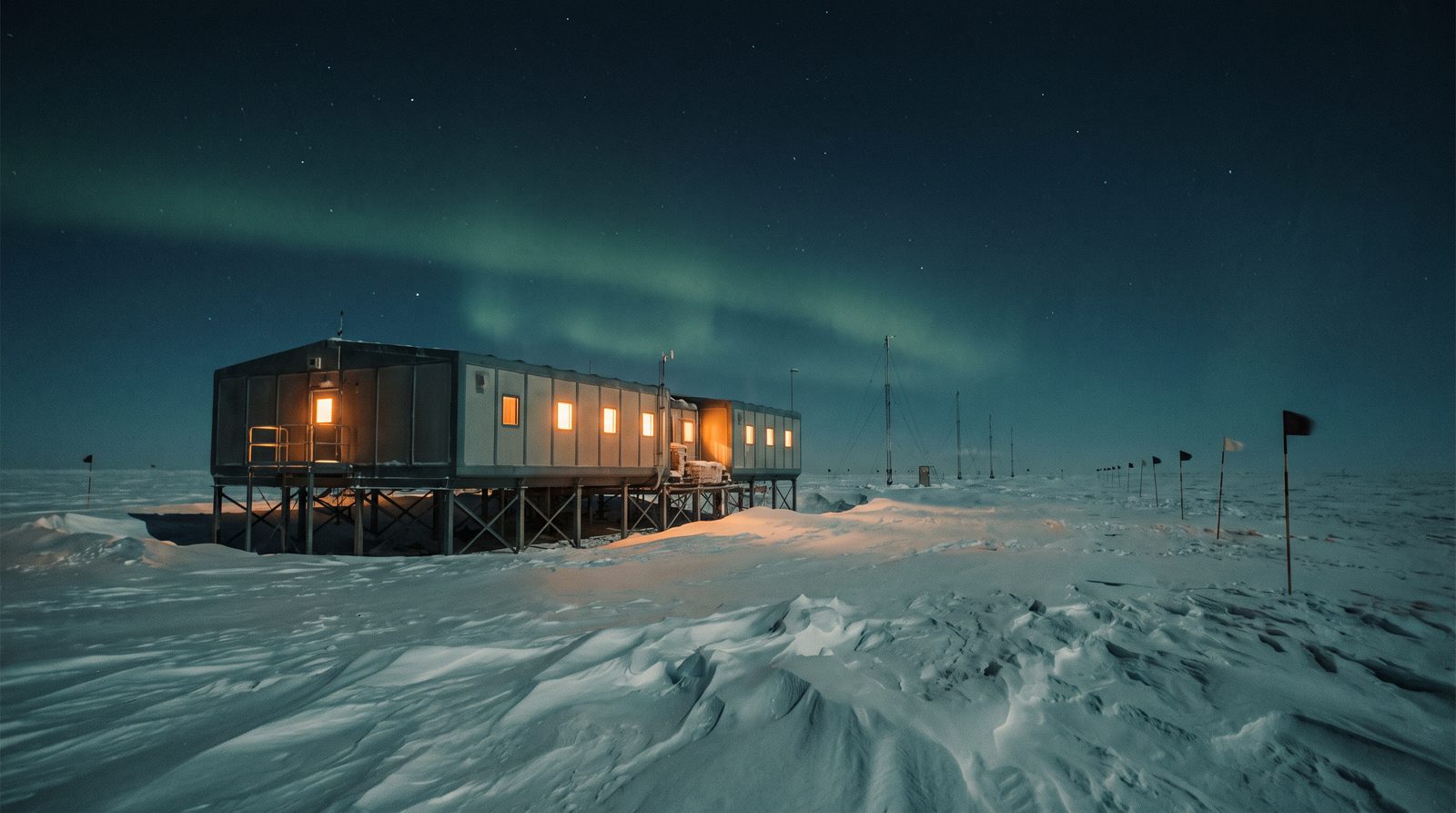
How Do People Sleep in Antarctica? Polar Night, Midnight Sun and the Problem With Flat Light
Antarctica is the cleanest natural experiment available on what the sun actually does for your sleep, because for months at a time it takes the sun away entirely, and then for months more it refuses to switch it off. Several hundred people a year live through both. They are healthy, screened, highly motivated, in warm buildings with good food and regular schedules. And their sleep falls apart anyway.
That is the useful part. Whatever is going wrong down there is not about mattresses or stress or screen time. It isolates one variable, and the answer it gives is more specific than “get some daylight”.
A year of measurements at 78 degrees south
The clearest dataset comes from Belgrano II, an Argentine station at almost 78°S, where thirteen army personnel spent a full year from January 2014. Researchers measured their sleep with wrist actigraphy for a week every month, alongside sleep logs, so the seasons could be compared against the same men rather than against a textbook.
- Night sleep shortened in midwinter. In July, at the depth of the polar night, nocturnal sleep dropped to 362 minutes from 427 minutes in March — a loss of about 65 minutes a night.
- Sleep drifted later, though that shift fell just short of statistical significance.
- Napping took over. More than half the men napped weekly, nap onset moved later through the winter, and average nap duration peaked at 164 minutes in September. That is not a nap; that is a second sleep.
- Measured alertness held up. On reaction-time testing, nothing changed significantly across the entire year — because the naps were doing their job.
That last pairing is the story in miniature. The main sleep period degraded, the body compensated by taking a long afternoon sleep, and performance was more or less preserved at the cost of a sleep pattern that had come apart into pieces.
Summer is not the relief you would expect
Ask anyone which half of the Antarctic year would wreck their sleep and they will say the dark one. The research says otherwise.
A study that took full polysomnography — proper brain-wave sleep staging, not a wrist monitor — during an Antarctic summer expedition found high sleep fragmentation, a major reduction in slow-wave sleep and an increase in REM. Slow-wave sleep is the deep, physically restorative portion, and it is the part you least want to lose. The phenomenon has its own name in the literature: polar insomnia. The paper’s title calls it new light on the subject, which is a better pun than it looks, because constant illumination is precisely the cause.
So the polar night shortens sleep and pushes it later. The polar summer keeps its length but hollows out its quality. Neither season gives the body a signal it can use.
The real problem is flatness
Your circadian system does not read brightness. It reads the difference between bright and dim, and when that difference arrives. A temperate day hands it an enormous swing — perhaps a hundred lux in a lit room at breakfast, tens of thousands outdoors by noon, near-total darkness at 2am. That swing is the signal.
Take the swing away and the clock does what a clock does when nobody sets it: it runs at its own pace. Studies in Antarctica have recorded sleep-wake cycles and melatonin secretion free-running during the period of complete darkness — drifting a little later each day, unmoored from the calendar, exactly as they do in a laboratory with no time cues at all. A more recent study found chronotypes shifting later across the polar night, and another recorded parasympathetic activity during sleep dropping through the dark months, so even the autonomic nervous system registers the season.
This is the same mechanism as the submarine, reached by the opposite route. A submarine crew has no natural light because there is a steel hull in the way. An Antarctic winterer has no natural light because the planet has tilted. The body cannot tell the difference.
An hour of light, and what it does and does not fix
If flatness is the problem, the obvious treatment is to manufacture a peak. That was tested at Halley Research Station, at 75°S, during the winter of 2007. Nine winterers were given bright white light for one hour each morning, from 08:30 to 09:30, for a fortnight, with control fortnights on either side.
It worked, and the detail of how it worked is the most useful thing in this article.
| What was measured | Effect of one hour of morning light |
|---|---|
| Circadian phase | Advanced by roughly 53 minutes |
| Wake-up time | Moved about 52 minutes earlier |
| Cognitive performance | Improved on two separate tests |
| Sleep start time | Advanced, but by less than wake time |
| Total sleep | Slightly reduced, as a result |
| Sleep quality, objective and subjective | No change |
| Subjective alertness | No change |
Morning light is a timing instrument. It pulled the clock earlier and it sharpened thinking. It did not make anyone’s sleep deeper, and because the wake time advanced more than the bedtime did, it actually trimmed a little off total sleep.
Which is worth holding on to, because a great deal of consumer writing implies that a light box is a sleep aid. It is not. It is a way of telling your body when “morning” is. If you are going to bed at the right time and still sleeping badly, light in the morning is not your missing piece.
What transfers to an ordinary winter
- Chase contrast, not brightness. A bright morning matters because the evening is dim. Blazing overhead lights at 11pm undo the morning’s work. The shape of the day is the signal.
- A northern-hemisphere winter is a mild polar night. Leaving in the dark and returning in the dark compresses your light curve toward flat. That is the same problem at a gentler dose, and the same fix applies: get the peak in early, deliberately.
- Use morning light for timing and something else for depth. If your complaint is “I cannot get up” or “I drift later every week”, light is the right tool. If it is “I sleep seven hours and wake up shattered”, look elsewhere.
- A long nap is a legitimate repair, not a failure. The Belgrano II men held their reaction times together across a polar winter largely by napping. If your nights are genuinely constrained, a planned afternoon sleep is a reasonable answer.
- Expect drift if you remove your anchors. A week of holiday with no fixed wake time and no morning daylight is a small free-running experiment, and it will run later every day, just as it does at 78 degrees south.
Find out whether your problem is timing or depth
The two need completely different fixes, and a week of diary data separates them quickly: drifting later points at light and schedule, while enough hours but no benefit from them points somewhere else entirely. If your hours are set by a rota rather than by you, the shift-work guide covers the protocols.
Free sleep diary → · The shift worker’s guide → · How solo sailors sleep → · How firefighters sleep on shift →
Common questions
Do people sleep less during the Antarctic polar night?
Yes. Across a year at Belgrano II station, nocturnal sleep fell from about 427 minutes in March to 362 minutes in July, a loss of roughly 65 minutes a night, while daytime napping increased sharply.
Is it harder to sleep in the polar night or the midnight sun?
They damage sleep differently. The polar night shortens night sleep and pushes it later. The Antarctic summer preserves duration but fragments sleep and sharply reduces slow-wave sleep, an effect known as polar insomnia. Neither provides the light contrast the body clock needs.
What is winter-over syndrome?
The cluster of effects reported by people who spend a winter at an Antarctic station: disturbed sleep, low mood, irritability and difficulty concentrating, arising from the combination of isolation, confinement and the absence of a normal light-dark cycle.
Does a light box help?
For timing, yes. An hour of bright morning light during the Antarctic winter advanced circadian phase by about 53 minutes and improved cognitive performance. It did not improve sleep quality, and it slightly shortened total sleep, so it is a tool for shifting when you sleep rather than for sleeping better.
Sources
- Folgueira A, et al. Sleep, napping and alertness during an overwintering mission at Belgrano II Argentine Antarctic station. Scientific Reports, 2019.
- Mottram V, Middleton B, Williams P, Arendt J. An hour of bright white light in the early morning improves performance and advances sleep and circadian phase during the Antarctic winter. Neuroscience Letters, 2012.
- Pattyn N, et al. Sleep during an Antarctic summer expedition: new light on “polar insomnia”. Journal of Applied Physiology, 2017.
- Pattyn N, et al. From the midnight sun to the longest night: sleep in Antarctica. Sleep Medicine Reviews.
- Chronotype delay and sleep disturbances shaped by the Antarctic polar night.