
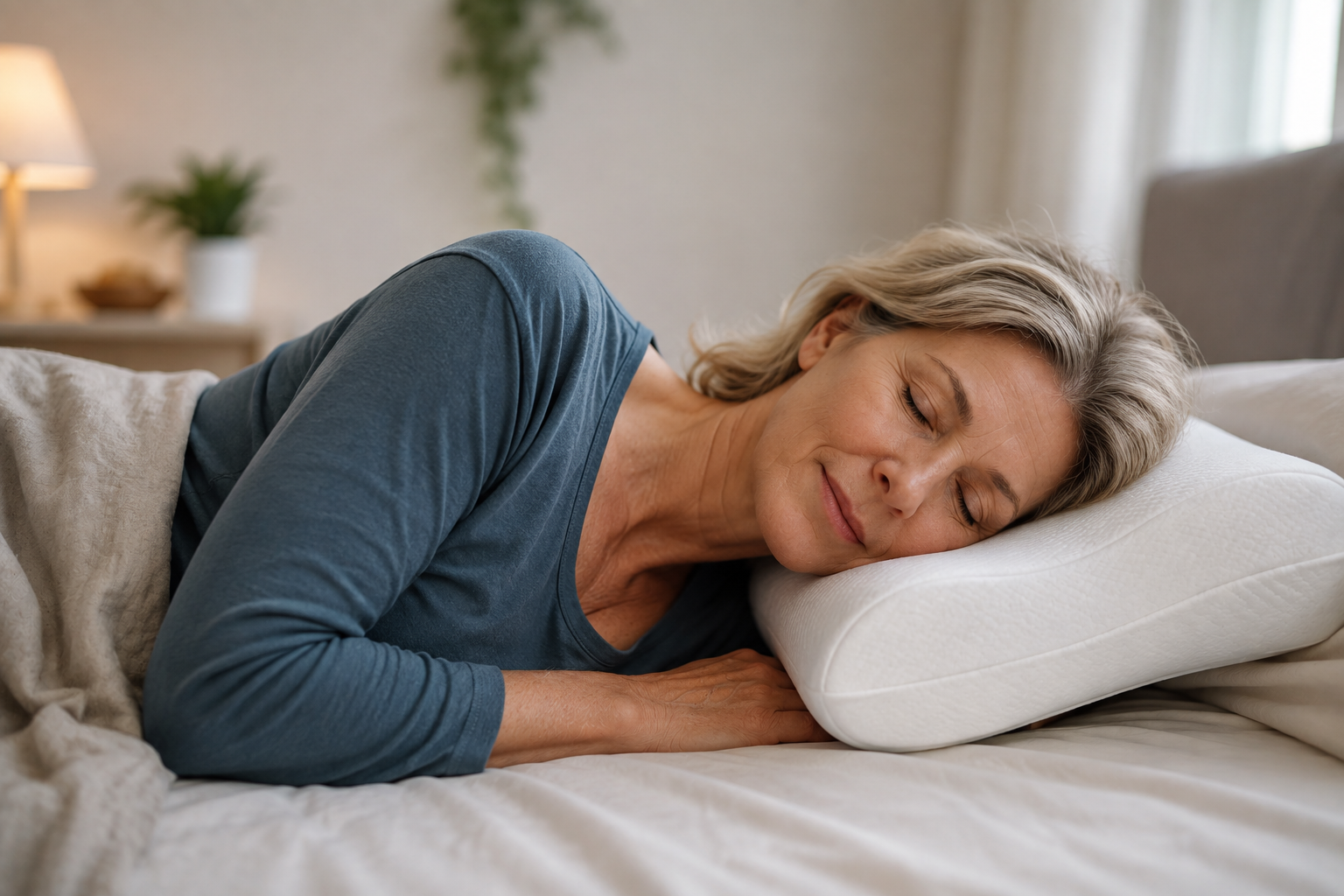
Best Pillow for Ehlers-Danlos Syndrome (2026): What Helps a Hypermobile Neck
Quick answer: with Ehlers-Danlos syndrome (especially hypermobile EDS) the neck has looser ligaments, so a pillow that lets the head sag, tilt or roll can leave it parked at the end of its range for hours. The pillow’s job is to hold the head still and neutral: roughly 7–10 cm on your back or 10–14 cm on your side, in a medium-firm material that does not collapse by 3am, with a shape that lets you turn without rebuilding the bed. Our pick is the Derila Ergo, a contoured memory-foam pillow with a 9 cm centre and 12 cm edges, at $59.99 with a 60-day money-back guarantee. It will not stabilise an unstable neck, it is not for stomach sleepers, and if heat wrecks your sleep a latex pillow may suit you better.
If you have EDS or hypermobility spectrum disorder, you have probably already been through a pile of pillows. The problem is not fussiness. Loose connective tissue changes what a pillow has to do, and most pillow advice is written for necks that stop moving on their own when they reach the end of their range.
Straight up about the evidence: nobody has run a trial of pillows in EDS. What we have is good data on how badly people with hEDS sleep, general pillow research, specialist reviews of the EDS neck, and the principles that follow. This guide keeps those separate, so you can see which parts are measured and which parts are reasoning.
How do you sleep? Find your pillow height.
Pick the position you spend most of the night in. Figures come from our pillow height calculator, for an average build on a medium mattress. Your condition can change which position is best; the guide below covers that.
You need 4.5–5.5 in of loft
That is 11.4–14 cm. On your side the pillow has to fill the gap between your ear and the mattress, so your shoulder width sets most of it.
- Broad shoulders or a firm mattress: go higher, up to 5.75–6.75 in
- Narrow frame or a soft mattress: go lower, down to 3–4 in
Derila fit: its 12 cm (4.7 in) wings sit inside this range. With broad shoulders on a soft mattress, check the calculator first.
You need 3.25–4.25 in of loft
That is 8.3–10.8 cm. Back sleeping needs less height than side sleeping, because the gap between your head and the mattress is much smaller.
- Broad build or a firm mattress: go higher, up to 4–5 in
- Narrow frame or a soft mattress: go lower, down to 2.25–3.25 in
Derila fit: its 9 cm (3.5 in) centre sits inside this range.
You need 3.75–4.75 in of loft
That is 9.5–12.1 cm. One height cannot serve both positions perfectly, so a single-height pillow is always a compromise between the two.
- Set the height for the position you spend most of the night in
- Broad build or a firm mattress: go higher, up to 4.75–5.75 in
Derila fit: its two zones cover both: the 9 cm centre when you are on your back, the 12 cm wings when you turn onto your side.
1–2 in of loft, or none at all
That is 2.5–5.1 cm. No pillow height makes stomach sleeping good for your neck, because it holds your head turned to one side all night.
- Use the flattest pillow you have, or none
- If you can, work towards side sleeping; the calculator shows the height you would need
Derila fit: not for stomach sleepers. Even its 9 cm centre is too high for this position.
Sleep in a recliner? The rules are different: see the recliner guide.
How EDS Affects Sleep
The NHS describes the Ehlers-Danlos syndromes as a group of rare inherited conditions that affect connective tissue. In hypermobile EDS the listed symptoms include joint hypermobility, loose and unstable joints that dislocate easily, joint pain and clicking, extreme tiredness, and dizziness with a raised heart rate after standing up.
The sleep numbers are grim. In a 2022 survey of 768 adults with hEDS published in Archives of Physical Medicine and Rehabilitation:
- 92.2% said their sleep was not restful
- 66.4% got less than seven hours a night
- 97.4% said pain interfered with their sleep, and for 37.75% that happened daily
- 20.1% were already using positioning, pillows or wedges to manage it
The authors named pain, temperature regulation and anxiety as the main drivers. Keep that list in mind. A pillow can help with part of the first one, can make the second one worse if you choose badly, and does nothing for the third.
Why a Hypermobile Neck Needs a Different Pillow
A 2022 review in The Spine Journal describes how EDS can cause ligamentous laxity and hypermobility of the cervical spine. That is the core of the pillow problem.
Here is the reasoning we use (it is logic, not a trial result). In a typical neck, tight ligaments and joint capsules act as a stop. If the pillow is too low or collapses, the neck bends a little and then the tissues take up the slack. In a hypermobile neck that stop comes later, so a bad pillow lets the head drift further: tipped back on a flat pillow, pushed forward on a stacked one, or tilted down on the side when the foam sags. The muscles then do the ligaments’ job all night, which fits with waking up stiffer and sorer than you went to bed.
That points to three priorities:
- Height that holds. Feather, down and cheap fibre flatten through the night. For a neck without a firm stop, losing 3 cm of loft by 3am matters more than it would for most people.
- Cradling, not just propping. A shape that holds the head in place (a recessed centre, raised edges or a neck roll) resists the head rolling to one side, where a flat block pillow does not.
- Easy repositioning. Pain and joint discomfort mean many people with EDS turn a lot at night. A pillow with a back height and a side height saves you rebuilding a stack every time you move.
The Loft Numbers
These are the neutral ranges we use across the site, measured with your head on the pillow rather than the height printed on the packet. The NHS advice for neck pain points the same way: a low, firm pillow, with your head at the same height as the rest of your body.
| Position | Target loft under load | Hypermobility adjustment |
|---|---|---|
| Back | 7–10 cm (3–4 in) | Fill the curve behind the neck so the head is not tipped back. A recessed centre stops the head rolling sideways when you drift off. |
| Side | 10–14 cm (4–5.5 in) | Fill the shoulder-to-ear gap exactly, so the neck is not side-bent. Too low also pushes the bottom shoulder to take more load, which matters for shoulders that sublux. |
| Stomach | Not recommended | The neck is turned towards the end of its range for hours, which is exactly what a lax neck cannot limit on its own. |
A softer mattress lets the shoulder sink, so you need slightly less side loft; broad shoulders need more. The pillow height calculator gives a number for your own build, and this guide shows how to tell within a week whether the height is wrong.
Memory Foam, Latex or Buckwheat?
No material has been tested in EDS, so the best general evidence is a 2010 trial in side sleepers published in the Journal of Pain Research. It compared polyester, regular foam, contoured foam, feather and latex pillows. Latex performed best for waking headache and arm pain; feather performed worst and produced the most waking symptoms. One result matters for this page: the contoured foam pillow did no better than a regular foam one. The participants did not have neck problems, so treat it as a guide rather than proof, but it is the fairest evidence there is, and it means a contour is not magic.
- Memory foam moulds slowly around the head, spreads pressure and keeps its height. The trade-offs are warmth and a sinking feel some people hate.
- Latex is springier, holds its shape, sleeps cooler and had the best result in the trial above. It is the obvious alternative if heat is a problem; our memory foam vs latex comparison goes into it.
- Buckwheat can be shaped by hand and is popular in hypermobility communities, but it is heavy, noisy and needs re-shaping when you turn. See buckwheat vs memory foam.
- Feather, down and fibre as the main head pillow: skip them. They are fine as knee or hug pillows.
Positions, and the Rest of the Bed
With EDS, hips, shoulders and knees can wake you as easily as the neck, so think about the whole position rather than just the head.
On your side
Head level with the spine. A pillow between the knees and ankles so the top leg does not drag the hip and lower back into a twist (the knee pillow guide shows the placement). A pillow to hug in front of you so the top arm is supported and the shoulder is not pulled forward all night; the shoulder pain guide covers the arm set-up. Do not sleep with the bottom arm under the pillow or an arm above your head. The thoracic outlet guide explains why an overhead arm causes trouble.
On your back
Nothing is rotated and the load is spread over the widest area. Add a pillow under the knees to take strain off the lower back. Keep the head pillow in range: too high pushes the chin down, too flat lets the head tip back.
On your stomach
Avoid if you can. A body pillow along your front can stop you rolling onto it during the night.
Temperature
The 2022 survey above named temperature regulation as a main driver of poor sleep in hEDS. Memory foam holds more warmth than fibre or latex. If you already run hot at night, weigh that before you buy anything, and look at the cooling pillow options.
Our Pick: The Derila Ergo
Our pick for EDS and hypermobility: Derila Ergo
Medium-firm memory foam with a 9 cm centre for your back and 12 cm edges for your side, shaped to cradle the head so it does not roll. $59.99, 60-day money-back guarantee.
Check today’s price →Read the full review first · Not for stomach sleepers
The Derila Ergo is a contoured, butterfly-shaped memory-foam pillow. The recessed centre sits at about 9 cm, the middle of the back-sleeping range, and the raised edges at about 12 cm, the middle of the side-sleeping range. That matches the three priorities above: the foam keeps its height through the night, the shape cradles the head rather than just propping it, and the two heights mean you can turn from back to side without rearranging anything. Our pages on what it is made of and the full review cover the build, the cover and the complaints.
At the time of writing it is $59.99 on the official store, with a 60-day money-back guarantee. With EDS, the 60 days is the part that matters most. Any new pillow can feel wrong for the first week (here is the normal adjustment), and a flare or a subluxation elsewhere can make anything feel wrong for a while. Give it several weeks before you judge, and read the return policy before you start so you know the steps.
Not for you if
- You have diagnosed CCI or AAI with specialist positioning advice. Follow that first. A general pillow is not a substitute for a prescribed collar or set-up.
- Heat reliably ruins your sleep. Memory foam holds warmth. Latex is the cooler option.
- You sleep on your stomach. A contoured pillow makes that position worse.
- Your build is outside average. The Derila comes in one size. Very broad or very narrow shoulders may need a height it does not give; check the calculator and look at an adjustable pillow instead.
- You already know you hate the sinking feel. Trust that. The Derila alternatives page covers the other routes.
What a Pillow Cannot Do
A pillow can take away one source of night-time strain. It does not treat EDS, it does not tighten ligaments, and it cannot stabilise a neck that is truly unstable. The things with specialist backing are elsewhere:
- Physiotherapy. The NHS says there is no specific treatment for EDS, but a physiotherapist can teach exercises to strengthen your joints, avoid injuries and manage pain, and an occupational therapist can help with daily activities.
- Specialist care for suspected instability. A 2017 review for the Ehlers-Danlos Society’s classification work lists a neck brace, physical therapy and avoiding the activities that provoke symptoms as the first line of treatment for atlantoaxial instability. The 2022 Spine Journal review adds that there is little data behind the imaging measurements used to diagnose instability in EDS, so this is a conversation for a specialist, not a forum.
- Help with pain and coping. The NHS lists counselling and cognitive behavioural therapy as options if long-term pain is getting hard to live with.
When It Is Not a Pillow Problem
The same 2017 review lists symptoms linked to instability where the skull meets the neck: headache, neck pain, dizziness, vertigo, shortness of breath, voice changes, altered vision and hearing, fainting and vomiting. With atlantoaxial instability, neck pain and headache at the base of the skull are the most common findings, sometimes with dizziness, nausea, facial pain, trouble swallowing, choking or breathing problems.
See a doctor, not a pillow guide, if your headache or neck pain comes with any of those symptoms, if you notice numbness, tingling or weakness in your arms or legs, clumsiness in your hands or trouble with balance, or if symptoms get worse over time. Source for the symptom list: Henderson et al., 2017.
If headaches that start in the neck are your main night-time problem, the cervicogenic headache and occipital neuralgia guides go further. Many people with hEDS also live with widespread pain; the fibromyalgia guide covers the pressure-sensitivity side.
Frequently Asked Questions
What is the best pillow for Ehlers-Danlos syndrome?
One that holds the neck neutral all night without collapsing and lets you change position without rearranging pillows: roughly 7-10 cm of loft on your back and 10-14 cm on your side, measured with your head on it. A medium-firm contoured memory-foam or latex pillow fits that brief. The Derila Ergo (9 cm centre, 12 cm edges) is our usual pick. No pillow has been tested in EDS specifically.
Is memory foam or latex better for hypermobility?
Neither has been trialled in EDS. In a general 2010 trial of side sleepers, latex produced the fewest waking symptoms and feather the most, while a foam contour pillow did no better than a regular foam one. Memory foam moulds slowly and holds its height; latex is springier and sleeps cooler. If heat disturbs your sleep, lean towards latex.
Can a pillow help craniocervical instability?
A pillow cannot stabilise the neck or treat craniocervical or atlantoaxial instability. Specialist reviews list a neck brace, physical therapy and avoiding provoking activities as first-line treatment. If you have been diagnosed with either, follow your specialist’s positioning advice before any general pillow guide, including this one.
What is the best sleeping position with EDS?
Back or side, with support at several points: the head pillow at the right height, a pillow between the knees on your side or under the knees on your back, and a pillow to hug so the top shoulder is not pulled forward. Avoid stomach sleeping and sleeping with an arm under the pillow or above your head.
Why is sleep so poor with hEDS?
In a 2022 survey of 768 adults with hEDS, 92.2% said their sleep was not restful and 97.4% said pain interfered with it. The authors named pain, temperature regulation and anxiety as the main drivers. A pillow only addresses one part of the pain side of that.
Disclosure: Sleep Align is reader-supported. If you buy through a link here we may earn a commission at no extra cost to you. This is general information, not medical advice.
More Pillow Guides
Recommended for Pain-Free Sleep
🛌 Derila Ergonomic Memory Foam Pillow
Contoured design that holds your cervical spine in neutral for the full night. Works for side and back sleepers. Backed by a 60-day money-back guarantee on the official store.
- ✓ Memory foam contour
- ✓ Side & back sleeper design
- ✓ 60-day money-back guarantee