
How to Sleep Better (2026): What Actually Works, in Order
Most “sleep better” lists have thirty tips on them, in no particular order, with no idea which ones matter. That is not useful at 2am. This page puts the same advice in the order the evidence supports, tells you what each change is actually worth, and admits where the evidence is thin.
I write about sleep products for a living and I have tested a couple of them myself, which I flag clearly where it comes up. I am not a clinician, and none of this is medical advice. It is the stuff that shows up again and again in the research, written plainly.
Before you change anything: measure one week
People are poor witnesses to their own sleep. In the caffeine study below, participants lost more than an hour of measured sleep and did not notice. If you change five things at once and feel a bit better, you will never know which one did it — and you will keep paying for the four that did nothing.
Keep a diary for seven nights first. Our free sleep diary does the arithmetic for you: time asleep, how long you take to drop off, how long you are awake in the night, and your sleep efficiency. It runs in your browser, there is no sign-up, and nothing you type reaches us. Then change one thing at a time and watch the numbers.
One number is worth knowing up front. Sleep efficiency is time asleep divided by time in bed. Above 85% is the threshold used in sleep restriction therapy as the point where time in bed gets extended rather than cut. If yours is 70%, the answer is almost never “spend longer in bed”.
1. Fix your wake time, not your bedtime
Your body clock anchors to when you get up and see light, not to when you get into bed. A fixed wake time — the same one on Saturday — sets the timer for the following night. Lying in at the weekend does the same thing to your clock as flying two time zones west and back again.
You cannot decide to fall asleep. You can decide when to get up. That is why this is first: everything else works better once the clock is stable. Expect it to feel worse for two or three days before it feels better, because you are trading a lie-in for sleep pressure at the right time of night.
2. Get outside early. Indoors is not daylight
Light is the main signal that sets your clock, and the gap between indoors and outdoors is much bigger than it looks. Your eyes adjust, so a bright kitchen feels similar to a dull garden. It is not close.
| Where you are | Roughly how much light |
|---|---|
| Typical home or office lighting | 50–500 lux |
| Outdoors, overcast | 1,000–10,000 lux |
| Outdoors, direct sun | 30,000–100,000 lux |
Practically: get outside within an hour of waking, for 10–20 minutes, without sunglasses. Walk the dog, take the coffee outside, get off the bus a stop early. On a dark winter morning a 10,000 lux lamp at breakfast is the usual substitute. In the evening, do the opposite — drop the lighting for the last hour or two, especially overhead lights.
Screens matter less than people think, and what you do on them matters more. A dim phone at arm’s length is a small light source; an argument on it at 11pm is not a light problem.
3. Move your caffeine cut-off earlier than feels necessary
This is the single change with the most striking evidence behind it, and the one people resist most. In a controlled trial, 400 mg of caffeine — roughly two strong coffees — taken six hours before bed cut measured sleep by more than an hour. The participants did not report noticing it.
Set the cut-off eight hours before your target bedtime and hold it for a fortnight. For a 10:30pm bedtime that is 2:30pm. Watch the “minutes to fall asleep” and “minutes awake in the night” columns in your diary. If nothing changes after two weeks, you have ruled out a big suspect cheaply, and you can have the afternoon coffee back.
Decaf is not caffeine-free, green tea is not automatically gentle, and pre-workout supplements are often 200–300 mg a scoop.
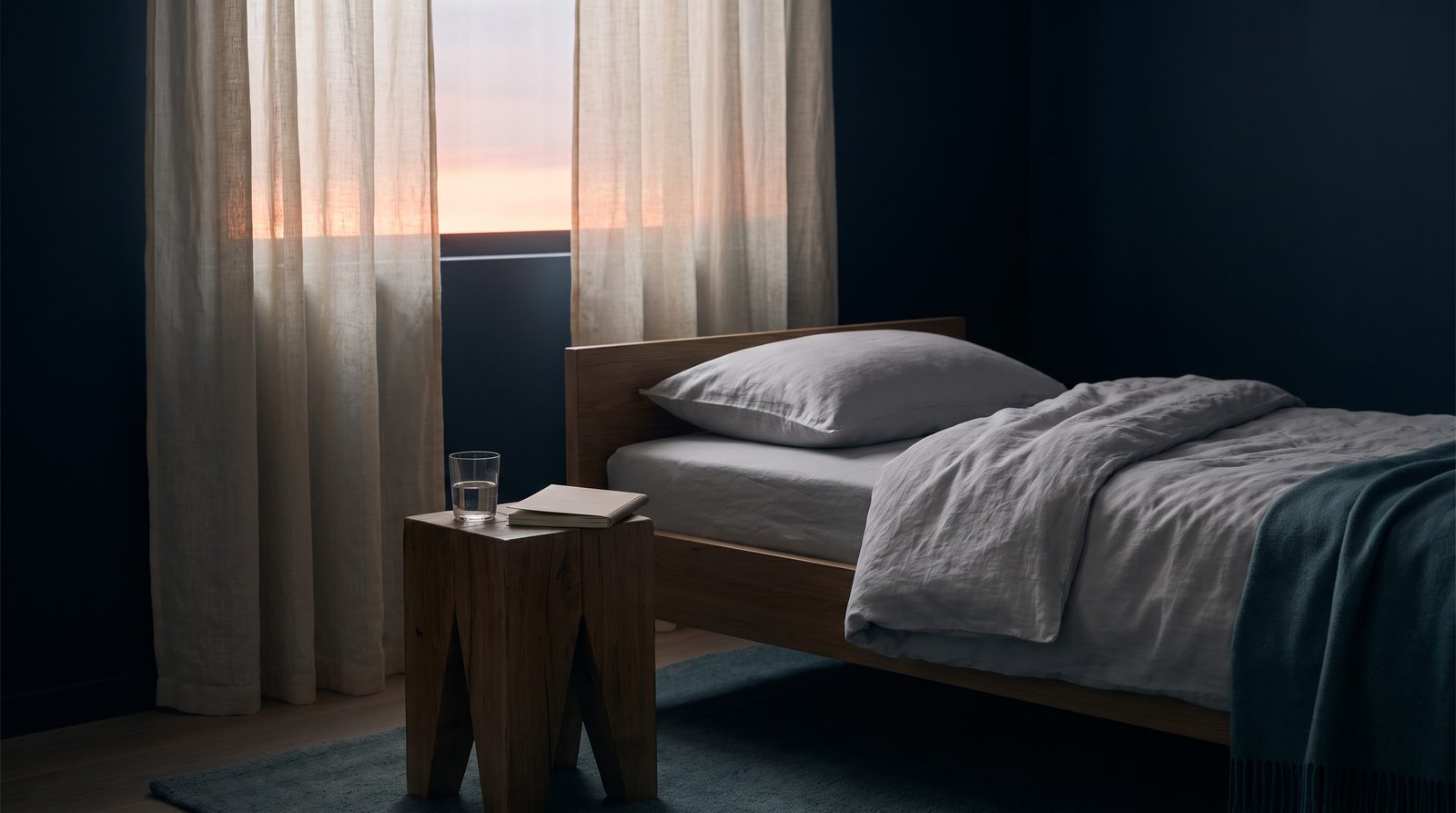
4. Make the room cold, dark and boring
Your core temperature has to fall for sleep to start, which is why a warm room fights you. The commonly cited target is around 18°C (65°F), with most adults doing well somewhere between 15.5°C and 19.5°C. Older adults often need the warmer end.
A warm shower or bath an hour or two before bed helps for the same reason it sounds like it should not: blood moves to the skin, sheds heat, and your core temperature drops faster afterwards.
- Dark. Blackout curtains or a cheap eye mask. Cover standby LEDs. Most people underestimate how much light their room has.
- Quiet, or consistently noisy. Steady sound beats intermittent sound. A fan or a white-noise track masks the car door at 1am better than silence does.
- Boring. No work, no scrolling, no television in bed. If your brain has learned that bed is where you worry, that association is treatable — see the wind-down below.
5. Alcohol: the sleep you get is not the sleep you need
A drink shortens the time it takes to fall asleep, which is why so many people swear by it. Then it fragments the second half of the night as it clears, suppresses REM early on, relaxes the airway — worse snoring and apnoea — and sends you to the bathroom.
You do not have to quit to test this. Move the last drink three hours earlier, or take four consecutive dry nights, and compare the “times you woke” column against your baseline week.
6. An hour that ends the day, every day
A wind-down is not a luxury, it is a signal. The point is repetition: the same short sequence, in the same order, so the routine itself becomes the cue. It does not need candles.
And the rule that does the heavy lifting: if you are awake and frustrated for what feels like twenty minutes, get up. Leave the room, keep the lights low, do something dull, go back when you are sleepy. Lying there teaches your brain that bed is where you lie awake. This is the part of insomnia treatment people skip because it is the least comfortable, and it is the part that works.
7. If you wake up sore, the fix is mechanical
Sleep advice usually ignores pain, which is strange, because pain is one of the most common reasons people wake up. If your diary shows you waking with neck, shoulder or back pain on most mornings, no amount of wind-down routine will fix it. The problem is what your body is lying on.
Pillow height is the variable most people get wrong. The gap between your neck and the mattress is bigger for side sleepers, broader shoulders and firmer mattresses, and the pillow has to fill exactly that gap — no more. Our pillow height calculator works it out from your position, build and mattress, and the neck-pain guide covers what to do about it.
Two practical notes from testing pillows for this site. A new pillow usually feels wrong for the first week, so judge it at two weeks, not two nights. And a memory-foam contour that suits a side sleeper often feels far too tall on your back. The Derila contour pillow is one I have used myself, and the review is honest about who it does not suit.
Start with the number, not the product
Work out the loft you need first — it takes about thirty seconds and costs nothing. If it turns out you need a mid-height contour, the Derila review covers what it is like to actually sleep on.
8. Supplements, honestly
This is where most sleep content stops being useful, because it is where the money is. So, plainly:
| What | What it is actually for | Honest read |
|---|---|---|
| Melatonin | Shifting the timing of your clock — jet lag, shift work, delayed sleep phase | A timing signal, not a sedative. Small doses (0.5–1 mg) a few hours before target bedtime beat the 10 mg gummies. Not a treatment for long-term insomnia. |
| Magnesium | Correcting a deficiency | Weak evidence for sleep in people who are not deficient. Cheap, low risk, often disappointing. |
| Valerian, chamomile, l-theanine | Mild calming | Small or inconsistent effects. Harmless for most people. Fine as part of a routine, not a fix. |
| 5-HTP | Serotonin precursor, used in some sleep blends | Genuine interactions. Do not combine with SSRIs, SNRIs, MAOIs, triptans, tramadol or St John’s Wort, because of serotonin syndrome risk. Ask a doctor first if you are pregnant or breastfeeding. |
If you have the basics in place and still lie there with a busy head at 1am, a sleep supplement is a reasonable thing to try — as long as you keep the diary running so you can tell whether it did anything. YU Sleep is the one I use myself, a sublingual liquid with a low dose of melatonin, and my review sets out the cost, the guarantee and the ingredient list, including the 5-HTP caveat above. If you take any of the medicines in that table, skip it and talk to a pharmacist instead.
What I use, once the basics are in place
YU Sleep, a sublingual liquid with a low dose of melatonin and a 60-day money-back guarantee. Not for anyone on the medicines listed above, and not a substitute for a fixed wake time and an earlier coffee.
See today’s price → Read the full review first →
Affiliate link — we earn a commission if you buy, at no extra cost to you.
9. When it has gone on for months, stop optimising
Chronic insomnia disorder, as the American Academy of Sleep Medicine defines it, means sleep trouble and daytime consequences at least three times a week for at least three months. At that point you are not looking for a better bedtime routine. You are looking for treatment.
The first-line treatment is cognitive behavioural therapy for insomnia (CBT-I), not medication. Sleeping pills are recommended mainly for people who cannot access CBT-I, for leftover symptoms after a proper attempt at it, or as a short-term addition. CBT-I is available as a course, through some GPs, and through structured apps.
Also worth ruling out before you blame your habits: sleep apnoea (snoring, gasping, waking unrefreshed, daytime sleepiness), restless legs, thyroid problems, and the side effects of medication you already take. Walk into that appointment with seven nights of diary printouts rather than “I think I sleep badly” — it is a much shorter conversation.
The whole thing, in order
- Measure a week. One change at a time after that.
- Same wake time daily, weekends included.
- Daylight within an hour of waking. Lights down in the evening.
- Last caffeine eight hours before bed.
- Room around 18°C, dark, steadily quiet.
- Alcohol earlier, or not at all on test nights.
- The same four wind-down steps nightly. Out of bed if you are awake and frustrated.
- Fix the pillow if you wake up in pain.
- Supplements last, and only with the diary running.
- Three months of bad nights means CBT-I, not another gadget.
None of it is exciting. That is rather the point: the boring things are the ones with the evidence behind them, and they are free.
Sources
- Drake C, Roehrs T, Shambroom J, Roth T. Caffeine effects on sleep taken 0, 3, or 6 hours before going to bed. Journal of Clinical Sleep Medicine, 2013.
- American Academy of Sleep Medicine. Clinical practice guideline on treatment for chronic insomnia disorder in adults.
- Cleveland Clinic. What is the ideal sleeping temperature for my bedroom?
- Didikoglu A, et al. Associations between light exposure and sleep timing and sleepiness while awake. PNAS, 2023.