
Best Pillow for Cervical Radiculopathy (2026): What Actually Helps at Night
Quick answer: cervical radiculopathy is a compressed or inflamed nerve root in the neck, and the symptom that matters is the one that travels — pain, pins and needles or weakness down one arm. At night you are trying to do two things at once: keep the neck neutral so the exit hole for the nerve stays as open as possible, and stop the arm being held in a position that drags on the nerve. That means a contoured pillow at roughly 7–10 cm on your back or 10–14 cm on your side, plus a second pillow under the affected arm. Our pick is the Derila Ergo: 9 cm centre, 12 cm edges, medium-firm foam that still holds its height at 5am. The good news is that this usually settles: over 85% of cases improve within 8 to 12 weeks, and about 90% do well without surgery. Weakness that is getting worse, clumsy hands or changes to walking or bladder control are a different matter and need a doctor now, not a new pillow.
Our pick for cervical radiculopathy: Derila Ergo
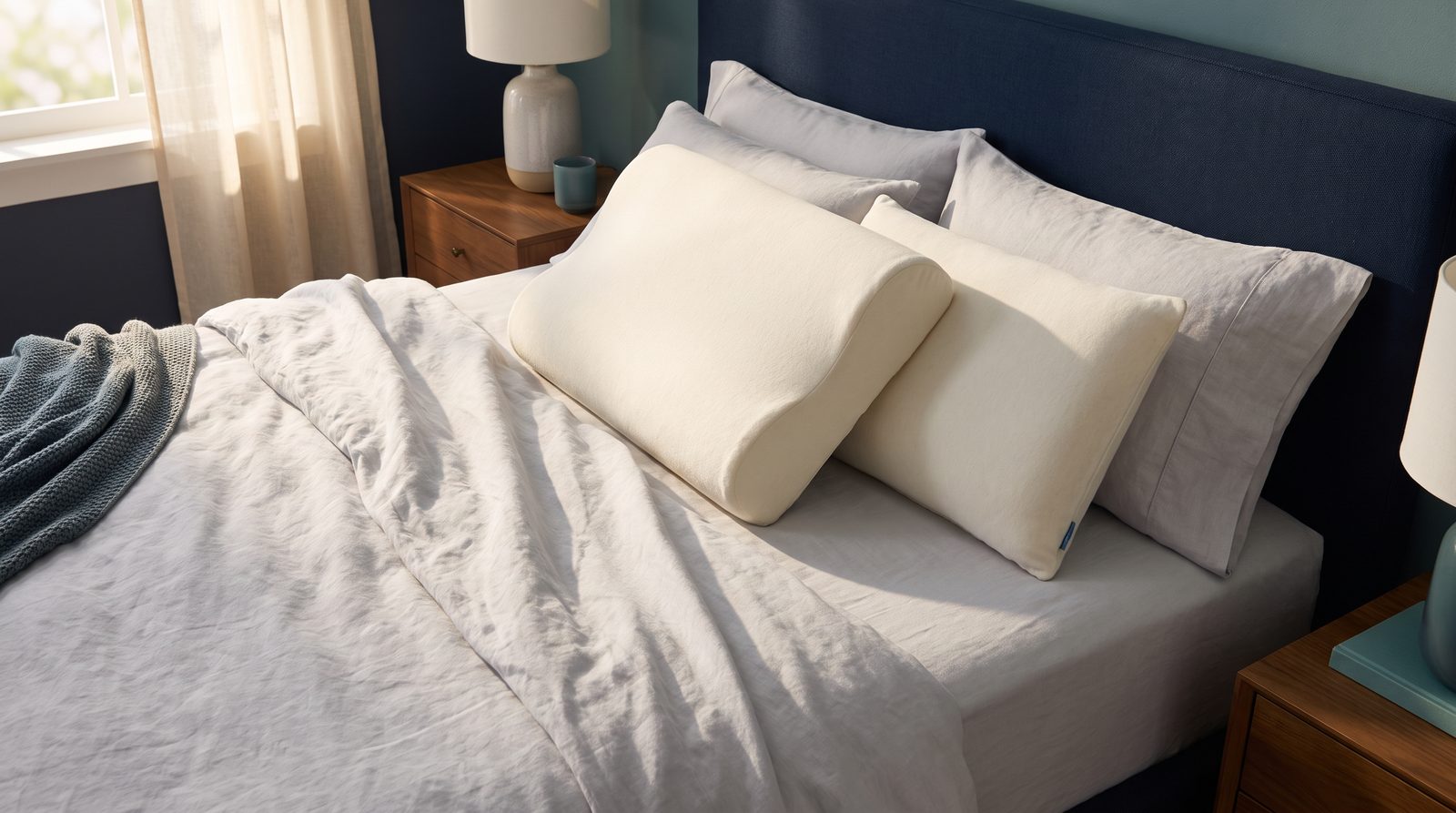
A 9 cm centre and 12 cm edges keep the neck neutral instead of side-bent or extended, which is the position that narrows the nerve’s exit. $59.99, 60-day money-back guarantee.
See today’s price →Read the full review first · Not for stomach sleepers
If the pain runs from your neck into a shoulder blade and down one arm, and certain positions set your fingers buzzing, you are dealing with a nerve root rather than a sore muscle. The pillow question is different from ordinary neck pain, because it is not only about the neck. Where your arm spends the night matters just as much.
How do you sleep? Find your pillow height.
Pick the position you spend most of the night in. Figures come from our pillow height calculator, for an average build on a medium mattress. Your condition can change which position is best; the guide below covers that.
You need 4.5–5.5 in of loft
That is 11.4–14 cm. On your side the pillow has to fill the gap between your ear and the mattress, so your shoulder width sets most of it.
- Broad shoulders or a firm mattress: go higher, up to 5.75–6.75 in
- Narrow frame or a soft mattress: go lower, down to 3–4 in
Derila fit: its 12 cm (4.7 in) wings sit inside this range. With broad shoulders on a soft mattress, check the calculator first.
You need 3.25–4.25 in of loft
That is 8.3–10.8 cm. Back sleeping needs less height than side sleeping, because the gap between your head and the mattress is much smaller.
- Broad build or a firm mattress: go higher, up to 4–5 in
- Narrow frame or a soft mattress: go lower, down to 2.25–3.25 in
Derila fit: its 9 cm (3.5 in) centre sits inside this range.
You need 3.75–4.75 in of loft
That is 9.5–12.1 cm. One height cannot serve both positions perfectly, so a single-height pillow is always a compromise between the two.
- Set the height for the position you spend most of the night in
- Broad build or a firm mattress: go higher, up to 4.75–5.75 in
Derila fit: its two zones cover both: the 9 cm centre when you are on your back, the 12 cm wings when you turn onto your side.
1–2 in of loft, or none at all
That is 2.5–5.1 cm. No pillow height makes stomach sleeping good for your neck, because it holds your head turned to one side all night.
- Use the flattest pillow you have, or none
- If you can, work towards side sleeping; the calculator shows the height you would need
Derila fit: not for stomach sleepers. Even its 9 cm centre is too high for this position.
Sleep in a recliner? The rules are different: see the recliner guide.
What Cervical Radiculopathy Actually Is
Each nerve root leaves the spine through a small opening between two vertebrae. Cervical radiculopathy is what happens when that root is compressed or inflamed at the exit: by a herniated disc, or by the bone spurs and lost disc height that come with age. The Cleveland Clinic splits it roughly by age: under 50 it is usually a disc, in the 50s and 60s degenerative disc disease, and past 70 it is narrowing from arthritis.
Two features separate it from a stiff neck. It is one-sided — your right arm, not both. And it travels, following the territory of whichever root is squeezed, which is why the fingers that tingle tell you something useful.
If your little and ring fingers are the ones going numb overnight, read why your little and ring fingers go numb at night before you blame your neck. A bent elbow under a pillow for hours does this to plenty of people with perfectly healthy necks.
Why Nights Are Often the Worst Part
People with radiculopathy usually describe the same pattern: tolerable by day, awful between 2am and 5am. Three things are going on.
- The neck holds one position for hours. Awake, you move constantly and never load the same root for long. Asleep, whatever the pillow dictates is what you get all night. Side-bending the neck toward the painful side narrows the exit holes on that side; tipping the head back does the same thing at several levels at once.
- The arm gets parked in bad positions. Tucked under the pillow, hanging off the edge, or folded tight across the chest. Each one adds tension somewhere along the nerve’s route.
- Inflammation is not being flushed away. Lying still for hours, with no muscle pump and no position changes, is when a swollen root feels most cramped.
The Loft Numbers
The targets are the same as for other neck conditions, but the penalty for getting them wrong is sharper here, because a few millimetres of side-bend is the difference between an open exit hole and a squeezed one.
| Position | Target loft under load | Radiculopathy adjustment |
|---|---|---|
| Back | 7–10 cm (3–4 in) | Usually the best position. Nothing is rotated or side-bent, and both sides are loaded equally. Support the arm on a slim pillow so the shoulder is not dragged backwards. |
| Side | 10–14 cm (4–5.5 in) | Lie on the unaffected side if you can, and fill the shoulder gap exactly. Too low tips the head down toward the mattress and closes the openings on the underneath side. |
| Stomach | Not recommended | Hours of rotation plus extension, which is the exact combination that narrows the nerve’s exit. It is also the position most likely to leave an arm dead by morning. |
Measure with your head on the pillow, not the box height: memory foam loses a couple of centimetres under a head. The pillow height calculator gives a number for your own build and mattress in about thirty seconds, and this guide explains how to tell within a week if you have it wrong.
The Arm Is Half the Problem
This is the part that other pillow guides miss. There is a well-known clinical test called the shoulder abduction relief sign: when someone with cervical radiculopathy raises the affected arm and rests the hand on top of their head, the arm symptoms often ease, because that position takes tension off the nerve root. Many people discover it by accident and end up sleeping with a hand on their head.
It tells you something useful, but do not simply copy it all night. An arm held fully overhead for hours squashes structures at the shoulder and can leave you with a new problem on top of the old one. The practical version is to support the arm partway:
- On your back: a slim pillow or folded towel under the forearm on the affected side, raising it a few centimetres so the shoulder is not pulled back and down into the mattress.
- On your side, lying on the good side: hug a second pillow so the top arm rests level rather than dropping forward across your body and rolling the shoulder in.
- Either way: keep the elbow relatively straight. A tightly bent elbow all night compresses the ulnar nerve, which produces its own numbness in the ring and little fingers and muddles the picture completely.
What to Look for in a Pillow
- A shape that holds the neck neutral, with a defined neck roll and a lower well for the skull, so the head is neither tipped back nor pushed forward.
- A height that lasts until morning. A pillow that is right at bedtime and flat by 2am delivers hours of extension exactly when symptoms peak. This is why feather, down and cheap polyester struggle here.
- Two usable heights — a lower centre for your back and higher edges for your side — so turning over does not mean folding or stacking anything.
- Medium-firm foam. Soft enough to settle into, firm enough that your neck muscles are not working to hold position.
- A second, slim pillow for the arm. Cheap, and for many people it does more than the main pillow.
Our Pick: The Derila Ergo
For the neck half of the job, the Derila Ergo is the pillow we recommend, and it is one I have used myself. The contour holds a 9 cm centre and 12 cm edges, which lands in the middle of both target ranges, and the medium-firm memory foam is still at those heights in the small hours. At the time of writing it is $59.99 for one or $99.98 for two, with a 60-day money-back guarantee. That window matters here, because a new pillow reliably feels wrong for the first week or so, and radiculopathy is not a condition you want to judge on two nights.
Not for you if:
- You sleep on your stomach and are not willing to change. The contour makes that position worse.
- Your calculator number is well outside 9–12 cm. The Derila comes in one height; an adjustable pillow suits outliers better.
- Your symptoms are worsening rather than settling. A pillow is comfort management, not treatment.
- You have had recent neck surgery and have not cleared pillow choice with your surgeon. See sleeping after cervical fusion instead, or after a cervical disc replacement if yours preserved the motion at that level.
Our pick for cervical radiculopathy: Derila Ergo
9 cm centre, 12 cm edges, medium-firm foam that keeps its height overnight. Pair it with a slim pillow under the affected arm. $59.99, 60-day money-back guarantee.
See today’s price →Read the full review first · Not for stomach sleepers
What the Pillow Cannot Do
A pillow stops the night making things worse. It does not decompress a nerve root. The reassuring part is that most of these settle on their own: the Cleveland Clinic reports that more than 85% of cases resolve within eight to twelve weeks, and around 90% do well without surgery. Physiotherapy, time, and sometimes a short course of medication do the work; the pillow keeps you from undoing it for eight hours a night.
Daytime matters too. Long stretches with the neck pushed forward at a screen, phone held in your lap, or hours of driving all narrow the same openings. If the pain is keeping you from sleeping at all, our guide to breaking the pain-insomnia cycle covers what to do with the hours you are awake.
When to Stop Experimenting and See Someone
Arm pain that is gradually improving is the normal course. These are not, and they need a clinician promptly rather than another pillow:
- Weakness that is getting worse — a grip that keeps failing, difficulty lifting the arm, dropping things
- Clumsy hands, trouble with buttons or handwriting, or a change in how you walk or balance. With neck symptoms, this suggests the spinal cord rather than a single root, and it is urgent
- Any change in bladder or bowel control — emergency
- Symptoms in both arms at once, rather than one side
- Neck pain after a fall, a car accident or a blow to the head
- Fever, unexplained weight loss, or a history of cancer alongside new neck pain
- Pain that is no better after several weeks of sensible conservative care
If the cause is a disc: radiculopathy from a C5-C6 or C6-C7 herniation needs the same neutral neck, with a little less margin for error. See the best pillow for a C5-C6 herniated disc guide for the disc-specific loft numbers.
Frequently Asked Questions
What is the best pillow for cervical radiculopathy?
A contoured memory-foam or latex pillow that keeps the neck neutral all night, at roughly 7–10 cm for back sleeping and 10–14 cm for side sleeping, measured with your head on it. Add a slim second pillow under the affected arm. The Derila Ergo, at 9 cm centre and 12 cm edges, is our usual recommendation, though the right height depends on your shoulder width and mattress firmness.
How should I sleep with a pinched nerve in my neck?
On your back if you can, with the neck neutral and the affected arm supported slightly on a folded towel or slim pillow. If you sleep on your side, lie on the unaffected side with a pillow that fills the gap between ear and shoulder exactly, and hug a second pillow so the top arm rests level. Avoid stomach sleeping, which rotates and extends the neck for hours.
Why is my arm pain worse at night?
Because the neck holds one position for hours, the arm often ends up tucked or folded in ways that add tension to the nerve, and lying still lets inflammation sit around an already crowded nerve root. People typically report the worst symptoms between 2am and 5am.
Does sleeping with my arm above my head help?
It often does relieve symptoms in the moment — that is the shoulder abduction relief sign, and it is used clinically as a pointer toward nerve root compression. It is not a good position to hold for a whole night, because it loads the shoulder. Supporting the arm partway on a pillow gives you most of the benefit without the new problem.
How long does cervical radiculopathy take to settle?
More than 85% of cases improve within eight to twelve weeks, and roughly 90% of people do well without surgery. Worsening weakness, clumsy hands, changes in walking, or any bladder or bowel change are exceptions that need assessment straight away.
Is cervical radiculopathy the same as a pinched nerve?
Yes, “pinched nerve in the neck” is the everyday name for it. It is not the same as cervical stenosis, which is narrowing of the spinal canal itself, or cervical spondylosis, which is the age-related wear that often causes both. We have separate guides for cervical stenosis and cervical spondylosis.
Disclosure: Sleep Align is reader-supported. If you buy through a link here we may earn a commission at no extra cost to you. This is general information, not medical advice.
Related guides
More Pillow Guides
Recommended for Pain-Free Sleep
🛌 Derila Ergonomic Memory Foam Pillow
Contoured design that holds your cervical spine in neutral for the full night. Works for side and back sleepers. Backed by a 60-day money-back guarantee on the official store.
- ✓ Memory foam contour
- ✓ Side & back sleeper design
- ✓ 60-day money-back guarantee