
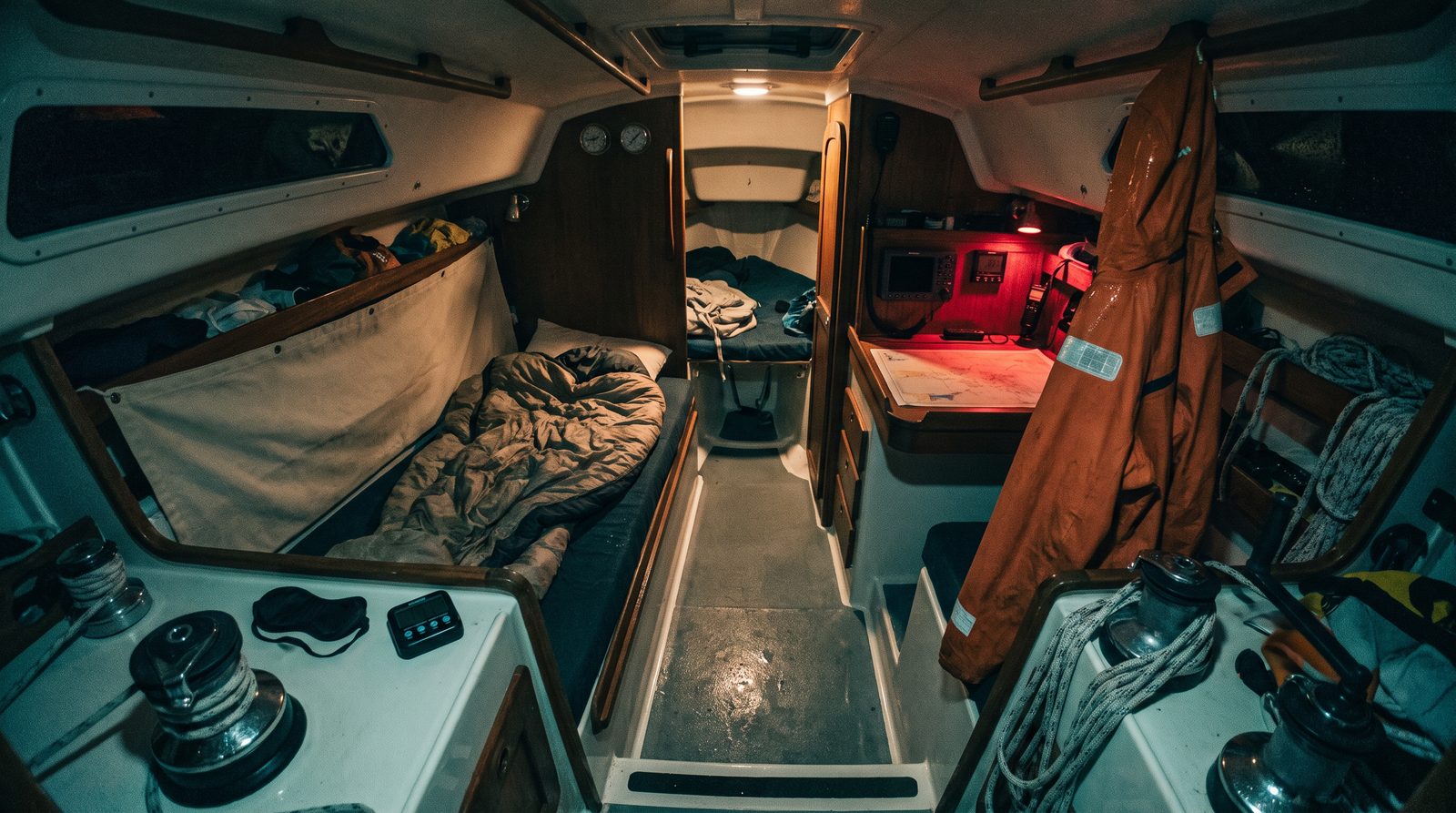
How Do Solo Sailors Sleep? Twenty-Minute Naps, Shipping Lanes and the Limits of Polyphasic Sleep
Sailing alone across an ocean creates a problem with no clean solution. Someone has to keep watch, and there is only one of you. The rules of the road at sea assume a lookout at all times; the human body assumes a consolidated night. You cannot satisfy both, so single-handed sailors have spent decades working out how to fail at it as gracefully as possible.
What makes this worth reading if you never leave dry land is that solo sailing is the one context where polyphasic sleep has been studied seriously in the field, on real people doing something dangerous, rather than in blog posts by people trying to reclaim four hours of their day. The findings are more interesting — and considerably more sobering — than the internet version.
Why the nap is about thirty minutes
The sleep schedule of a solo sailor is not chosen. It falls out of a collision calculation.
From the deck of a small yacht your horizon is somewhere around ten miles for a large ship’s superstructure. Commercial traffic moves at fifteen to twenty knots. So a vessel that was invisible when you closed your eyes — genuinely below the horizon, not merely unnoticed — can cover that distance and reach you in roughly half an hour. That single number sets the ceiling on how long a sailor dares to sleep in shipping lanes.
This is why technology has changed sleep at sea more than any sleep technique has. An AIS transponder with a proximity alarm watches for ships that are broadcasting their position; radar picks up squalls and vessels that are not, at a cost of three or four amps, which matters when your battery also has to drive the autopilot. Those alarms are what buy a sailor the difference between a twenty-minute doze and something approaching real sleep.
What solo sailors actually do
The routines vary more than you might expect, and the variation is instructive.
- Laura Dekker, who sailed round the world as a teenager, took frequent ten-minute naps with thirty-minute sleeps between horizon checks. Her longest unbroken stretch on the voyage was a single hour, in clear open water. Her reasoning is the arithmetic above: big ships do fifteen to twenty knots, visibility is about ten miles, so half an hour is the safe interval.
- Jean-Luc Van Den Heede, a veteran of multiple circumnavigations, works in ninety-minute blocks, waking to check conditions between them. He can fall asleep in three to five minutes — a skill that is partly temperament and largely practice.
- Andy Pag runs an interval timer app continuously, day and night, set to fifteen, thirty or forty-five minutes depending on where he is.
Two details from those routines transfer straight to land, and they are the least glamorous parts. The first is multiple alarms you have to physically get out of bed to silence — Dekker’s precaution against the thing that actually kills solo sailors, which is not fatigue but oversleeping through one alarm. The second is that Pag rigged a clear, clutter-free mattress in the cockpit and used an eye mask, and found both his sleep duration and its depth improved. A dedicated place to sleep and control over light, on a boat, in the wet.
Dekker’s summary of the whole business is the most honest line in any of the literature: she sleeps when she can, no matter what time of day it is.
What the research found
The foundational work is Claudio Stampi’s field study of 99 sailors in solo and double-handed ocean races, published in Work & Stress in 1989. Two findings stand out. Most sailors arrived at multi-nap schedules spontaneously, without being taught, and adapted to them without major difficulty — two-thirds settled on mean sleep episodes of between twenty minutes and two hours. And under those conditions of prolonged, unavoidable sustained demand, splitting restricted sleep into several naps protected performance better than taking the same restricted total in one block.
That work had real consequences. Stampi advised competitive single-handers directly, and Ellen MacArthur followed his napping guidance through her Transat win in 2000 and her solo circumnavigation record.
Three decades later, a team at the University of Bologna went at the question from the other end. They surveyed 42 skippers before the Mini Transat La Boulangère, a 4,050-mile solo transatlantic crossing, and asked what they had done to prepare. The results are worth sitting with.
| Pre-race strategy | Share of those who had one | What it means |
|---|---|---|
| Sleep extension | 52% | Banking extra sleep in the weeks before the start |
| Polyphasic training | 26% | Practising the nap schedule in advance |
| Gradual sleep deprivation | 22% | Progressively shortening sleep to “toughen up” |
Then two findings that complicate the picture.
First, not one of the 42 was an evening type. Forty per cent were morning types and sixty per cent intermediate, against a general population where evening types are common. Either larks are drawn to this, or owls do not last. The researchers also noted the curious pattern that the skippers bothering with a sleep strategy were mostly the intermediate types, while the morning types tended not to plan at all — presumably because their body clock was already doing them a favour.
Second, and more bracing: neither having a pre-race strategy nor which strategy you chose made a significant difference to final arrival times. The preparation that half of them believed in did not show up in the results.
Read the two studies together and a coherent picture emerges. How you handle sleep at sea — splitting it into naps — measurably protects performance. What you do beforehand to prepare for it appears to matter far less than the people doing it assume. That is a pattern worth recognising, because it repeats everywhere: the tactic during the hard period does the work, and the elaborate preparation ritual is mostly reassurance.
The part the polyphasic sleep community leaves out
Stampi’s sailor research is the most-cited evidence behind every “hack your sleep into six twenty-minute naps” scheme on the internet. So it is worth being plain about what it does and does not show.
It shows that if your sleep is already going to be restricted and you cannot change that, splitting it into naps is the better of two bad options. It does not show that naps create sleep out of nothing, and Stampi himself does not advocate ultrashort napping as a lifestyle.
A 2026 review of the polyphasic evidence puts numbers to the cost. Polyphasic sleepers show lower sleep efficiency and a higher proportion of light sleep than people taking the same short total in one block, because every extra sleep opportunity multiplies the transition cost of falling asleep and eats into deep sleep. Both groups — polyphasic and monophasic — were worse off than normal sleepers on sleepiness, vigilance and mood, and the polyphasic group’s vigilance impairment was slightly the worse of the two. On the radical schedules, the review is blunter still: slow-wave sleep is what immune regulation and the brain’s overnight clearance depend on, and one case study of a strict six-nap schedule found the subject had almost entirely stopped releasing growth hormone.
So: a legitimate tactic for someone alone in the Atlantic with a legal duty to keep watch. Not a productivity technique.
What actually transfers to land
- Bank sleep before you need it. The most popular strategy among experienced skippers was also the least exotic one, and unlike the others it has decent support: going into a hard stretch well rested helps. Going in deliberately underslept to “adapt” does not.
- Naps are damage control, not currency. Use them when the night is going to be short regardless — an on-call shift, a newborn, a long drive. Do not use them to buy back hours you would otherwise have slept.
- Make the alarm require standing up. The oldest trick on this list and still the most effective, for exactly the reason Dekker gives.
- Give naps a dedicated place and darkness. An eye mask and a clear, consistent spot measurably improved sleep for a man on a boat in the rain. Your spare room has fewer excuses.
- Know your chronotype and stop fighting it where you can. The larks in that fleet needed no strategy. If you are an owl on an early roster, the answer is light timing, not willpower.
If your own nights are broken by a schedule, not an ocean
Rotating shifts, on-call rotas and early starts are the same problem at a smaller scale: sleep taken when it is available rather than when the body wants it. The shift-work guide covers the practical protocols, and a week with the sleep diary will tell you whether your schedule or something else is doing the damage.
The shift worker’s guide → · Free sleep diary → · How submariners sleep → · Sleeping through the polar night → · How firefighters sleep on shift →
Common questions
How long do solo sailors sleep at a time?
Usually between ten and forty minutes near shipping lanes, extending to around ninety minutes in empty water with AIS and radar alarms running. In Stampi’s study of 99 ocean racers, two-thirds averaged sleep episodes of twenty minutes to two hours.
Who steers the boat while they sleep?
An autopilot or wind vane self-steering gear. The autopilot’s reliability depends on battery charge, which is one reason power management and sleep management are the same problem on a small boat.
Does polyphasic sleep actually work?
It works as a way of distributing sleep that is already going to be restricted, which is why it protects performance in ocean racing. It does not reduce the amount of sleep you need. Reviewed against normal sleep, polyphasic schedules show lower sleep efficiency, more light sleep and impaired vigilance, and the most extreme versions carry real physiological costs.
Are solo sailors mostly early risers?
In the 42 skippers surveyed before the Mini Transat, 40% were morning types and 60% intermediate types. None were evening types, which is a striking departure from the general population.
Sources
- Filardi M, Morini S, Plazzi G. Pre-race sleep management strategy and chronotype of offshore solo sailors. Nature and Science of Sleep, 2020.
- Stampi C. Polyphasic sleep strategies improve prolonged sustained performance: a field study on 99 sailors. Work & Stress, 1989.
- Cheating hypnos: can polyphasic sleep schedules reduce the need for sleep? Review, 2026.
- How do solo sailors sleep at sea? Experts share their tips and advice. Yachting Monthly.