
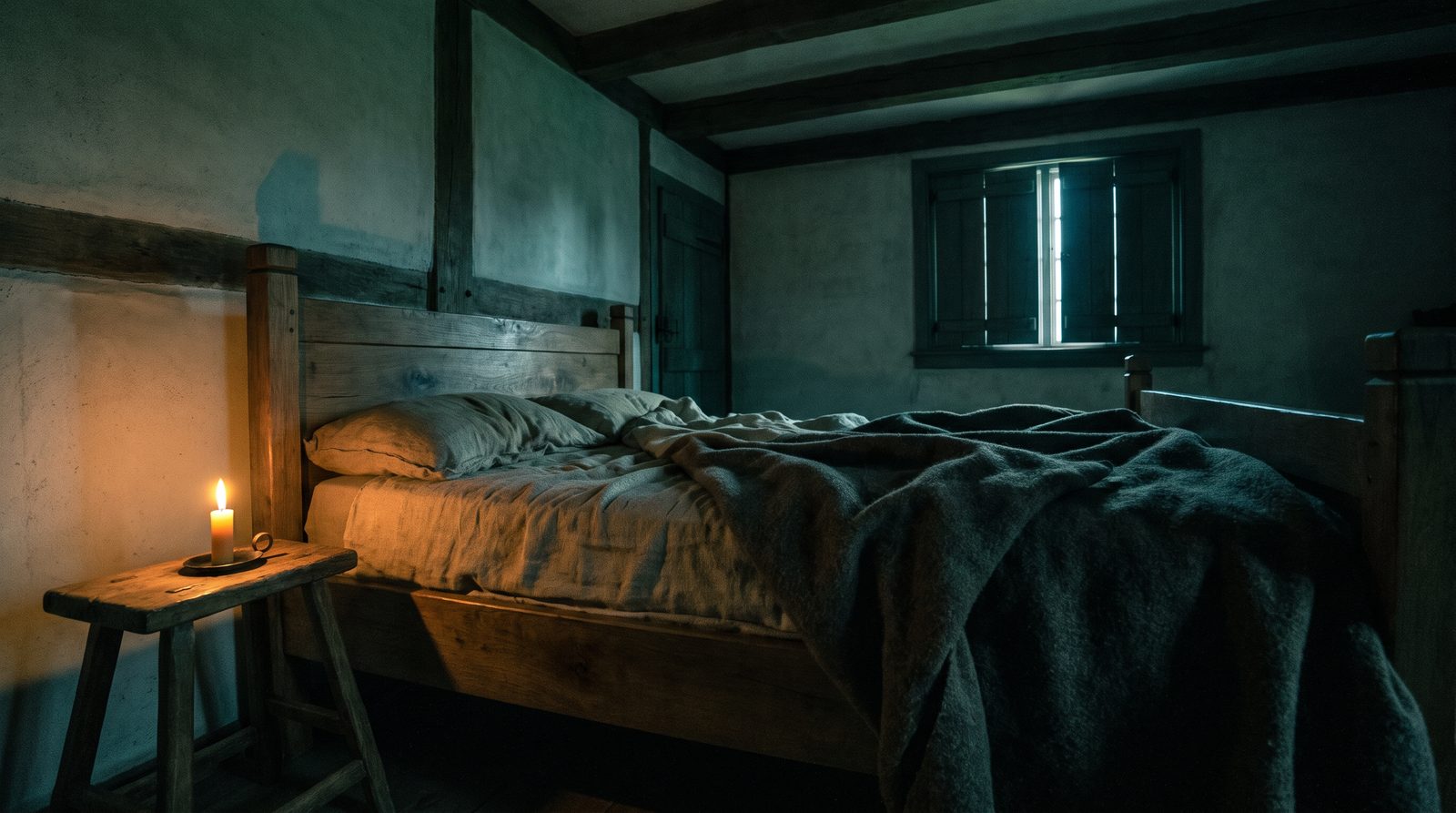
Did People Really Sleep in Two Shifts Before Electricity? The Honest Answer
Few claims about sleep have travelled as far or as fast as this one. Before artificial light, the story goes, people went to bed around nine, slept for three or four hours, woke around midnight for an hour of prayer, sex, chores or conversation, then went back down for a second sleep until dawn. Electricity destroyed it, and our unbroken eight hours is a recent industrial invention we mistake for nature.
It is a wonderful story. It is also usually presented as settled, which it is not. Here is what each strand of evidence actually shows.
Where the claim comes from
The historian Roger Ekirch assembled the case, drawing on hundreds of scattered references in letters, diaries, court records, medical texts and literature across Europe and beyond. The pattern he described is specific: households retiring between nine and ten, a first sleep of roughly three to three and a half hours, waking after midnight for an hour or so, then a second sleep until morning. The waking interval was not treated as a problem. People used it.
The strength of the argument is the sheer volume of references and their casualness — writers mention “first sleep” the way we might mention teatime, without explaining it.
The experiment that seemed to confirm it
In 1992 Thomas Wehr published a study that is cited in virtually every article on this subject. He moved healthy volunteers from a conventional 16-hour photoperiod to a 10-hour one — meaning 14 hours of darkness every night, roughly what a northern winter would impose without artificial light.
Their sleep expanded and then split. It divided into two bouts of several hours each, separated by an interval of one to three hours of quiet wakefulness, totalling around nine hours. The first bout was deeper; the second was lighter with more REM. The duration of nocturnal melatonin secretion expanded too, which matters — it means the internal timing system had genuinely reorganised, not merely that people were bored in the dark.
That is a real and striking result. Note carefully what it demonstrates, though: that human sleep can become biphasic given a very long dark period. It does not demonstrate that any particular historical population lived that way.
The historical challenge
In 2023, writing in Medical History, Niall Boyce re-examined the source material for early modern England and reached a markedly different conclusion. He does not claim segmented sleep never happened. He argues it was not the widespread, routine practice the popular account describes, and that the evidence admits other readings. Specifically:
- “First sleep” was ambiguous. The phrase could mean the deepest phase of a continuous night’s sleep, or the first time you woke, or simply the early part of the night — not necessarily one of two scheduled sleeps.
- Many sources describe unusual circumstances. Illness, night-watch duty, imprisonment, servants on call. These are not descriptions of how an ordinary household slept on an ordinary night.
- The anthropological parallel is shaky. Terminology in other cultures that translates as “first” and “second” sleep may simply mark early and late night.
- The laboratory support is conditional. Wehr’s participants were in windowless darkened rooms for 14 hours, which is not the lighting environment of an early modern bedroom with a fire, a candle and shutters.
His summary line is a good one for anyone assessing evidence: ambiguous sources are not made any less ambiguous by collecting more of them.
What happens when you actually measure people without electric light
This is the part that almost never makes it into articles on the subject, and it is the most direct evidence available.
In 2015 a team led by Jerome Siegel published measurements of sleep in three pre-industrial societies with no electric lighting: the Hadza of Tanzania, the San of Namibia and the Tsimane of Bolivia. Not diaries, not literary references — actual recorded sleep.
| What they found | Figure |
|---|---|
| Actual sleep per night | 5.7 to 7.1 hours |
| Time between sleep onset and waking | 6.9 to 8.5 hours |
| Sleep onset after sunset | About 3.3 hours after |
| Seasonal difference | Roughly 1 hour more in winter than summer |
| Napping | Rare — under 7% of winter days, under 22% in summer |
| Segmented night sleep | Not observed |
They did not go to bed at sunset. They did not sleep nine hours. They did not split the night in two. And they slept slightly less than the average in industrialised countries — which is why Siegel’s summary of the wider claim was blunt: the idea that modern life has cut our sleep below what our ancestors got is, on this data, a myth.
So what is the honest position?
Reconciling these takes less effort than it might seem, and the reconciliation is more interesting than either extreme.
- Sleep splits when the dark period is long. Wehr demonstrated this convincingly. Fourteen hours of darkness is more night than most people can sleep through, and the surplus shows up as a wakeful gap.
- That is a high-latitude winter phenomenon, not a universal human default. The Hadza, San and Tsimane live nearer the equator, where nights are never that long. They have no surplus darkness to fill, and they sleep in one piece.
- Early modern northern Europe had very long winter nights. So segmented sleep there is entirely plausible in winter — which is different from claiming it was the year-round human norm that electricity abolished.
- The historical record is thinner than its popularity implies. Boyce’s objections are serious and have not been dismissed.
What we can say with confidence is narrower and more useful than the meme: how you sleep is shaped by how long your night is, and that has always varied by latitude and season.
If you wake in the middle of the night
This is where the story does real damage, because it gets deployed as reassurance: you are not an insomniac, you are an ancestral biphasic sleeper. That is comforting and it might be wrong.
Two things are worth separating.
- Brief waking is genuinely normal. Everyone surfaces several times a night; most people do not remember it. Waking, registering the time, and going back down within a few minutes is not a disorder.
- Lying awake for an hour, distressed, is a different thing. That has causes worth identifying — cortisol timing, pain, temperature, alcohol, a bladder, an anxious mind — and calling it “second sleep” does not address any of them.
There is one genuinely actionable point buried in all this. If your bedroom is dark for far longer than you can sleep, you have engineered Wehr’s experiment for yourself. Spending ten hours in bed to get seven hours of sleep reliably produces a wakeful gap, and the standard fix is to shorten time in bed rather than extend it — which is exactly what sleep restriction therapy does.
Find out which one yours is
A week of diary data answers this quickly, because it gives you sleep efficiency — time asleep divided by time in bed. If that number is low, the problem is very often too many hours in bed rather than too few. The 3am guide covers the specific causes worth ruling out.
Free sleep diary → · Why you wake at 3am → · How to sleep better, in order →
This is part of a series on how people sleep where the clock does not help — alongside submariners, solo sailors, Antarctic winterers and firefighters.
Common questions
Did people really have a first sleep and a second sleep?
The historian Roger Ekirch documented many references to the practice in early modern Europe, but a 2023 reassessment in Medical History argues the sources are ambiguous and that segmented sleep was not the routine, widespread pattern usually claimed. It likely happened, at least in long winter nights, but “this is how everyone slept” overstates the evidence.
Is biphasic sleep natural?
It is a natural response to a long night. Given 14 hours of darkness, healthy people’s sleep split into two bouts with one to three hours of wakefulness between them. Given ordinary night lengths, the three pre-industrial societies ever measured without electric light slept in a single block.
How much did people sleep before electricity?
In the Hadza, San and Tsimane, between 5.7 and 7.1 hours a night, with sleep beginning about 3.3 hours after sunset and about an hour more in winter. That is at the low end of what industrialised populations report, not above it.
Does waking at 3am mean I am sleeping the ancestral way?
Not necessarily, and treating it that way can delay a fix. Brief waking is normal. Lying awake for an hour and finding it distressing has identifiable causes, and if you spend far more time in bed than you can sleep, a wakeful gap is the predictable result.
Sources
- Wehr TA. In short photoperiods, human sleep is biphasic. Journal of Sleep Research, 1992.
- Yetish G, Kaplan H, Gurven M, et al. Natural sleep and its seasonal variations in three pre-industrial societies. Current Biology, 2015.
- Boyce N. Have we lost sleep? A reconsideration of segmented sleep in early modern England. Medical History, 2023.
- Ekirch AR. At Day’s Close: Night in Times Past — the origin of the segmented sleep thesis.
- University of California, Los Angeles. Our ancestors probably didn’t get 8 hours a night either.