
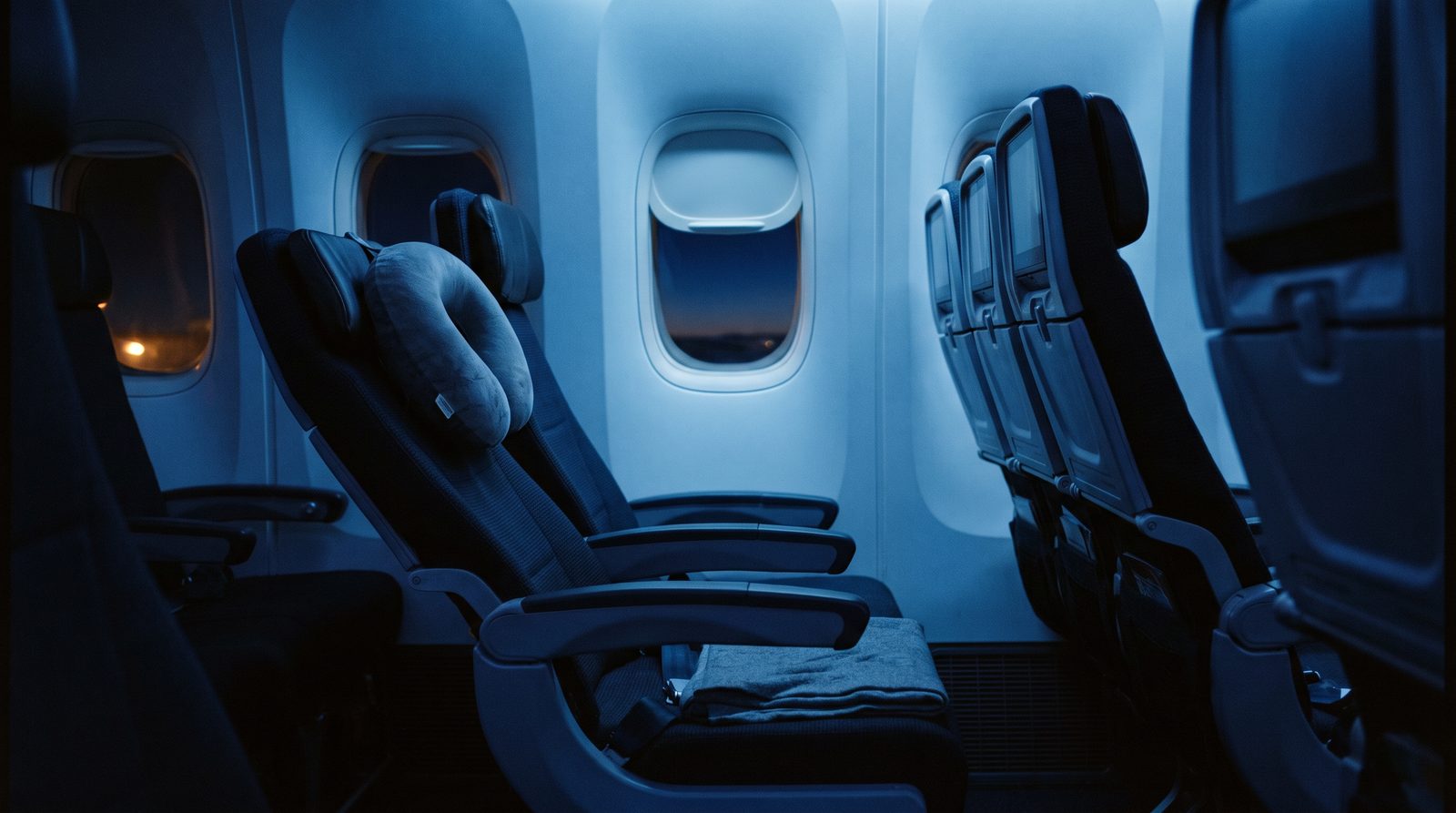
How to Sleep on a Plane: The Seat, the Timing and the Pillow Worn Backwards
The short version: an economy seat reclines about ten to fifteen degrees, which leaves you near 105 degrees — the worst angle there is for sleeping, because your head still needs muscular effort to stay upright and drops sideways the moment you fall asleep. Three things fix most of it. Book a window seat, so you have a second surface to lean on. Wear your horseshoe pillow the other way round, with the opening at the front, so it holds your jaw instead of cushioning the part of your head the seat already supports. And decide whether you should be sleeping at all, which depends on which direction you are flying, not on how tired you feel.
Most advice about sleeping on planes is about comfort. Comfort is the smaller half of it. The larger half is timing, because a long flight is not just an uncomfortable night — it is the moment your body clock gets dragged across several time zones, and what you do in those hours decides how the next three days go.
First, Should You Be Sleeping At All?
This is the question almost nobody asks before boarding, and it is the one with the biggest payoff.
The rule underneath both panels is the same: change your watch to destination time at the gate and behave as though you are already there. Eastward flights are the harder direction for most people, because you are asking your body clock to move earlier, and it resists that more than it resists staying up late.
The Seat Decides More Than the Gadgets
- Window, always, if sleeping is the plan. You get a wall to lean against, which is a second surface for your head, and nobody climbs over you at three in the morning. An aisle seat is better only if you expect to be up and down.
- Avoid the last row. It often will not recline at all, and it is next to the galley and toilets, which means light, noise and traffic all night.
- Check the exit row before you pay for it. Extra legroom, but many exit-row seats also do not recline, and the door area can be noticeably colder.
- Bulkhead is a trade. More legroom, no seat in front to recline into you, but no under-seat storage and it is where bassinets go.
- Just in front of an exit row is often the worst seat on the aircraft — a full-recline seat behind you and sometimes limited recline of your own.
Once on board, recline as soon as the seatbelt sign goes off after climb, rather than after the meal. The seats behind fill up with reclined passengers quickly, and going last means going into a smaller space.
Wear the Pillow the Other Way Round
This is the single most common mistake, and it is easy to fix.
Most people put a horseshoe pillow on with the gap at the front, so the thick part sits behind the neck. But the back of your head is the one part the seat already supports. What the seat cannot do is stop your head falling sideways, and that is the drop that wrenches your neck.
Turn it around. Put the opening at the front of your throat so the bulk sits under your jaw and against both ears. Now it catches your head on either side before it can fall. It looks slightly odd and it works considerably better. If it feels too tight at the front, you have it in the right place and want a size smaller.
Why not a proper contoured pillow? Because at 105 degrees there is almost nothing behind your head for it to press against, so a thick pillow pushes your head forward into flexion instead of supporting it. Our guide to sleeping in a chair sets out the angle bands in full — a plane seat sits in the one where a wrap beats a pillow every time.
The Cabin Is Working Against You
Three things about the environment are worth planning around rather than enduring.
- It is extremely dry. Cabin humidity typically sits well below twenty per cent, far drier than most deserts, because the air is drawn in from outside at altitude where there is almost no moisture. Drink more water than you think you need, skip the extra coffee, and take contact lenses out before you sleep.
- It is loud. Cruise noise in an economy cabin is usually somewhere around eighty decibels — not dangerous, but a constant that keeps you in lighter sleep. Foam earplugs cost almost nothing and do more than noise-cancelling headphones for actual sleep, because you can lean your head on the window with them in.
- The cabin is pressurised to an altitude, not to sea level. Typically the equivalent of somewhere between six and eight thousand feet, so there is slightly less oxygen available than on the ground. This is fine for healthy passengers and is one reason alcohol tends to hit harder in the air.
On the drink: a glass may help you drop off and will fragment the second half of your sleep, which on a flight is the half you actually needed. It also dehydrates you in an already dry cabin. If you want one, have it early and follow it with water.
Your Legs on a Long Flight
The neck is what you will complain about. Circulation is the part that actually matters.
Sitting still for hours with your legs below heart level slows blood flow in the deep veins, and bent hips and knees compress the veins behind the knee. That combination is the mechanism behind travel-related deep vein thrombosis, and it is the same picture we describe for chair sleeping generally — a long flight is simply the most concentrated version of it.
- Twenty slow ankle flexes each foot, every hour or two you are awake. The calf muscle is the pump that returns venous blood, and it only works if the ankle moves.
- Get up and walk the aisle once every couple of hours on anything over about four hours.
- Put your bag under the seat in front so your feet rest on it rather than hanging.
- Do not take a sedative and then sit motionless for nine hours. That combination is the one worth avoiding.
If you have had a clot before, are pregnant, have recently had surgery, or are on hormone therapy, this is a conversation to have with your doctor before a long flight rather than something to manage with ankle pumps alone.
The Bed at the Other End
Here is the part that gets left out of every article about sleeping on planes. The flight is one bad night. The week that follows is five or six more, on whatever pillow the hotel buys in bulk.
If you have worked out the loft that keeps your neck neutral at home, every bed you do not own is a gamble — hotels stock one or two generic pillows chosen for laundry cost, and spare rooms stock whatever was spare. This is why more people travel with their own pillow than will admit to it, and why it is a more sensible habit than it sounds. A contour in the hold or the boot of the hire car covers the hotel, the rental and the spare room in one go. The horseshoe is just for the seat.
For the nights after the flight
Stop gambling on hotel pillows
The Derila Ergo is a fixed contour with a recessed 9 cm centre and raised 12 cm sides — the shape we point to most often for side and back sleepers who wake with a stiff neck. It is a bed pillow, not a seat pillow: pack it for where you are going, not for the flight. Check your own number first with the height calculator, and read the full review before you buy.
See today’s Derila price →$59.99 for one at the time of writing, 60-day money-back guarantee, and the seller sets the price. Affiliate link — we may earn a commission at no cost to you.
Frequently Asked Questions
Which way round should you wear a travel pillow?
With the opening at the front of your throat, so the bulk sits under your jaw and against both ears. The back of your head is already supported by the seat; what the seat cannot do is stop your head falling sideways, and that is what the thick part should be catching.
Is a window or aisle seat better for sleeping?
Window, clearly. You get a wall to lean against, which gives your head a second surface, and nobody needs to climb over you during the night. Choose an aisle only if you expect to be getting up often.
Should I sleep on the plane or stay awake?
It depends on direction. Flying east you lose hours and land in the morning, so sleeping on board is the priority and you should aim for the longest block you can. Flying west you gain hours and land in the afternoon, so staying awake is usually better, with a nap under an hour at most. Set your watch to destination time and behave as though you are already there.
Why does my neck hurt so much after a flight?
Because an economy seat sits near 105 degrees, where your head still needs muscular effort to stay upright. When you fall asleep that effort stops, your head drops sideways, and it stays there for hours without the small adjustments you would make in a bed. A wrap-style pillow that holds your head to your body is the fix; a thicker pillow behind your head makes it worse.
Nothing here is medical advice. If you have a clotting history, are pregnant, have had recent surgery, or have a heart or lung condition, speak to your doctor before a long flight.