
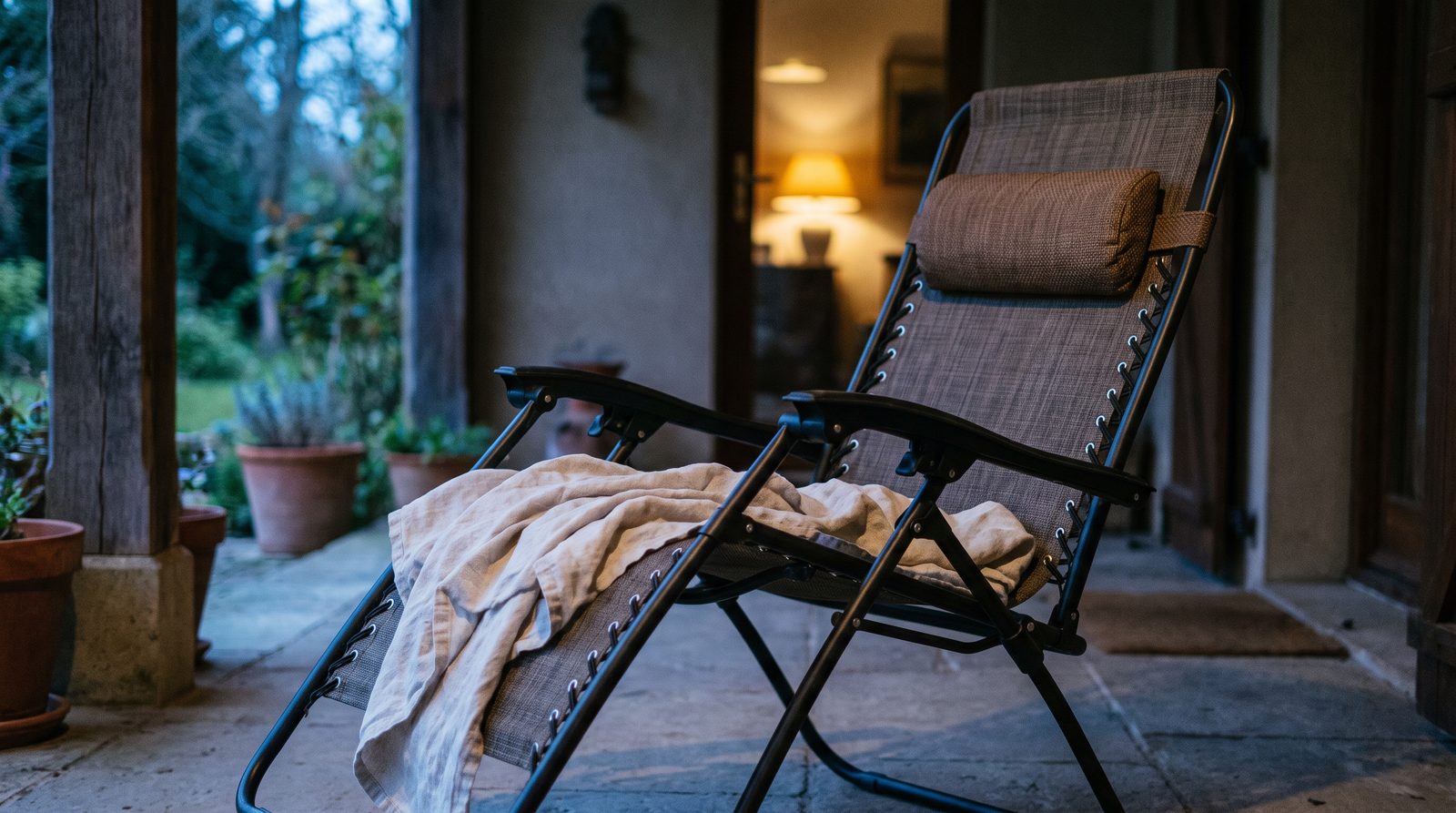
Zero-Gravity Chairs for Sleeping: What the Position Actually Does
The short version: a zero-gravity chair opens to roughly 125 to 135 degrees and raises the knees above the level of the heart. That combination is the best geometry of any chair for sleeping in — the recline is deep enough that the backrest carries your head, and the raised legs deal with the circulation problem that makes chair sleeping worse than a bed. The weak point is almost always the headrest, which on most models is a small sliding pad sized for an hour of lounging rather than a night. That leaves a gap of one to three inches behind your neck, and filling it properly is what turns the chair from pleasant into genuinely restful.
The name comes from a posture worked out for spaceflight, where the body at rest in the absence of gravity settles into a particular neutral position: hips and knees bent, thighs raised, arms floating slightly forward. Furniture makers borrowed the shape because it is the position the body adopts when nothing is pushing it anywhere.
That is a nice origin story and it is not the reason the chair works for sleeping. The reason is more ordinary, and it is worth being precise about, because the marketing around these chairs makes claims the shape does not support.
What the Position Actually Does
Two real effects, and both are mechanical rather than mystical.
The legs finish above the heart. This is the one that matters most. Sitting still for hours with the legs below heart level slows blood flow in the deep veins, and bent hips and knees compress the veins behind the knee. That combination is the mechanism behind deep vein thrombosis, and it is the main reason we are cautious about nightly chair sleeping in general. A zero-gravity chair is the one design that removes it by default rather than depending on you remembering to raise a footrest. It is also why these chairs help people with swollen ankles or legs.
The recline is deep enough to be real. At 125 to 135 degrees the backrest genuinely carries your head, so your neck muscles can switch off without your head falling forward. Most armchairs and sofas stop around 110 to 120, which feels reclined and is not — that band is where people wake with a wrenched neck.
What it does not do, despite what you will read: it does not decompress your spine in any measured sense, it does not improve circulation beyond the effect of raising your legs, and it is not a treatment for anything. It is a well-shaped chair. That is enough.
The Headrest Is Where They All Fall Down
Almost every zero-gravity chair ships with a small sliding pillow on two elastic straps. It is designed for an hour with a book. For a night it is usually the wrong size and in the wrong place.
When you recline, your upper back meets the chair but the natural curve of your cervical spine leaves an air gap behind your neck. Unsupported, your head tips back into extension and stays there. The standard pad tends to sit behind the skull rather than the neck, which pushes your head forward instead — the opposite error, same sore morning.
The gap you are filling is smaller than a bed needs. In bed a side sleeper fills four to six inches from mattress to ear. Reclined here, you are filling one to three. Bring a standard bed pillow and you will push your chin toward your chest all night. Worth knowing yours: sit in the chair at your sleeping angle, have someone slide a rolled towel behind your neck, add or remove turns until your head sits level and your throat feels open, then measure the towel.
This is the chair a contour was made for
A recessed centre, sat behind the neck
The Derila Ergo has a recessed 9 cm centre with raised 12 cm sides. In a zero-gravity chair that shape does both jobs at once: the recess fills the gap behind the neck without pushing your head forward, and the raised sides stop it rolling to one side as you drop off. Slide it down so it sits behind the neck, not under the back of the skull. Unlike an office chair or a plane seat, this is a chair where a contour is genuinely the right tool.
See today’s Derila price →$59.99 for one at the time of writing, 60-day money-back guarantee, and the seller sets the price. Affiliate link — we may earn a commission at no cost to you. Check your own loft first with the height calculator, or read the full review.
Zero-Gravity Chair or Recliner?
They overlap, and the right answer depends on why you are in the chair.
- Swelling, oedema, tired legs. Zero-gravity, comfortably. Knees above heart is the whole point, and a recliner only matches it if you use the footrest every single time.
- Getting in and out easily, especially after surgery. Recliner, usually, and a powered one if the budget allows. Zero-gravity frames sit low and can be awkward to rise from, which matters a great deal after abdominal or joint surgery. Our recliner sleeping hub covers the post-operative cases in detail.
- Reflux or breathing that worsens when flat. Either works. What matters is head above stomach, which both achieve.
- A whole night, every night. A proper indoor recliner is built for it. Most zero-gravity chairs are outdoor loungers with a mesh sling, and mesh that is fine for an afternoon can be unpleasant by four in the morning.
One genuine caution. If you have had a knee replacement, a chair that holds the knee bent all night works directly against the extension you are in physiotherapy to regain. We cover that conflict in sleeping in a recliner after knee or hip replacement, and it applies at least as strongly here.
What to Look For if You Are Buying One
- A locking mechanism, not just a free-float. Cheaper frames drift back to upright when you shift. You want a position that holds.
- An adjustable headrest that slides low enough to reach your neck rather than your skull, or accept that you will be using your own pillow.
- Indoor build if it is going indoors. Padded upholstery rather than an outdoor mesh sling, if this is a chair you will sleep in rather than sit in.
- Height off the floor. Sit in one before buying if you have any difficulty rising from low seats.
- A weight rating you comfortably clear, and a frame that does not flex when you shift your weight at the far end of the recline.
How Long Is It Safe?
Better than most chairs, because of the leg position, but the general caution still applies. Sustained hip and knee flexion night after night tightens the muscles that cross those joints, and a bed remains the better long-term default unless there is a reason you cannot use one.
Worth raising with a doctor if you cannot lie flat without becoming breathless, if you have been in a chair for months with no clear reason, or if you wake with pain, warmth or swelling in one calf.
Frequently Asked Questions
Can you sleep all night in a zero-gravity chair?
Yes, and of the chair options it is among the best, because the recline is deep enough for the backrest to carry your head and the knees finish above heart level. The two things to sort out are neck support, since the supplied headrest pad is usually too small and sits too high, and warmth, since an outdoor mesh sling gets cold overnight.
What angle is a zero-gravity chair?
Roughly 125 to 135 degrees between torso and thigh, with the knees raised above the level of the heart. That places it in the band where sleeping upright actually works — most armchairs stop between 110 and 120 degrees, which feels reclined but still leaves your head needing muscular effort to stay put.
Is a zero-gravity chair good for back pain?
Many people find it comfortable, because bending the hips and knees reduces the pull on the lower back and the reclined position takes load off the spine compared with sitting upright. What it does not do is decompress the spine in any measured therapeutic sense, whatever the marketing says. Treat it as a comfortable position rather than a treatment.
What pillow should I use in a zero-gravity chair?
A thin contoured pillow or rolled towel filling one to three inches behind the neck — not behind the skull, and not a standard bed pillow, which pushes the chin toward the chest. This is one of the few chairs where a contoured pillow is the right shape, because the backrest gives it something to press against.
Nothing here is medical advice. If you are sleeping upright because you cannot breathe lying down, or because of pain that is not improving, speak to a clinician.