
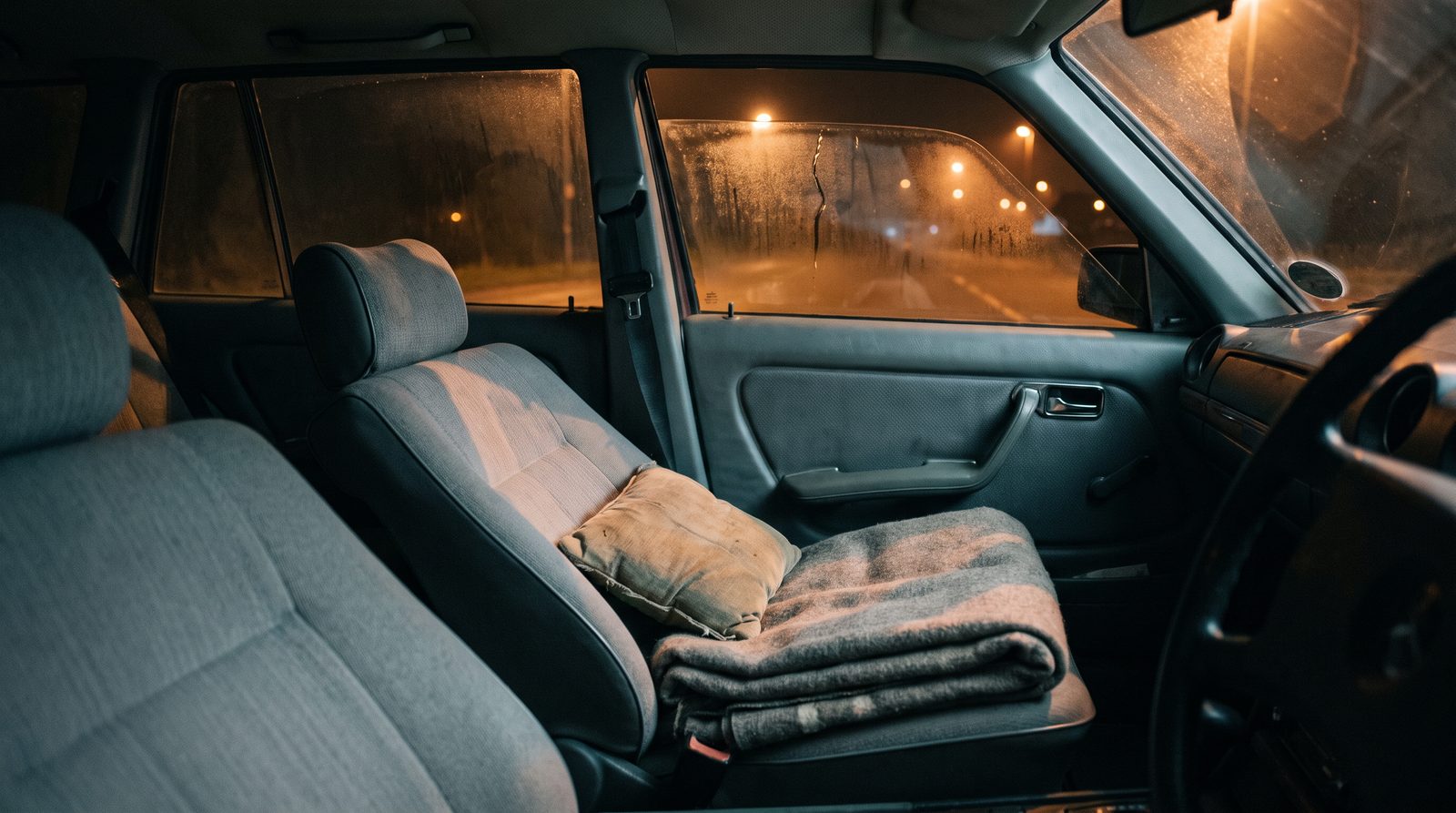
Sleeping in a Car: The Setup, and the One Rule You Cannot Break
The short version: a car seat is a better chair to sleep in than almost any furniture in your house. It has a real headrest and most front seats recline past 130 degrees, which puts it in the band where the backrest actually carries your head. Recline it properly rather than dozing at the driving angle, get your feet up, and fill the small gap behind your neck. The one rule that is not negotiable: never sleep with the engine running. Exhaust contains carbon monoxide, it is colourless and odourless, and it can seep into a stationary cabin. Leave a window open a little for ventilation, and use blankets rather than the heater.
People sleep in cars for all sorts of reasons. A long drive with a tired driver, which is the sensible version. A night between shifts when home is an hour away. A festival, a road trip, a ferry queue. Sometimes because there is nowhere else, which is a harder situation and one this article tries not to be glib about.
Whatever the reason, the mechanics are the same, and they are surprisingly favourable.
Why a Car Seat Beats Your Armchair
Sleeping upright fails at the neck. When you fall asleep, muscle tone drops and whatever the seat is not holding, gravity takes — your head pitches forward, or drops sideways, and stays there for hours.
What decides whether that happens is the recline angle, and a car does well on both counts that matter. Most front seats go past 130 degrees, which is inside the range where the backrest genuinely carries your head. And unlike an office chair or a dining chair, a car has a proper headrest at the right height. Our guide to sleeping in a chair sets out the four angle bands in full; a reclined car seat sits in the good one, alongside a recliner and a zero-gravity chair.
The catch is that most people do not recline far enough. Dozing at the driving angle, somewhere near 100 degrees, is the worst of both worlds. Put the seat right back.
The non-negotiable part
Never sleep with the engine running
Exhaust gas contains carbon monoxide. It has no colour, no smell and no taste, and in a stationary vehicle it can find its way into the cabin — through a worn exhaust, through the ventilation intake, or by pooling around the car in an enclosed space. Carbon monoxide poisoning first makes you sleepy and confused, which are exactly the things you will not notice when you are already asleep.
This applies with the windows open. It applies in a garage absolutely, but also in a lay-by with snow banked around the exhaust. If you are cold, use blankets and layers, not the engine.
Setting the Car Up
- Recline to at least 130 degrees. Further if the seat behind allows it. This is the single biggest difference between waking rested and waking with a wrenched neck.
- Move the seat back first, then recline. Sliding back before dropping the backrest gives you room and stops your knees ending up higher than your hips.
- Fill the gap behind your neck. When you recline, your upper back meets the seat but the curve of your neck leaves an air pocket. Unfilled, your head tips back into extension all night. You are filling one to three inches here, not the four to six a bed needs.
- Get your feet up. Onto a bag on the footwell floor, or across to the passenger side. Legs below heart level for hours is the circulatory part.
- Crack a window. Two fingers of gap on the side away from the weather. A sealed car with a person breathing in it gets humid and stuffy quickly, and condensation on every window by morning is the sign you did not have enough airflow.
- Back seat, flat, if you can. Lying down beats any seated position. In an estate or hatchback with the seats folded, a foam mat and a proper pillow is a genuinely good night’s sleep rather than a compromise.
For the gap behind your neck
A car is one of the few seats where a contour is the right shape
Past about 120 degrees the headrest gives a pillow something to press against, which is exactly what an office chair or a plane seat cannot do. The Derila Ergo has a recessed 9 cm centre and raised 12 cm sides — the recess fills the gap without pushing your head forward, and the sides stop it rolling. Sit it behind the neck rather than under the skull. It also comes out of the boot and onto the bed wherever you are going, which is where most people get the use out of it.
See today’s Derila price →$59.99 for one at the time of writing, 60-day money-back guarantee, and the seller sets the price. Affiliate link — we may earn a commission at no cost to you. Check your loft with the height calculator or read the full review.
Temperature Is the Real Danger
A car is a metal box with large glass panels and almost no insulation. It loses heat far faster than a building overnight, and gains it far faster in sun. Neither direction is something to improvise around.
- Cold nights. Layers, a proper sleeping bag or duvet rather than a thin blanket, a hat, and something insulating underneath you — the seat draws heat out of your back. A windscreen cover cuts radiant loss through the largest pane of glass.
- Warm nights. Park in shade if you will still be there in the morning, because a parked car heats extraordinarily quickly once the sun is on it. Cracked windows on both sides give you cross-flow. Window screens or a mesh help.
- Never leave a child or an animal sleeping in a parked car in any weather. The temperature inside changes much faster than people expect, in both directions.
Where You Park
The legal position varies enormously by country, and within countries by council, so treat this as things to check rather than rules.
- Motorway services are the intended answer for a tired driver in most of Europe and usually allow a few hours, sometimes with a time limit that starts a parking charge. They are lit, busy and have facilities.
- Being over the limit matters even when parked. In many jurisdictions being in charge of a vehicle while unfit can be an offence even if you are asleep and not driving. Keys out of the ignition and being in the back seat helps the argument, but it is not a guarantee.
- Residential streets, private car parks and laybys vary from perfectly normal to prohibited. Signage is worth reading before you settle.
- Lock the doors, keep valuables out of sight, and tell someone where you are. Park somewhere you would be comfortable walking, not somewhere isolated for the sake of quiet.
If You Pulled Over Because You Were Falling Asleep
Then you did the right thing, and the useful thing to know is how long to stop for.
Twenty minutes leaves you in light sleep and you wake clear. Somewhere between thirty and seventy minutes you are likely to be woken out of deep sleep, which brings fifteen to thirty minutes of genuinely impaired attention — a bad state to drive in, and worse than not having slept at all. Either keep it to twenty or commit to ninety. Coffee immediately before a twenty-minute nap works well, because caffeine takes about twenty minutes to take effect. We cover the mechanism properly in sleeping in an office chair and in how firefighters sleep on shift.
Do not treat a nap as a substitute for a night’s sleep before a long drive. It buys you an hour or two of alertness, not a shift.
Frequently Asked Questions
Is it safe to sleep in a car?
Yes, with the engine off, a window cracked for ventilation, and sensible attention to temperature and where you have parked. The serious risk is carbon monoxide from a running engine, which is why that rule has no exceptions. The secondary risks are cold, heat and security, all of which are manageable with preparation.
Can you sleep in a car with the windows closed?
A modern car is not airtight, so you will not run out of oxygen. But a sealed cabin gets humid and stuffy, and you will wake to condensation on every window. Leaving a couple of fingers of gap on the sheltered side makes for a far better night. With the engine running, closed windows are dangerous — but so are open ones, because the answer there is to turn the engine off.
What is the best position to sleep in a car?
Lying flat across a folded back seat, if the car allows it. Failing that, a front seat slid fully back and reclined past 130 degrees, with something filling the one to three inch gap behind your neck and your feet raised onto a bag. Dozing at the normal driving angle is the worst option and the one most people default to.
How long should I nap if I pull over while driving?
Twenty minutes, or ninety if you have the time. The window between roughly thirty and seventy minutes is the one to avoid, because waking out of deep sleep leaves fifteen to thirty minutes of impaired attention before you are fit to drive.
Nothing here is medical or legal advice. Parking and drink-driving rules vary by country and local authority — check the ones that apply where you are.