
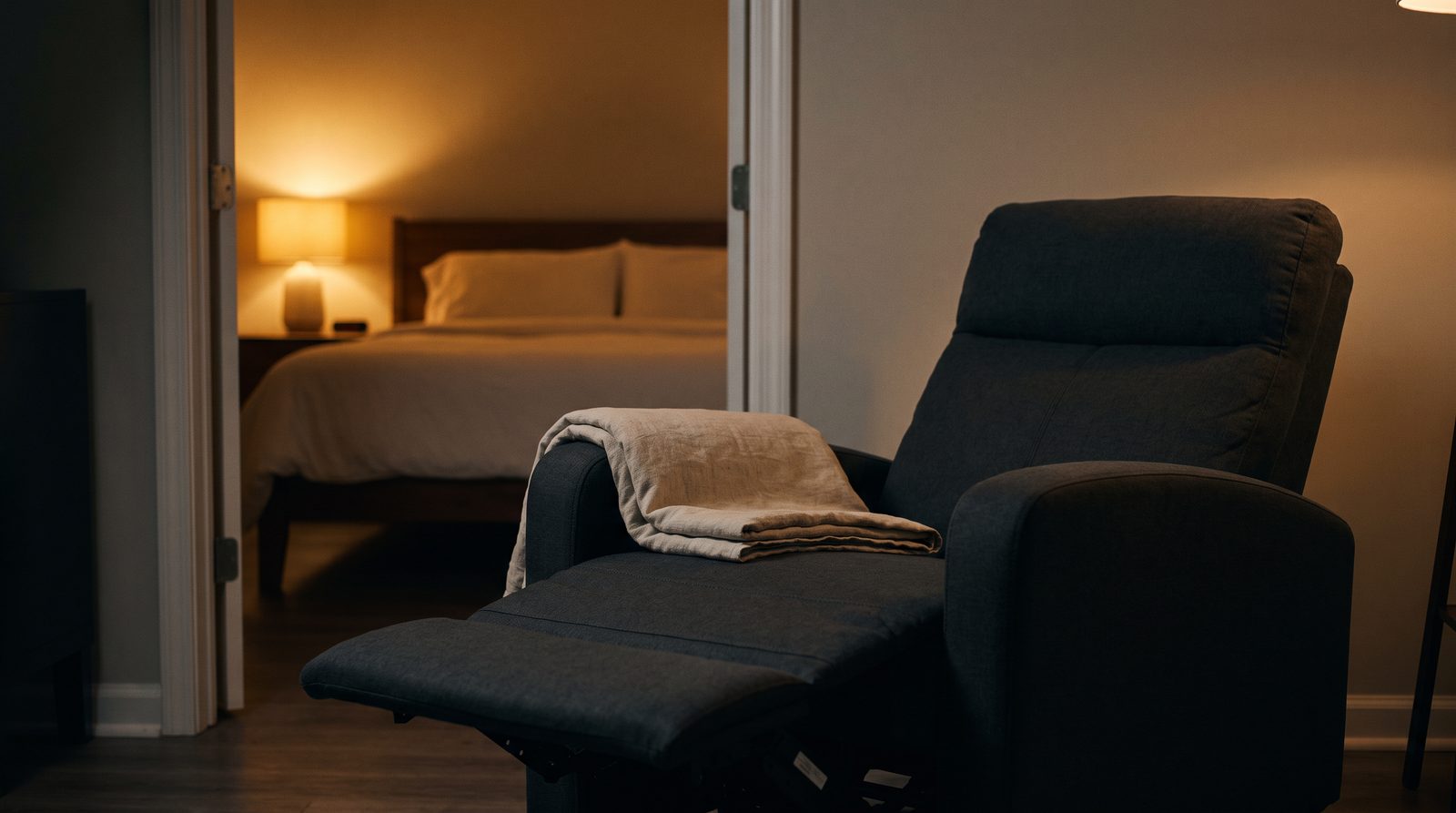
Sleeping in a Recliner vs a Bed (2026): What It Means If the Chair Keeps Winning
Quick answer: a bed is the better place to sleep for almost everyone, almost all of the time — more surface area, more freedom to move, less pressure on any one spot. So if the recliner keeps winning, the useful question is not “which is better” but what is the chair doing that your bed is not? It is nearly always one of three things: it keeps your head and chest raised, which helps reflux and some breathing problems; it keeps your knees bent and your lower back supported, which suits some back pain; or it is quietly compensating for a bed set-up that is wrong for your neck. The first two are worth a doctor’s opinion. The third is worth fixing, because it is the one you can actually solve.
If the chair keeps winning, that is information
Plenty of people drift into recliner sleeping after an illness, an operation or a bad few weeks, and then simply never go back. It rarely feels like a decision. One night in the chair is more comfortable, then a week is, and eventually the bed is where the laundry goes.
What gets missed is that a recliner is not a neutral alternative to a bed. It does one specific thing a flat mattress cannot: it holds your upper body above your stomach and keeps your hips and knees bent. If that consistently feels better, something about being horizontal is causing you a problem — and the chair is treating the symptom rather than the cause.
What the recliner is actually doing
- Keeping acid down. Raising the head and chest uses gravity to keep stomach contents where they belong. Elevating the head of the bed is standard advice for night-time reflux, and a recliner does it by default. If you wake with a sour taste, a cough or a hoarse voice, this is likely your answer.
- Changing how you breathe. Lying flat on the back lets the tongue and soft tissues fall backwards. For some people with positional breathing problems, being propped up genuinely reduces that — which is why position is one factor in sleep apnoea. A recliner is not a treatment for apnoea, but it can mask it well enough that you never get it looked at.
- Unloading the lower back. Lying flat with the legs straight pulls the lumbar spine into extension. A reclined position with the knees bent takes that pull off, which is why people with certain back problems find a chair easier than a mattress.
- Keeping swelling down. After surgery, with the leg raised, this one is simply practical and usually temporary.
See a doctor rather than buying a better chair if you have become breathless lying flat, if you have needed steadily more pillows over recent weeks or months to breathe comfortably, if you wake gasping, or if there is swelling in your ankles alongside it. Needing to sleep upright to breathe is a recognised symptom, not a quirk of taste, and it has causes worth finding early.
What a bed still does better
- Spreads your weight over far more area. In a chair, a large share of your body weight sits on your backside and heels all night. Over months, that concentration matters, particularly if you are older, thin, or have reduced sensation.
- Lets you move. Healthy sleep involves constant small position changes you never remember. A recliner restricts most of them, and waking stiff is the usual result.
- Does not keep your hips and knees bent for eight hours. Long periods folded up with the legs down is not ideal for circulation. If you are sleeping in a chair regularly, raising the footrest so the legs are supported and more level is the sensible version.
- Keeps the habit reversible. The longer you sleep in a chair, the harder going back tends to feel — partly because the underlying problem is still there, untouched.
The pillow problem hiding behind a lot of recliner sleeping
This is the one nobody checks, and it is the most fixable of the lot.
A recliner holds your head in a fixed, supported position. You cannot really get your neck wrong in one. A bed, by contrast, lets your head do whatever your pillow dictates — and if that pillow is the wrong height, you spend the night with your neck bent sideways or your chin pushed toward your chest. Wake up sore enough times and the chair starts to look like the better bed.
Worth testing before you conclude you are a recliner sleeper. If the chair is beating your bed and you have no reflux, no breathing symptoms and no back diagnosis, the bed is likely losing on a pillow that does not fit you. Our pillow height calculator gives a supported range for your frame and mattress, and the gap between what people are sleeping on and what the number says is routinely 3 to 4 cm.
Before you give up on the bed
If your number and your pillow do not match, that is worth correcting before you resign yourself to a chair. The Derila Ergo holds a fixed 9 cm recessed centre for back sleeping and 12 cm lobes for side sleeping, in foam firm enough that the height you lie down on is the height still there at 4 am — which a collapsing pillow is not. $59.99 for one, $99.98 for two ($49.99 each) at the time of writing, with a 60-day money-back guarantee. If the bed still loses after a fair trial, you have learned something useful and you get your money back.
See today’s Derila price → Read the full reviewIf you are going to sleep in the chair anyway
Sometimes it is the right call — after surgery, during a flare, or because it is simply the only way you get any sleep at all. In that case do it properly rather than by accident:
- Get the angle right. Not upright, not nearly flat. See the best recliner angle for sleeping.
- Raise the footrest properly so your legs are supported along their length rather than hanging.
- Support your head so it cannot fall sideways. The sideways slump is what produces the classic recliner neck ache — see the best pillow for recliner sleeping.
- Shift position deliberately when you wake in the night, since the chair will not let you do it unconsciously.
- Treat it as temporary unless a clinician says otherwise, and keep asking what the chair is compensating for.
Medical disclaimer: This article is general information, not medical advice. Needing to sleep upright to breathe comfortably should be assessed by a doctor.
This page contains affiliate links. If you buy through a link we may earn a commission at no extra cost to you. Our content is based on published guidance and public buyer feedback; vendors have no input.
Related guides
For the long-term question, is sleeping in a recliner bad for you. For technique, how to sleep in a recliner. If breathing is the reason, sleeping in a recliner for sleep apnoea. If it started after an operation, see after knee or hip replacement.
More Pillow Guides
Recommended for Pain-Free Sleep
🛌 Derila Ergonomic Memory Foam Pillow
Contoured design that holds your cervical spine in neutral for the full night. Works for side and back sleepers. Backed by a 60-day money-back guarantee on the official store.
- ✓ Memory foam contour
- ✓ Side & back sleeper design
- ✓ 60-day money-back guarantee