
Best Pillow After Knee Replacement (2026): The One Place It Must Not Go
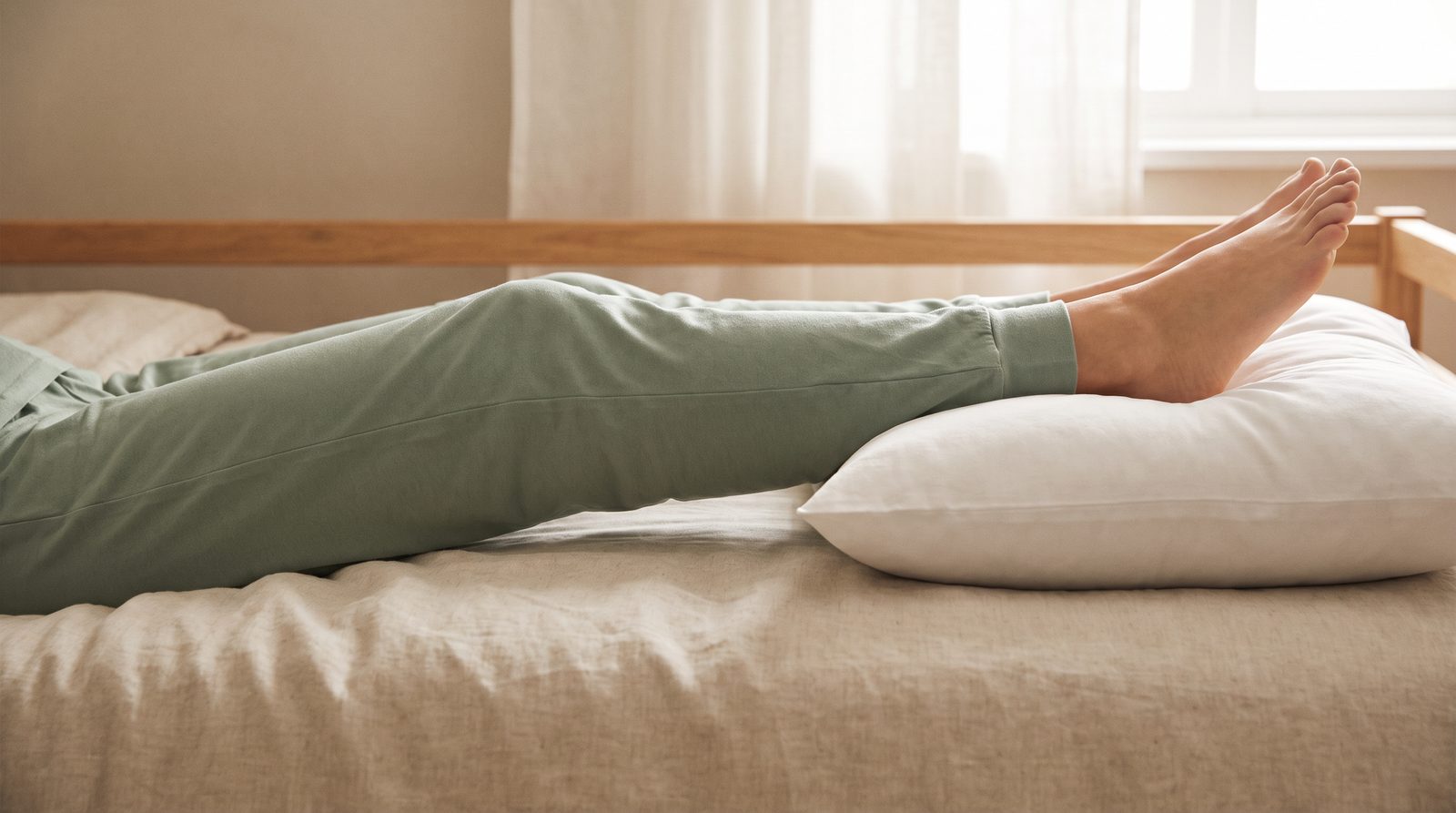
Quick answer: there is one rule here that matters more than every product recommendation put together, and it is a rule about where the pillow does not go. Do not put a pillow under your knee. After a knee replacement, getting the leg to straighten fully is one of the things your whole result is judged on, and a pillow under the knee holds it bent for hours every night. Elevate the whole leg instead, supported from calf to ankle with the knee flat, if you need to bring swelling down. Once you are allowed onto your side, a firm pillow goes between the knees, never under one.
Your surgical team’s instructions override anything here. Rehabilitation protocols after total knee replacement differ between surgeons and between patients. Use this to understand the reasoning, then check the specifics with your own physiotherapist.
Why the knee is stricter than the hip
After a hip replacement, the thing being protected is stability — keeping the new joint in positions it cannot dislocate from. After a knee replacement, the thing being protected is range of movement, and particularly the last few degrees of straightening.
A knee that will not fully straighten changes how you walk, loads the other leg, and is tiring in a way that is hard to explain to anyone who has not had it. Regaining those last degrees later is slow, uncomfortable work, and it is far easier to never lose them. So the early weeks are spent encouraging the knee flat, not resting it bent.
Which puts you directly at odds with instinct. A swollen, painful joint wants to be bent and propped. It feels better immediately. The problem is that eight hours a night of feeling better is also eight hours a night of tissue settling into a shortened position.
How to elevate without bending
- Support the whole leg, not the knee. Put the pillow under the calf and ankle so the leg is raised as one straight unit, with nothing directly under the back of the knee.
- Raise the foot above the heart for swelling to drain, rather than just lifting it a little.
- Check the knee is actually flat once you are settled. It is easy to build a pile that looks right and still leaves the joint resting at an angle.
- Use a firm pillow. A soft one compresses under the weight of a leg and quietly becomes a wedge under the knee — exactly what you were avoiding.
Positions, and when
- On your back is the usual default early on, leg straight, elevated when swelling needs it.
- On your side, once your team allows it — lie on the non-operated side with a firm pillow between the knees. This keeps the operated leg in line rather than dropping across the body, and keeps the weight of the upper leg off the new joint.
- On the operated side is usually uncomfortable for a good while, and is not something to force.
- A recliner is often easier than a bed for the first week or two, particularly for getting in and out without bending. See sleeping in a recliner after knee or hip replacement.
Night pain is normal here, and it lasts longer than people expect
Disturbed sleep after a knee replacement is extremely common, and it often continues for months rather than weeks. That is worth knowing in advance, because a lot of people assume something has gone wrong when it is simply the usual course of this particular operation.
It is still worth telling your team about, since pain that is not controlled makes rehabilitation harder and rehabilitation is what determines the outcome. But do not read ordinary night pain as a sign you should start propping the knee up to get comfortable — that trade is a bad one.
And the pillow under your head
The same thing happens here as after a hip: if you normally sleep on your side and you are now on your back for several weeks, you are doing it on a pillow built for side sleeping. That pillow is taller than your back-sleeping loft by several centimetres, which means weeks of your chin being pushed toward your chest. We cover the numbers in best pillow after hip replacement, and they apply unchanged here.
One pillow for both halves of the recovery
Weeks on your back, then back onto your side — two different heights, which usually means two pillows. The Derila Ergo carries both: a 9 cm recessed centre for the back-sleeping stretch and 12 cm lobes for afterwards, in foam firm enough to still hold those heights by morning. $59.99 for one, $99.98 for two ($49.99 each) at the time of writing, with a 60-day money-back guarantee.
See today’s Derila price → Read the full reviewWhat to avoid
- A pillow under the knee. The one that actually costs you something.
- A soft pillow under the leg, which becomes a pillow under the knee within an hour.
- Sleeping curled on the operated side before your team says it is fine.
- Letting pain go unmanaged on the grounds that it is expected. Expected and acceptable are different things, and poor sleep slows rehabilitation.
- Assuming hip advice applies. The hip rules are about stability and crossing the midline. The knee rules are about straightening. They are not interchangeable.
Medical disclaimer: This article is general information, not medical advice. Positioning, elevation and activity after knee replacement must be confirmed with your surgical and physiotherapy team.
This page contains affiliate links. If you buy through a link we may earn a commission at no extra cost to you. We have not tested any product after this operation and nothing here is a recovery protocol. Our content is based on published guidance and public buyer feedback; vendors have no input.
Related guides
For the hip equivalent and its very different rules, best pillow after hip replacement. For the between-the-knees technique, sleeping with a pillow between your knees. If a chair is easier than a bed at the moment, sleeping in a recliner vs a bed.
More Pillow Guides
Recommended for Pain-Free Sleep
🛌 Derila Ergonomic Memory Foam Pillow
Contoured design that holds your cervical spine in neutral for the full night. Works for side and back sleepers. Backed by a 60-day money-back guarantee on the official store.
- ✓ Memory foam contour
- ✓ Side & back sleeper design
- ✓ 60-day money-back guarantee