
Short answer: Sleep lines are creases produced by mechanical loading: the face is pressed against a pillow and the skin is compressed, stretched and sheared. A review in the Aesthetic Surgery Journal separates these from expression wrinkles, which come from muscle contraction, and states that the two differ in cause, location and anatomical pattern. The associated press release from The Aesthetic Society reports that sleep wrinkles occur mainly on the forehead, lips and cheeks and tend to run perpendicular to expression wrinkles. The only change the authors describe as reliable is removing the loading itself, which means sleeping on the back rather than the side or front.
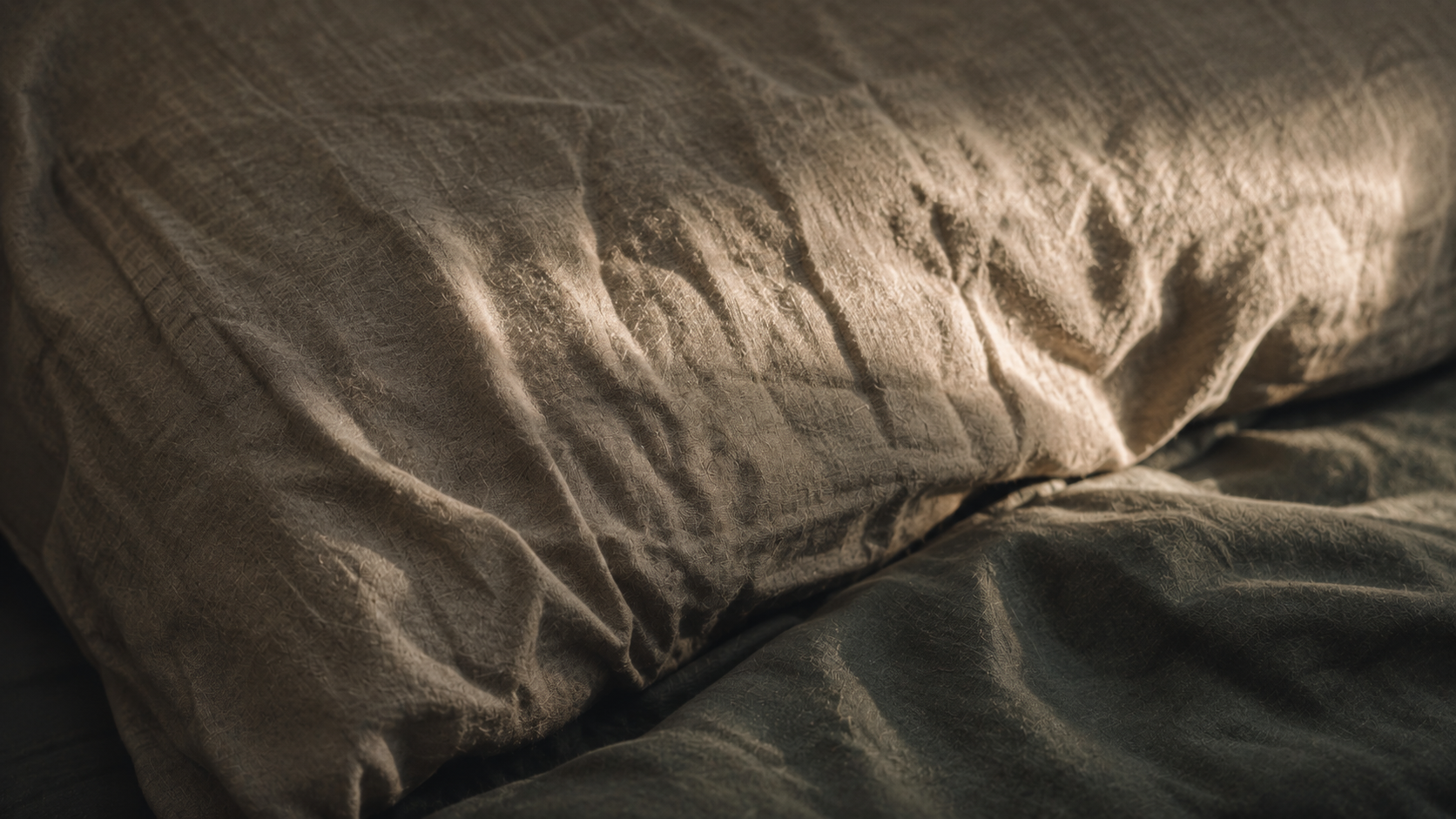
What a sleep line is, mechanically
The abstract of the 2016 Aesthetic Surgery Journal review by Anson and colleagues is direct about the mechanism. It states that compression, shear and stress forces act on the face in lateral or prone sleep positions, and that this is distinct from skin distortion caused by facial expression. The face is not moving. It is being loaded.
Reporting on the same review, Healio described the tissue as experiencing shear, compression and tensile mechanical forces during side or stomach sleeping, and noted that the resulting wrinkles appeared to occur at locations where the skin buckles to external forces. Buckling is the useful word. A crease forms where compressed skin has nowhere to go but fold.
This is why the problem belongs to pillow and position rather than to the skin surface. The input is load and duration. Anything that does not change the load or the duration is not addressing the mechanism.
How sleep lines differ from expression lines
The Aesthetic Surgery Journal abstract states that expression wrinkles and sleep wrinkles differ in aetiology, location and anatomical pattern. That is the whole distinction in one sentence: different cause, different place, different direction.
The Aesthetic Society press release accompanying the review adds a practical test. Expression wrinkles are caused by muscle contraction, so botulinum toxin can act on them. Sleep wrinkles are caused by mechanical compression, and the release states plainly that they cannot be eliminated using botulinum toxin. A line that does not respond to a muscle-targeted treatment is unlikely to be a muscle-driven line.
Where they appear, and which way they run
The Aesthetic Society press release reports that sleep wrinkles predominantly appear on the forehead, lips and cheeks. These are the regions that take the pressure when the head is turned onto a pillow.
On direction, the release states that most sleep wrinkles tend to be perpendicular to expression wrinkles. A forehead expression line runs horizontally, following the frontalis muscle; a sleep line in the same region tends to run across it. That crossing pattern is the most usable feature for telling the two apart on your own face.
The release also notes that sleep patterns can reinforce expression lines, so the two are not always cleanly separate. Where a sleep line and an expression line happen to share a direction, the loading adds to what the muscle already does.
| Feature | Sleep wrinkles | Expression wrinkles | Source |
|---|---|---|---|
| Cause | Compression, tension and shear forces on the face pressed against a sleep surface | Contraction of facial muscles | Aesthetic Surgery Journal abstract; The Aesthetic Society press release |
| Typical location | Forehead, lips and cheeks; wherever skin buckles under external force | Wherever the underlying muscle acts | The Aesthetic Society press release; Healio |
| Direction relative to expression lines | Mostly perpendicular to expression wrinkles, though some patterns reinforce them | Reference direction, set by the muscle's line of pull | The Aesthetic Society press release |
| Whether they fade during the day | Not established: no accessible source gives a same-day resolution time. What is stated is that they worsen over time with repetition, skin thinning and reduced elasticity | Not addressed in the accessible sources | The Aesthetic Society press release; see caveats |
| Response to botulinum toxin | Cannot be eliminated with botulinum toxin, as no muscle contraction is driving them | Muscle-driven, so a muscle-targeted agent is relevant | The Aesthetic Society press release |
| What changes them | Avoiding facial distortion; sleeping on the back rather than side or front | Not covered by these sources | Healio; The Aesthetic Society press release |
Do they fade, and what the sources will not tell you
This is where the popular writing runs well ahead of the evidence. Everyone has seen a crease on waking that is gone by mid-morning, but we could not find an accessible source that puts a number on how long that takes, or at what point a crease stops resolving.
What is sourced is the direction of travel. The Aesthetic Society press release states that sleep wrinkles tend to worsen over time due to repetition combined with thinning of the skin and decreased elasticity as we age. Repetition plus reduced recoil is the stated mechanism for a transient crease becoming a settled one. No source we could read gives a timeline for that transition, so we do not give one.
What the dermatology bodies actually say
Given how confidently sleep position is discussed in beauty coverage, the silence of the main patient-facing dermatology pages is worth recording. The American Academy of Dermatology's public page listing eleven ways to reduce premature skin ageing does not mention sleep position, pillows or sleep creases at all. Its eleven items cover sun protection, self-tanner instead of tanning, smoking, repetitive facial expressions, diet, alcohol, exercise, gentle cleansing, washing, moisturiser and irritating products.
The Academy's public page on wrinkles likewise attributes them to ageing and to sun exposure, without reference to sleep. Cleveland Clinic's article on preventing wrinkles does not mention sleep position or pillowcases either, though it does discuss sleep duration.
The honest reading is that sleep position sits below the threshold these bodies use for public guidance, while sun exposure and smoking sit well above it. That does not make the mechanism wrong. It does mean anyone presenting a pillow change as a leading anti-ageing measure is going beyond what the dermatology bodies are prepared to say.
The silk pillowcase claim, checked
The claim is that a silk or satin surface reduces friction and therefore reduces facial creasing. It is asserted constantly by pillowcase retailers. We looked for the study behind it and did not find one.
GoodRx's physician-reviewed article on silk pillowcases addresses the wrinkle claim directly and states that there are no studies to support it, adding more broadly that there is not research to back up claims on the benefits of using a silk pillowcase. The study it does cite on silk and skin concerns atopic dermatitis, not wrinkles.
It is not that pillowcase fabric has never been tested against facial wrinkles. It has, once, with a different material. A double-blind, randomised, placebo-controlled trial reported by Healio put 61 women, average age about 47, on copper oxide-containing or ordinary pillowcases for eight weeks, and found reduced crow's feet wrinkle depth in the copper group at four and eight weeks by expert grading and 3D image analysis, with no change in controls. That result carries a real caveat: one of the researchers, Gadi Borkow, was chief medical scientist at Cupron Scientific, the copper textile company. It also says nothing about silk. So the position is that the fabric claim most people repeat has no trial behind it, and the one fabric trial that exists is small, short, industry-linked and about a different material.
What the review says actually changes the loading
Healio quotes the reviewers' conclusion that the only reliable way to minimise sleep wrinkles is to avoid facial distortion, while acknowledging that sleep position is extremely difficult to consciously change.
In The Aesthetic Society release the lead author, Dr Goesel Anson, states that if you can stay on your back, that is ideal, and notes that specialty pillows exist which are designed to help maintain that position and to minimise facial distortion during sleep. That is a description of the category, not an endorsement of any product, and no comparative trial of such pillows against facial wrinkles was found in this research.
Read as mechanics, the logic is simple and holds: a face that is not pressed against a surface is not being compressed, stretched or sheared. Everything else in this area is an attempt to make that loading gentler rather than to remove it, and the evidence for those attempts is thinner than the marketing suggests.
Common questions
How do I tell a sleep line from an expression line?
Direction is the most usable clue. The Aesthetic Society press release states that most sleep wrinkles run perpendicular to expression wrinkles, so a line that crosses your usual creases rather than following them is the likelier sleep line. Location helps too: the release names the forehead, lips and cheeks as the main sites.
Does sleeping on my back actually help?
It is the only change the reviewers describe as reliable. Healio reports their conclusion that the only reliable way to minimise sleep wrinkles is to avoid facial distortion, and the lead author is quoted saying that staying on your back is ideal. The same sources note that consciously changing sleep position is extremely difficult.
Do silk pillowcases prevent wrinkles?
There is no study we could find that supports this. GoodRx's physician-reviewed article states directly that there are no studies to support the wrinkle claim for silk pillowcases. The claim may still turn out to be true, but at present it is an assertion rather than a finding.
Has any pillowcase fabric been tested against facial wrinkles?
Yes, but not silk. Healio reported a double-blind randomised trial of 61 women over eight weeks in which copper oxide-containing pillowcases reduced crow's feet wrinkle depth compared with ordinary pillowcases. The trial was small and short, and one of the researchers was chief medical scientist at the copper textile company involved.
Will botulinum toxin remove sleep lines?
Not according to the sources here. The Aesthetic Society press release states that sleep wrinkles, formed by mechanical compression rather than muscle contraction, cannot be eliminated using botulinum toxin. That difference in response is one of the clearest practical distinctions between the two kinds of line.
Why does the American Academy of Dermatology not mention this?
Its public page on reducing premature skin ageing lists eleven measures and none of them concerns sleep position, pillows or sleep creases. Its public page on wrinkles attributes them to ageing and sun exposure. The mechanism is described in the aesthetic surgery literature, but it has not been taken up in the main patient-facing dermatology guidance.
Do sleep lines become permanent?
The Aesthetic Society press release states that sleep wrinkles tend to worsen over time due to repetition combined with thinning of the skin and decreased elasticity as we age. That describes a transient crease gradually settling. No accessible source we found gives a timescale or an age at which this happens, so we do not offer one.
Where this fits
This page is one row of a larger reference. The night-time symptom reference maps 50 night-time symptoms to the sleeping position associated with each, the likely mechanical cause, what published sources say to change, and the sign that means seeing a clinician instead. For 13 of those 50, no published source describes any bedding change at all.
Also relevant here: the other thing side-sleeping pressure does to that side of your face, side-sleeping support and where your face sits.
Sources
- Aesthetic Surgery Journal (Anson et al., Sleep Wrinkles: Facial Aging and Facial Distortion During Sleep) – abstract only
- The Aesthetic Society – press release on the sleep wrinkles study
- Healio – Researchers review wrinkles occurring through facial compression during sleep
- American Academy of Dermatology – 11 ways to reduce premature skin aging
- American Academy of Dermatology – Wrinkles
- Cleveland Clinic – Is Your Skin Aging? 7 Ways to Prevent Wrinkles
- GoodRx (medically reviewed) – 5 Ways a Silk Pillowcase Can Benefit Your Hair and Skin
- Healio – Pillowcases with copper oxide reduced crow's feet lines
Suggested citation: Sleep Align (2026). Sleep lines on the face: what the pillow is actually doing Retrieved from https://sleepalign.org/sleep-lines-on-face-from-pillow/
If you are moving to back sleeping, the height changes Back sleeping needs a lower pillow than side sleeping — usually by an inch or more. Switching without changing height trades one problem for another.