
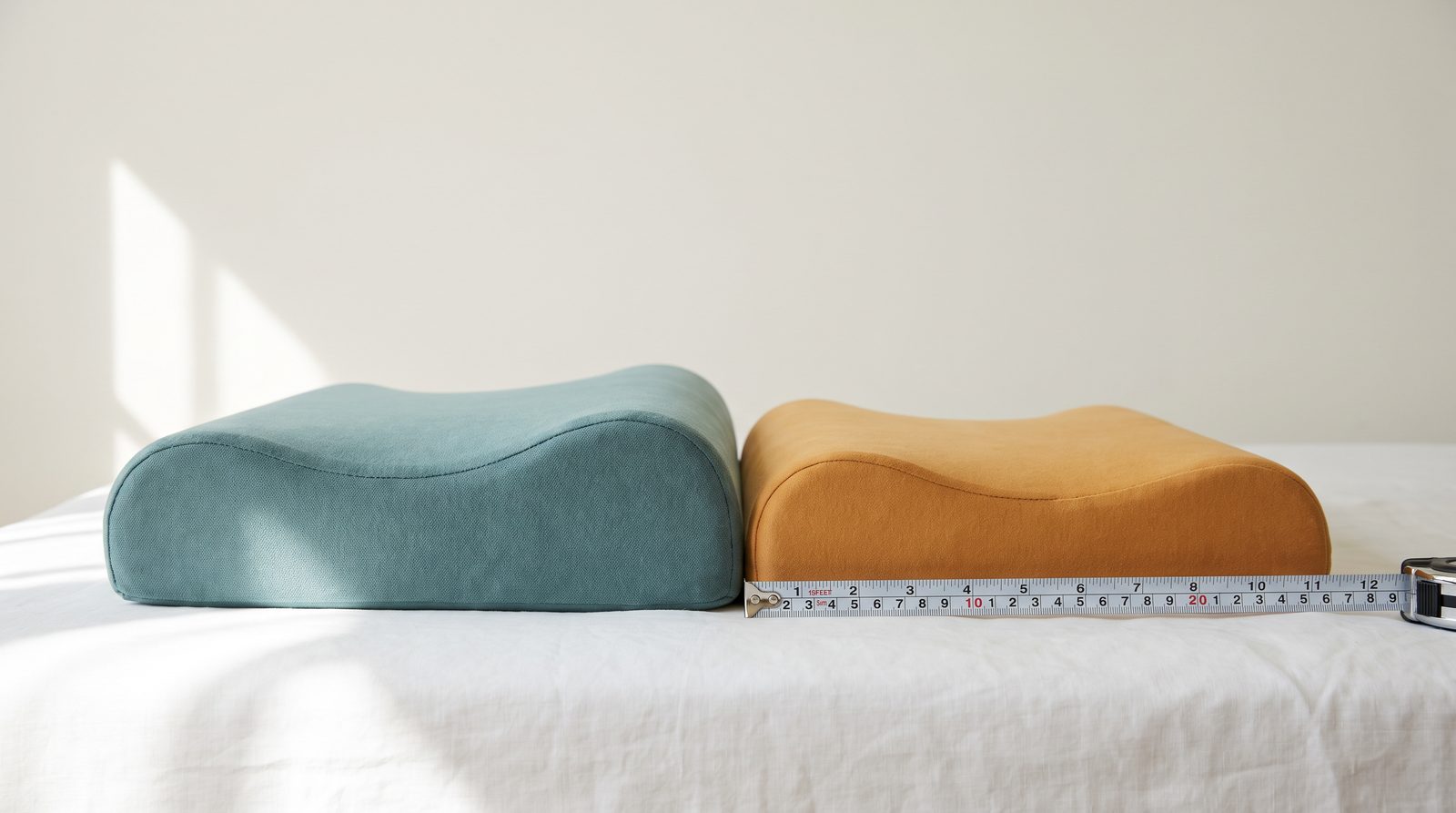
Derila vs Pillow Haven (2026): Two Contour Pillows, Two Very Different Heights
Both of these are sold the same way: direct-to-consumer, heavy discounting, a contoured shape promising neck relief. They look similar in photographs. They are not interchangeable, and the reason is a single measurement that neither brand puts front and centre.
Disclosure up front: we earn a commission if you buy Derila through a link on this site. We have no relationship with Pillow Haven. That is exactly why the sections below include Derila’s own drawbacks — a comparison that only criticises the product we do not sell would be worthless to you. (Short on time? Skip to which one we’d buy, or read our full Derila review.)
The specifications, side by side
| Derila Ergo | Pillow Haven | |
|---|---|---|
| Type | Moulded contour, fixed shape | Moulded contour with a central groove |
| Height | 4.7 in (about 12 cm) at the edge, lower in the centre | Around 7 in (about 18 cm), reported |
| Fill | Medium-firm memory foam | High-density memory foam, medium-firm |
| Adjustable? | No | No |
| Typical price | Around $59, less per pillow in multipacks | Advertised near $49.75, against a stated “original” of $184.02 |
| Trial period | 60-day money-back guarantee | 100 nights advertised |
Why the height gap decides it
A pillow’s job is to fill the gap between the side of your head and the mattress so your neck stays in line with your spine. That gap is set by three things: your sleeping position, your shoulder width, and how far your shoulder sinks into your mattress. It is not a matter of taste.
Broadly, back sleepers need somewhere around 3 to 5 inches. Side sleepers need more — commonly 4 to 6, and above that if you have broad shoulders and a firm mattress that lets you sink very little. Our height cheat sheet sets out all 28 combinations.
Put the two pillows against that range and the picture is clear.
- Derila at 4.7 in lands in the middle of the usual range. It suits a lot of side sleepers and the taller end of back sleepers. It is too high for most stomach sleepers, and too low for a broad-shouldered side sleeper on a firm mattress.
- Pillow Haven at around 7 in sits above what most people need. It is plausible for a broad-shouldered side sleeper on a firm mattress. For a back sleeper it is well over the mark, and a contour that is too tall does not simply feel odd — it holds your neck flexed forward all night, which is one of the most reliable ways to wake up sore.
This is the part people get backwards. With a flat pillow, too much loft partly collapses under your head. A moulded contour is built not to collapse — holding its height is the whole point — so if it is the wrong height, it holds you in the wrong position with some determination.
Get your number before you choose
Thirty seconds, no sign-up. It takes your position, build and mattress firmness and returns a loft figure in inches and centimetres. If your answer comes out near 12 cm, that is Derila’s territory. If it comes out near 5 inches or below, neither of these pillows is your answer and a lower contour will serve you better.
Buying: the differences that are not about the pillow
Both brands sell through direct-response advertising with steep discounts, which is a category that rewards caution generally. But there are specific things worth knowing about Pillow Haven before you order, and we would say the same about any product with this pattern.
- It is sold under several different domains. We found the product offered at pillowhaven.us, pillow-haven.com and thepillowhaven.com, each carrying its own separate customer-review history. When a product has multiple storefronts, it becomes much harder to know who you are actually buying from, who honours the trial, and where a return goes.
- The reference price does not look like a real one. An “original” of $184.02 against a selling price under $50 is not a discount pattern you see from a manufacturer pricing to its costs. Treat the percentage saved as marketing rather than information.
- Refund reports are mixed. Among published customer reviews are accounts of people requesting a return under the advertised trial and being offered a partial refund — around 30% — rather than their money back. A 100-night trial is only worth what the company does when you invoke it.
- Product consistency is questioned. Reviews include complaints of pillows arriving flat, thin, or unusually hard.
To be even-handed: Derila attracts complaints too, and we have written about them at length in our honest look at whether Derila is a scam. The common ones are a firmer feel than expected, a break-in period people are not warned about, and subscription-style upsells at checkout. Its window is also shorter than Pillow Haven advertises — a 60-day money-back guarantee against a claimed 100 nights, though a stated window is only worth what the company does when you invoke it. What Derila does have is a single main storefront and a consistent published height, which makes it a more predictable purchase, not a flawless one.
So which should you buy?
- Your measured loft is near 12 cm / 4.7 in, and you want a contour that holds position: Derila is the closer fit, and it is the one of the two we can speak to from use.
- You are a broad-shouldered side sleeper on a firm mattress and your number comes out near 7 in: Pillow Haven is in the right height range — but given the storefront and refund issues above, we would look for a pillow with a published specification and a retailer you can return to.
- Your number is 5 in or below, or you sleep on your front: neither. Both are too tall, and a moulded contour will hold you there all night.
- You do not know your number: that is the actual first step, and it is free.
If Derila is the right height for you
It is a fixed 4.7 in medium-firm contour with a 60-day money-back guarantee. Read the full review first — it is candid about the break-in period and about who should not buy it.
See today’s price → Read the full Derila review →
Affiliate link — we earn a commission if you buy, at no extra cost to you.
Also worth reading: Derila vs Nuzzle if you are considering an adjustable pillow instead, Derila vs Sutera for another fixed contour, and Derila alternatives if you have decided against it.
Common questions
Is Pillow Haven better than Derila?
Neither is better in the abstract, because they are different heights. Pillow Haven is around 7 inches and Derila is 4.7, so the right one is whichever matches your measured loft. For most sleepers that is Derila, simply because 4.7 inches falls inside the range most people need and 7 inches does not. Derila also publishes its height, which Pillow Haven does not.
Is Pillow Haven a scam?
We have seen no evidence that orders go undelivered, so “scam” overstates it. But it is sold under multiple domains with an implausible reference price, and there are published customer accounts of partial refunds being offered instead of the advertised trial refund. Those are reasons for caution rather than proof of fraud.
How tall should a contour pillow be?
It depends on your position, shoulder width and mattress firmness. Back sleepers are usually around 3 to 5 inches; side sleepers commonly 4 to 6, more with broad shoulders on a firm mattress. A contour that is too tall holds the neck flexed all night, which is worse than the same error in a flat pillow because a contour is designed not to compress.