
Best Pillow for a C5-C6 or C6-C7 Disc Bulge (2026): What Actually Helps
Quick answer: With a C5-C6 or C6-C7 disc bulge you want a pillow that holds your neck in neutral — neither tipped back nor pushed forward. A pillow that is too flat lets your head fall into extension, which narrows the exact opening the nerve root exits through and is the fastest way to wake up with a numb arm. Too high pushes you into flexion and loads the front of the disc. For most people that means a medium-firm contoured pillow with a lower centre and raised sides: roughly 9–10cm under the back of the head when lying on your back, rising to around 12cm to fill the shoulder gap on your side. Stomach sleeping is the one position to stop.
If a scan has told you the bulge is at C5-C6 or C6-C7, you already know more than most people searching for a pillow. Those two levels are not a coincidence — they are where cervical discs fail most often, and the symptoms they produce are specific enough that you can usually tell which one is involved from your own hand.
This page covers what those levels do, why pillow height matters more for them than for almost any other neck problem, and what to actually look for.
Why it is nearly always C5-C6 or C6-C7
Your neck has seven vertebrae. The lower ones carry the weight of the head through the greatest range of movement, and the junction around C5 to C7 is where the mobile cervical spine meets the much stiffer thoracic spine below. Load concentrates there. That is why C5-C6 and C6-C7 account for the large majority of cervical disc herniations, and why the two of them come up again and again in scan reports.
It also means the mechanics are predictable. A bulge at these levels narrows the intervertebral foramen — the small bony tunnel the nerve root passes through on its way to your arm. Anything that narrows that tunnel further makes symptoms worse. Anything that opens it helps. Your pillow decides which of those happens for seven or eight hours a night.
Which fingers go numb tells you which level
Each nerve root supplies a predictable patch of skin. If you get numbness, tingling or pain down the arm, where it ends is a strong clue:
This is a guide, not a diagnosis — overlap between levels is common and only imaging settles it. But it explains something people often find confusing: if your little and ring fingers are the numb ones, the problem is probably lower than C6-C7, and it may not be your neck at all. Numbness in exactly those two fingers is also the classic pattern for ulnar nerve compression at the elbow, which sleeping with your arm bent under you will reliably produce. If you have no scan and are working backwards from the symptom, start with why your arm goes numb at night instead.
Our pick for cervical disc problems
See today’s price →Derila Ergo · 9cm centre, 12cm wings · 60-day guarantee
What your pillow is actually doing to the disc
Two wrong positions, each with a different mechanism.
Too flat — the neck drops into extension. When your head tips backwards, the facet joints at the back close down and the foramen gets smaller. This is the single most provocative position for a bulging disc with nerve involvement, and it is the mechanism behind the test a clinician does when they tip your head back and sideways to reproduce your arm symptoms. If you wake with the arm numb and it eases once you sit up, a flat pillow is the first suspect.
Too high — the neck is pushed into flexion. Chin towards chest for hours increases pressure through the front of the disc and puts the nerve roots on stretch. It tends to produce a deep ache and morning stiffness rather than sharp arm symptoms, but it works against healing.
Neutral is the target: ears stacked over shoulders, the small natural forward curve of the neck supported rather than flattened or exaggerated. That is the entire job of the pillow.
Is a contoured pillow actually your answer?
Three questions, then a loft number and a straight yes or no — including the times the answer is no.
The three things that matter when choosing
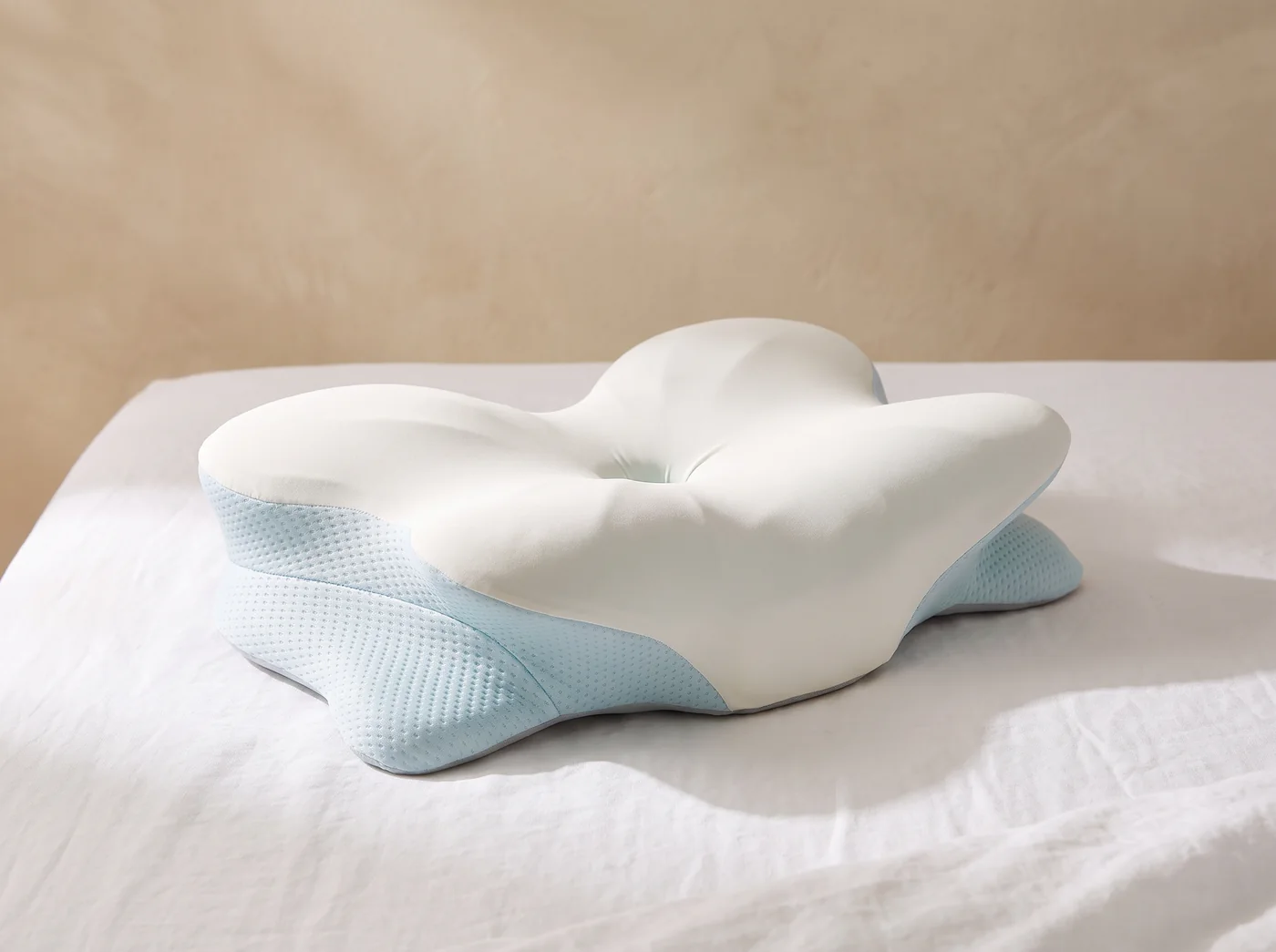
- Height, and two of them. Back sleeping needs less loft than side sleeping, because on your side the pillow has to bridge the whole gap from shoulder tip to ear. A pillow with one flat height cannot be right for both. A contoured pillow with a lower centre channel and higher outer wings gives you two heights in one surface — around 9–10cm in the middle, around 12cm at the sides suits most adults.
- Firmness that holds overnight. A soft pillow that compresses by 2am puts you back into extension for the second half of the night, which is often why people wake at 4am with the arm gone rather than at bedtime. Medium-firm foam that resists bottoming out matters more here than it does for ordinary neck ache.
- A shape that stops you rolling onto your front. Raised wings make stomach sleeping genuinely uncomfortable, which sounds like a drawback and is actually the point — see below.
If you want to work out your own number rather than take an average, our pillow height calculator takes shoulder width and sleeping position and gives you a target loft.
Sleeping positions, best to worst
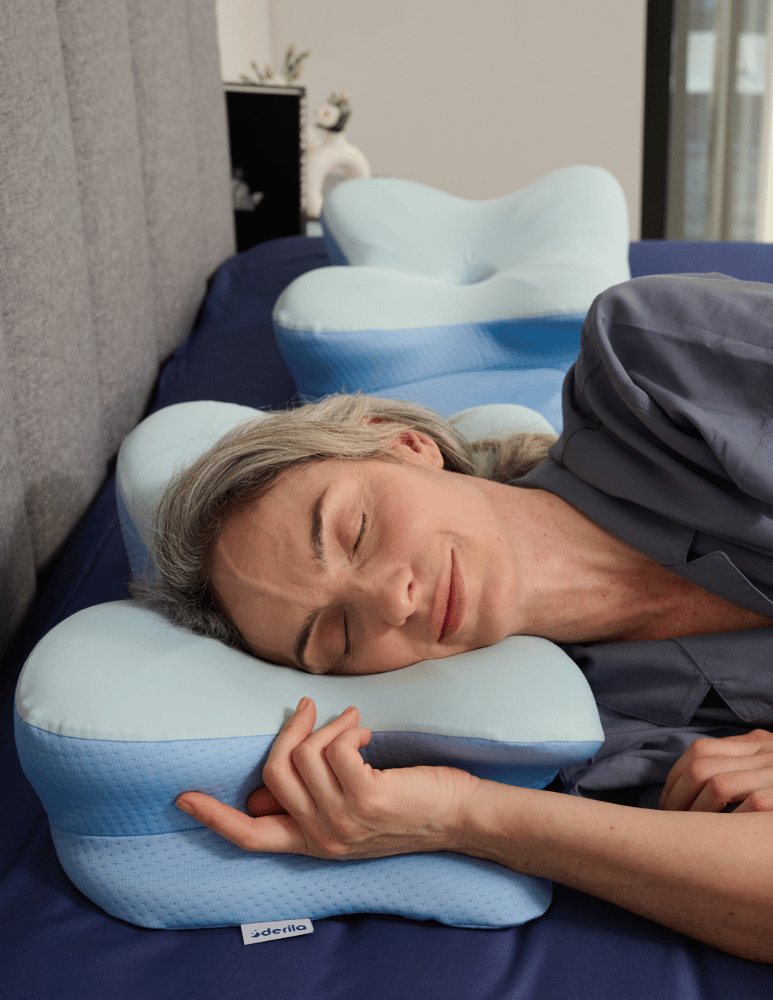
On your back — usually best. Weight is distributed evenly and the neck can sit in neutral. Keep the pillow under the neck and head, not under the shoulders, and resist a thick pillow. Some people find a small rolled towel inside the pillowcase under the neck curve helps; others find it too much.
On your side — fine, with the right loft. The loft has to match your shoulder width or your neck bends sideways all night. Keep the bottom arm out in front of you rather than tucked under your head: lying on the arm compresses the ulnar nerve at the elbow and gives you a second source of numbness on top of the first.
On your front — stop. Stomach sleeping forces the neck into rotation held at end range for hours, usually with extension on top. For a cervical disc bulge with radiating symptoms, it is the worst available position, and no pillow fixes it. The only real solution is to make the position uncomfortable enough that you stop defaulting to it, which a contoured pillow does by design.
What we recommend, and the honest caveats
The Derila Ergo matches the specification above closely: a moulded medium-firm memory foam contour with a centre channel of roughly 9cm and wings of roughly 12cm, which is the two-height arrangement a C5-C6 or C6-C7 bulge wants. It is the pillow we point people to most often for cervical disc problems, and it is the one our readers buy most.
Three things to be straight about before you spend:
- The shape is fixed. You cannot add or remove fill. If your measured loft is well outside the 9–12cm range — very broad shoulders, or a very small frame — an adjustable shredded-fill pillow will serve you better.
- There is an adjustment period. A contoured pillow feels wrong for the first few nights, especially if you have been using something thick. Judge it at two weeks, not on night one.
- It is not a treatment. A pillow removes a nightly aggravator. It does not reduce a disc bulge. What actually goes wrong after people order — including the adjustment period and the shipping charge that is added at checkout — is set out in our Derila complaints guide.
Frequently asked
What pillow height is best for a C5-C6 disc bulge?
Enough to keep your neck neutral and no more. For most adults that is around 9–10cm under the head when lying on the back, and around 12cm on the side to fill the shoulder gap. Too flat is more provocative than too high, because it tips the neck into extension and narrows the nerve opening.
Should I sleep without a pillow with a cervical disc bulge?
Generally no. Going flat lets the head drop into extension, which closes down the foramen the nerve root passes through. The no-pillow advice circulating online suits some stomach sleepers and almost nobody with a bulging cervical disc.
Why does my arm go numb at night but not in the day?
Because at night you hold one position for hours without the constant small adjustments you make when awake. A sustained extended or rotated neck position narrows the nerve opening long enough for symptoms to build. The position your pillow puts you in is doing that work.
Is memory foam good for a disc bulge?
Contoured medium-firm memory foam suits it well, because it holds a set height all night rather than compressing flat. Soft memory foam that bottoms out partway through the night is the version to avoid.
How long before a new pillow helps?
Expect a few uncomfortable nights while your neck adapts, then a fair test over about two weeks. If arm symptoms are clearly worse after two weeks rather than better, the loft is probably wrong for you.
Can a pillow heal a bulging disc?
No. It removes one repeated aggravator for a third of the day, which gives everything else — physiotherapy, time, medication — a better chance to work. Most cervical radiculopathy settles over weeks to months with conservative management.
Two heights in one pillow
9cm centre for back sleeping · 12cm wings for side sleeping · 60-day guarantee
See today’s price →