

Breastfeeding Neck and Back Pain: The Pillow Setup That Fixes It
The short version: “nursing neck” comes from leaning down to the baby and looking at them for hours a day. The fix has two halves. During feeds, use pillows to bring the baby up to breast height and to support your back and arms, so you can sit upright with your shoulders down. At night, sleep on a pillow that holds your neck straight, because night is the only time those muscles get to recover. A nursing pillow is for feeding while you are awake, never for the baby to sleep on.
Feeding a newborn is a desk job nobody trained you for. A new baby commonly feeds 8 to 12 times in 24 hours, and each feed can last twenty minutes or more. That adds up to several hours a day in one position, usually hunched forward with your head down and one shoulder lifted. Do that for a few weeks and your neck, shoulders and back will let you know.
The good news is that this is a posture problem, and posture problems respond to setup. This guide covers why it happens, exactly where the pillows go for each feeding position, the safety rule that comes with nursing pillows, and what to sleep on so your neck recovers overnight. Everything here applies to bottle feeding too.
How Common Is It?
Very. The surveys that have asked breastfeeding mothers about pain all point the same way, even though the exact figures differ.
| Study | Who | What it found |
|---|---|---|
| BMC Musculoskeletal Disorders, 2024 | 395 breastfeeding women in Poland, online survey | 48% had neck pain every week. Neck pain was milder in women who fed lying down than in those who fed sitting in a chair. |
| Clinical and Experimental Obstetrics & Gynecology, 2023 | 336 breastfeeding women in Riyadh | 67.6% reported neck pain and 72.3% lower back pain. Pain was linked to feeding position. Only 25% had been taught about posture. |
Both were surveys of volunteers, so the true rates may be lower. But two details stand out. Position changes the pain, and most mothers are never shown how to sit. Both are fixable.
The night half of the fix: a contoured pillow that keeps your neck straight while you sleep. We recommend the Derila Ergo, which comes with a 60-day guarantee.
Why Feeding Hurts Your Neck and Back
- You take the breast to the baby. When the baby sits too low, you round your back and drop your shoulders forward to reach. The upper back and the base of the neck carry that for the whole feed.
- You look down. Watching the latch and the baby’s face keeps your head tilted forward. The further the head tips, the harder the muscles at the back of the neck have to work to hold it.
- Your arms hold the weight. Without support under your forearm, your shoulder creeps up toward your ear and stays there.
- Your core is still recovering. The stomach muscles that normally share the work of sitting upright are stretched after pregnancy, so your back does more.
- Then you sleep badly on it. Short, broken sleep on a pillow that lets your head sag gives sore muscles no chance to settle before the next day’s feeds.
Pick Your Feeding Position
Where do you feed most? Tap one for the pillow setup.
Chair or sofa. The most common position, and the one most linked to neck pain when it is set up badly.
- Behind you: a firm cushion in the small of your back so you sit upright, not slumped into the sofa.
- On your lap: a nursing pillow or two firm bed pillows, high enough that the baby reaches the breast without you leaning.
- Under your elbow: the chair arm or another cushion, so your shoulder can drop.
- Under your feet: a low stool or a stack of books. Raised knees tip the baby toward you.
- Your head: once the baby is latched, look up and rest your head back.
Sitting up in bed. Fine for night feeds if you build a proper backrest.
- Behind you: two pillows or a wedge against the headboard, supporting you from hips to shoulders. A single pillow behind your shoulders folds you forward.
- Under your knees: one pillow, to stop you sliding down and to ease your lower back.
- On your lap: a nursing pillow or firm bed pillow to lift the baby.
- Afterwards: baby back in their own bed, backrest pillows moved aside, then lie down properly. Do not sleep sitting up.
Lying on your side. The position with the least neck pain in the Polish survey, and a relief if sitting is sore.
- Your head: a pillow that fills the space between ear and mattress, so your neck stays straight. Rest your head fully on it and stop propping yourself on your elbow.
- Behind your back: a pillow to lean into.
- Between your knees: a pillow to keep your hips level.
- The baby: on their side facing you, on the flat mattress, with pillows and covers kept well away from them.
- Afterwards: baby back to their own sleep space on their back.
The Rule That Fixes Most of It
Bring the baby to the breast, not the breast to the baby. Set yourself up first: back supported, shoulders down, feet flat. Then use pillows to raise the baby until their mouth is level with the nipple. If you have to lean, the pillow stack is too low.
Three smaller habits help as much as any product:
- Look up. You need to watch the latch at the start. After that, lift your head, rest it back and look across the room.
- Switch sides and positions. Alternate which arm holds the baby, and mix sitting feeds with lying-down ones so the same muscles are not loaded every time.
- Reset after each feed. Roll your shoulders back and down five times, then gently draw your chin straight back, as if making a double chin, five times. It takes thirty seconds.
Choosing a Nursing Pillow
A nursing pillow is simply a firm cushion shaped to sit around your waist. What matters when choosing one:
- Firmness. It has to hold the baby at breast height for the whole feed. A soft one sinks, and you end up leaning again.
- Height for your body. A long torso needs a thicker pillow, or a bed pillow underneath it.
- A snug fit. A gap between pillow and stomach is where the baby slides. Wrap-around styles with a strap stay put.
- A washable cover. It will need it daily.
Two firm bed pillows do the same job if you would rather not buy one. If you had a caesarean, a nursing pillow also keeps the baby’s weight off the scar. See our guide to the best pillows after a C-section.
The safety rule
A nursing pillow is for feeding while you are awake and holding the baby. It is never a place for a baby to sleep, nap or be propped up alone. The US Consumer Product Safety Commission brought in a federal safety standard for nursing pillows, in force since April 2025, after linking them to at least 154 infant deaths between 2010 and 2022. Nearly all happened when a baby was left to sleep on one. When the feed is over, the baby goes on their back in their own flat, empty sleep space.
The Night Half: What You Sleep On
You can set up every feed perfectly and still wake up stiff if your pillow lets your head hang all night. Muscles that have worked all day need to rest in a neutral position, with your neck in line with your spine. On your side that means a pillow tall enough to fill the gap between ear and mattress. On your back it means a lower pillow with support under the curve of the neck.
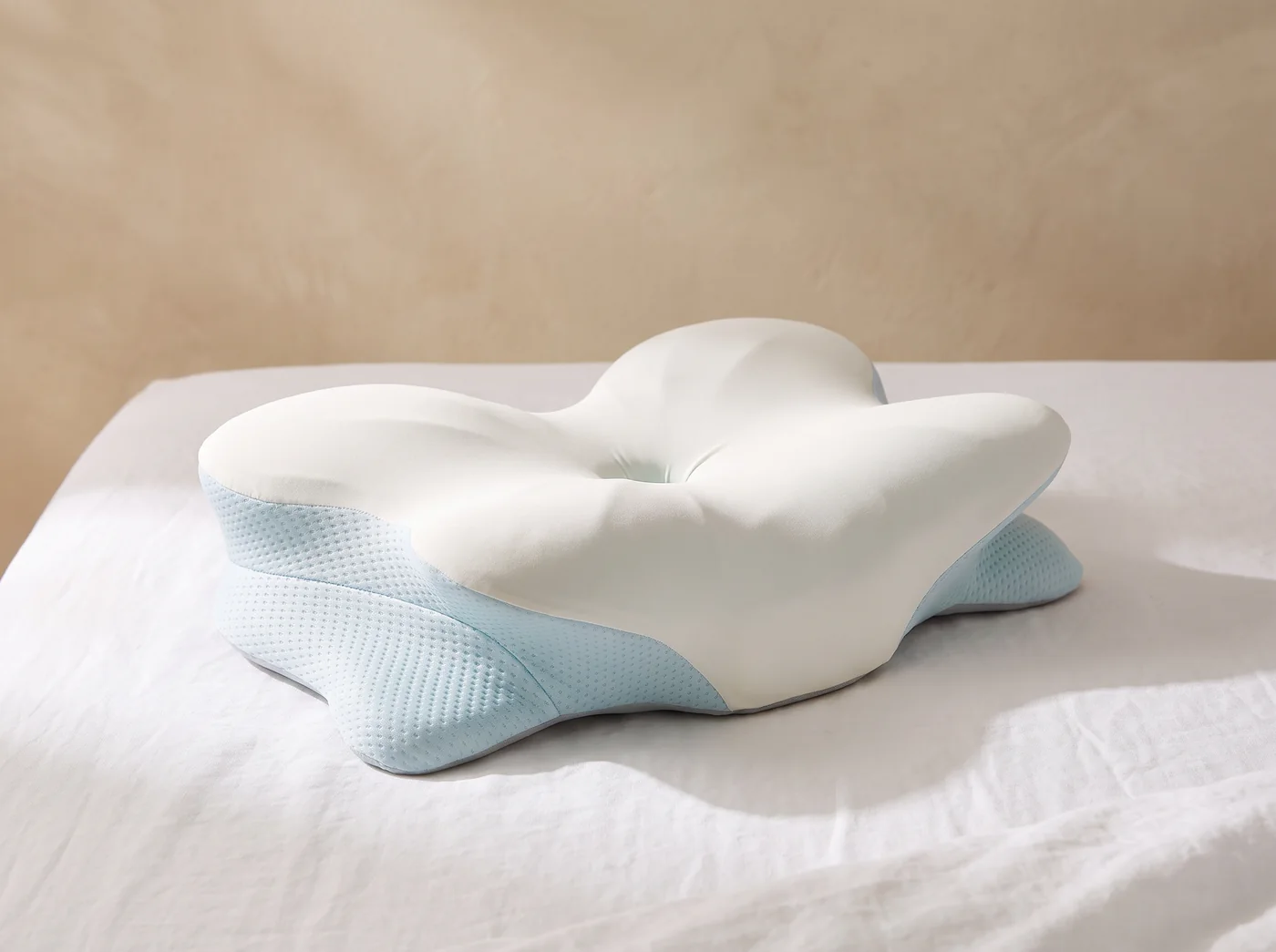
Our pick: Derila Ergo
The Derila Ergo is a contoured memory foam pillow built around that idea. The center is low for back sleeping, a raised roll supports the curve of your neck, and the wings at each side are taller for side sleeping. New mothers switch positions constantly, and this shape is the right height in both.
The foam is medium firm and holds its shape through the night. I have slept on it myself. It costs $59.99 for one or $99.98 for two, with shipping worked out at checkout, and it has a 60-day money-back guarantee, so you can judge it over several weeks of real nights. It suits side and back sleepers, not stomach sleepers.
We earn a commission if you buy through this link, at no extra cost to you. Full details in our Derila pillow review, or check your ideal height with the pillow height calculator.
What Pillows Cannot Fix
Posture pain is a dull ache that eases when you change position and improves over a week or two once the setup is right. See a doctor or physiotherapist if yours does not follow that pattern, in particular if you have:
- Numbness, tingling or weakness in an arm or hand
- Sharp pain at the base of the thumb or wrist when lifting the baby
- Neck pain with a severe headache, fever or changes in your vision
- Back pain that wakes you and does not ease in any position
- Pain that is getting worse after two weeks of better posture
If feeding itself hurts, or the baby struggles to latch, a lactation consultant can check positioning in person. A poor latch often causes poor posture, because you contort yourself to make it work.
Frequently Asked Questions
Why does my neck hurt from breastfeeding?
Mostly because of posture. Leaning down to the baby and looking at them for hours a day overloads the muscles at the back of the neck and between the shoulder blades. Raising the baby on pillows and looking up once they are latched removes most of the strain.
How do I stop neck and shoulder pain while breastfeeding?
Support your back, raise the baby to breast height with a firm pillow, rest your elbow on something, and put your feet on a low stool. Look up during the feed, switch sides and positions, and sleep on a pillow that keeps your neck straight.
Is side-lying breastfeeding better for neck pain?
In a 2024 survey of 395 breastfeeding women, neck pain was milder in those who fed lying down than in those who fed sitting in a chair. Rest your head fully on a pillow, keep bedding away from the baby, and move the baby to their own sleep space afterwards.
Do I need a nursing pillow?
It helps, but two firm bed pillows do the same job. What matters is that the baby is lifted to breast height so you do not lean. Use it only while you are awake and feeding, never for the baby to sleep on.
What pillow should I sleep on if breastfeeding hurts my neck?
A contoured pillow that supports the curve of the neck and is the right height for both side and back sleeping, since you will switch between them all night. That is why we recommend the Derila Ergo.
The Bottom Line
Raise the baby, drop your shoulders, look up, and switch positions. Then give your neck a proper pillow for the hours you do get to sleep. Most nursing neck pain eases within a couple of weeks of doing both.
Related: newborn night shifts for tired parents, how to sleep after giving birth, best pillows after a C-section and how to stop waking up with neck pain.
Sources
- The influence of breastfeeding factors on the prevalence of back and neck pain: data from an online survey. BMC Musculoskeletal Disorders, 2024.
- Musculoskeletal pain among breastfeeding women in Riyadh. Clinical and Experimental Obstetrics & Gynecology, 2023.
- US Consumer Product Safety Commission: Safety Standard for Nursing Pillows, Federal Register, 25 October 2024.
- American Academy of Pediatrics: A parent’s guide to safe sleep.
More Pillow Guides
Recommended for Pain-Free Sleep
🛌 Derila Ergonomic Memory Foam Pillow
Contoured design that holds your cervical spine in neutral for the full night. Works for side and back sleepers. Backed by a 60-day money-back guarantee on the official store.
- ✓ Memory foam contour
- ✓ Side & back sleeper design
- ✓ 60-day money-back guarantee