
Do You Really Swallow 8 Spiders a Year in Your Sleep?
The short version: No. No study stands behind the “eight spiders a year” figure, and the Burke Museum’s curator of arachnids says no case of a sleeping person swallowing a live spider is on formal record in the scientific or medical literature. Spiders read a sleeper’s breathing, heartbeat and snoring as danger. Even the myth’s famous origin story has fallen apart. What really shares your bed is much smaller, and a hot wash and a zip cover deal with it.
You have probably heard it from a friend or a quiz book: the average person swallows eight spiders a year while asleep. It sounds just plausible enough, and unpleasant enough to remember.
This page traces where the claim came from, using only sources we could open and check. Then it looks at what genuinely lives in bedding and pillows, and what to do about it without panic.
Key facts you can quote
- No case of a sleeping person swallowing a live spider is on formal record in the scientific or medical literature (Burke Museum, Rod Crawford).
- Arachnologist Rod Crawford estimates that a made-up bed has maybe one or two spiders cross it per year (Mental Floss, 2013).
- Adult house dust mites are about 0.5 mm long, and they cannot bite or sting (University of Kentucky Entomology).
- In a study of 10 used pillows aged 1.5 to more than 20 years, each held 4 to 16 species of fungi, and Aspergillus fumigatus was found in all 10 (Woodcock et al., Allergy, 2006).
- Bed bugs are not known to spread disease, and they tend to live within 8 feet of where people sleep (CDC).
Free to quote with a link to this page.
Where the claim came from (and why that story wobbles too)
Layer one: the Snopes account. For years the standard explanation came from the fact-checking site Snopes. As Mental Floss summarised it in 2013, Snopes said a columnist named Lisa Holst used the spider “statistic” in a 1993 PC Professional article, as an example of absurd things people believe when they read them in an email, borrowing it from a 1954 book on insect folklore. Her warning about false facts had become the most famous false fact of all.
Layer two: nobody could find Lisa Holst. The same Mental Floss piece found almost nothing about Holst or PC Professional beyond retellings of the spider story. A blogger who hunted for the column came up empty, and the Library of Congress had no record of the magazine. Its conclusion: the origin story itself might be made up.
Layer three: the book does not say it. Later reporting by Tyler Adkisson, now at Scripps News, found that the 1954 book, Insect Fact and Folklore, is real but has no section on spiders and does not contain the claim. No one has found Holst, and her name works as an anagram of “this is a big troll.”
Layer four: Snopes’ own position. Several later write-ups say Snopes has since described the Holst story as its own joke. We could not open the Snopes pages to confirm that, so treat it as reported, not verified.
What is left standing? Nobody has traced the figure to a real study, and its true starting point is unknown. A fake fact may have been given a fake origin, and the internet repeated both.
What the evidence actually says
Set the origin aside: could it happen? Arachnologists, the scientists who study spiders, have looked at it from the spider’s side.
| The claim | What the record shows | Source |
|---|---|---|
| People swallow spiders in their sleep | No case on formal record in scientific or medical literature | Burke Museum |
| Spiders are drawn to sleeping people | Breathing, heartbeat and snoring send vibrations that warn spiders off | Scientific American |
| Beds are full of spiders | Maybe one or two spiders cross a made-up bed per year | Mental Floss, quoting Rod Crawford |
| Spiders hunt in beds | Beds offer no prey for spiders, unless bed bugs are present | Scientific American |
| The figure came from a 1993 column | No trace of the column, the magazine or the author has been found | Mental Floss; Scripps News |
Rod Crawford, curator of arachnids at the Burke Museum in Seattle, calls it a very widespread urban legend with no basis in fact. So many unlikely things would have to happen at once that, for practical purposes, he says we can rule it out.
A spider would have to cross a breathing body, reach the face and walk into a mouth pushing out warm air. Crawford told Mental Floss that spiders are unlikely to enter a mouth exhaling warm breath. Scientific American added that an open-mouthed sleeper is likely snoring, which keeps spiders away, and that most people would wake if a spider crawled across their face.
Biologist Bill Shear told Scientific American that spiders regard us “much like they’d regard a big rock.” Crawford said vibrations are a big part of a spider’s world, and a sleeping person is not something a spider would willingly approach.
The experts do not say it is impossible, only that it would be a strictly random event. The one credible case Crawford gives involved a child in a grassy field on a windy day, when a ballooning spider (a young spider drifting on silk) blew into her open mouth. She was awake and outdoors.
Why the myth spreads so well
You cannot disprove it. You were asleep. Crawford notes that people who tell him they found a spider leg in their mouth never kept the evidence.
It comes with a number. “Eight a year” sounds measured, yet Crawford points out that the number changes with each telling.
It mixes disgust with a small truth. Spiders live in houses and mouths fall open in sleep. But as Carroll and Vreeman, authors of Don’t Swallow Your Gum!, told Mental Floss, we do not automatically swallow every time something enters our mouths, and the odds of everything lining up are tiny.
The debunk became part of the legend. A false fact invented to warn about false facts was such a good story that people shared it as eagerly as the myth.
What really is in your bed at night
Your bed is not spider territory, but it is not empty either. Here is what the evidence supports, without exaggeration.
House dust mites
Dust mites are relatives of spiders, ticks and chiggers. The University of Kentucky’s entomologists say adults are about 0.5 mm long, cannot bite or sting, feed mainly on shed skin flakes, and are most numerous in beds, stuffed sofas and nearby carpet.
They matter because of allergy: the allergy-causing proteins are found especially in their droppings. National Jewish Health notes that children allergic to dust mites are five times more likely to develop asthma.
You may have read that a third of an old pillow’s weight is dust mites and their debris. We could find no study behind that number, which is why we debunked it in our pillow replacement guide.
Fungi in pillows
In 2006, a team at the University of Manchester cultured fungi from 10 pillows that had been in regular use for between 1.5 and more than 20 years. Each held 4 to 16 species. Aspergillus fumigatus, a mould the authors flagged as relevant to asthma and sinusitis, turned up in all 10, and more of it was found in synthetic pillows than feather ones.
Ten pillows is a small sample, and the study measured what was there, not whether it made anyone ill.
Bed bugs, sometimes
Bed bugs are the one bed-dweller that does feed on sleeping people. The CDC says they range from 1 mm to 7 mm, hide during the day on or around the bed, and tend to live within 8 feet of where people sleep. They are not known to spread disease, but bites can cause itching, lost sleep and, rarely, allergic reactions. Signs include rusty spots on the mattress, shed skins and a sweet, musty smell. Since beds offer spiders nothing to eat unless bed bugs are present, a spider that keeps turning up in bed is a hint to check the seams.
What to do about it
Pick what worries you most.
You can let this one go.
- No case of a sleeping person swallowing a live spider is on record. Spiders avoid the vibrations a sleeping body makes.
- Beds give spiders nothing to eat. If you keep finding them on the bed, check the mattress seams for signs of bed bugs.
- If the worry itself keeps you awake, that is the real sleep problem; see our guide to a racing mind at night.
- Getting comfortable fast helps. A supportive pillow is a small, practical step.
Covers, heat and dry air do the work.
- Put your pillow and mattress in zippered, allergen-proof covers with pores too small for mites to pass through.
- Wash sheets and pillowcases weekly in hot water, 130°F (about 54°C), and dry on high heat.
- Keep indoor humidity below 50%. Mites take in water through their skin and dry out easily.
- For a child with a confirmed mite allergy, the University of Rochester advises synthetic-fibre pillows over foam, feather or down, so ask your doctor about fill.
A simple weekly routine is enough.
- Strip and hot-wash sheets and pillowcases once a week.
- Use a zip pillow protector under the pillowcase. It is far easier to wash than the pillow itself.
- Check the pillow, not just the case. If it is lumpy, flat or stained, our pillow replacement guide explains when to swap it.
The routine in short. Wash bedding weekly in 130°F water (National Jewish Health, University of Rochester). Put pillows and mattress in zippered dust-proof covers, which Kentucky, National Jewish Health and Rochester all recommend. Keep humidity under 50%; National Jewish Health says mites do not survive below it. If you find bed bug signs, act promptly: the CDC notes they can live several months without a blood meal.
A stuffy nose every morning, itchy eyes in bed or asthma that is worse at night is worth raising with a doctor. Allergy testing shows whether dust mites are really the trigger.
A pillow that is easy to keep clean and comfortable
None of this needs a new pillow. But if yours is flat, lumpy or leaves your neck sore, a bed clean-up is a good moment to fix that too.
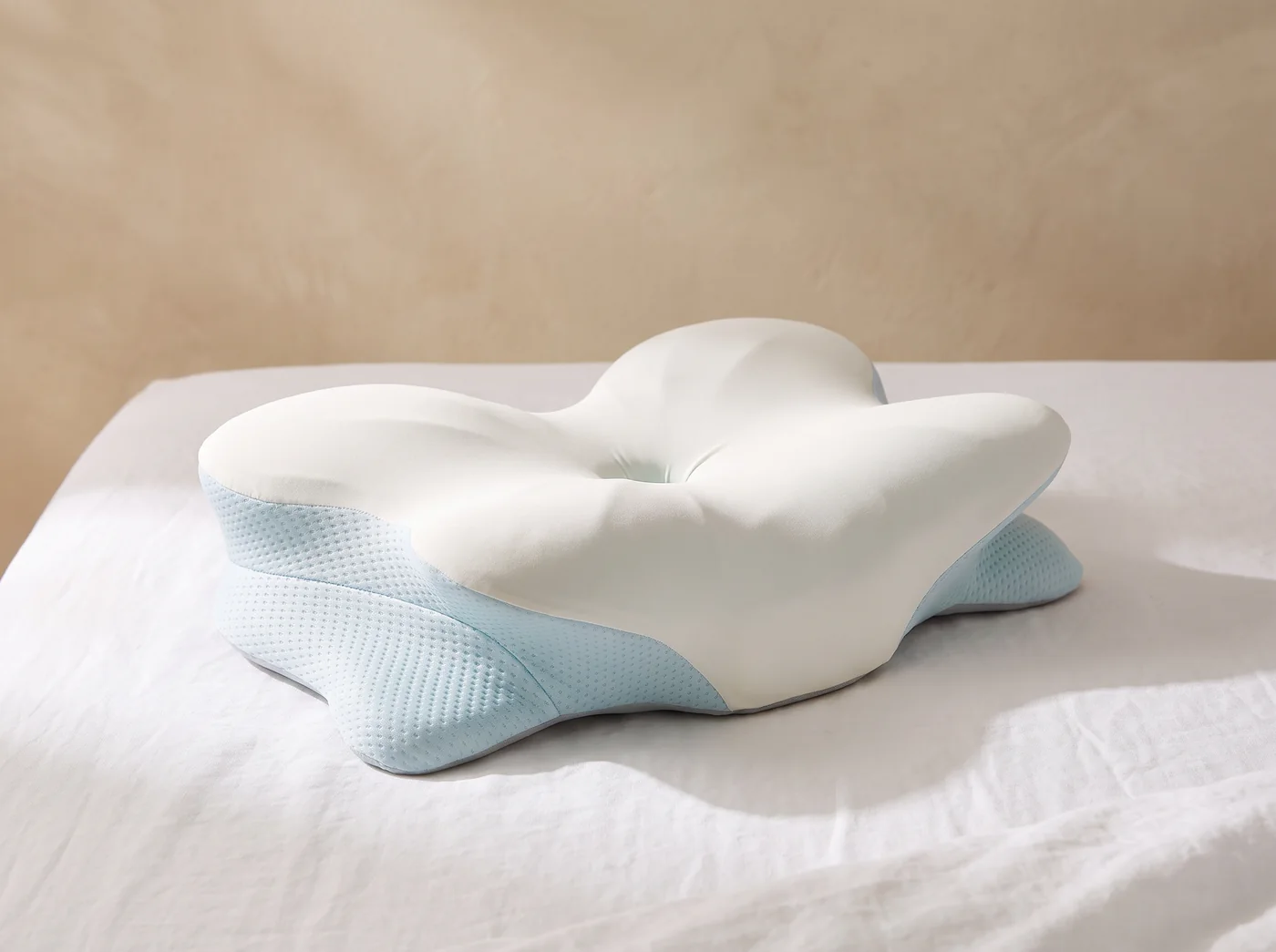
The Derila Ergo is a contoured memory-foam pillow with a low center (about 9 cm), a raised neck roll and taller side wings (about 12 cm). It is medium-firm and suits side and back sleepers, not stomach sleepers. I have slept on it myself. It costs $59.99 for one, $99.98 for two, or $149.96 for four (three plus one free), with a 60-day money-back guarantee. Shipping is calculated at checkout.
One honest note: the Derila sales page we checked does not say whether the pillow has a removable, washable cover, so we will not claim it. Treat it like any foam pillow: zip protector, pillowcase over that, both hot-washed weekly. With a diagnosed mite allergy, check pillow fill with your doctor first.
We earn a commission if you buy through this link, at no extra cost to you. Full details in our Derila pillow review.
Frequently asked questions
Has anyone ever actually swallowed a spider in their sleep?
No case is on formal record in the scientific or medical literature, according to the Burke Museum’s arachnid curator. Experts say it would be a rare, random event, not an eight-a-year habit.
Who was Lisa Holst?
She was said to have written a 1993 PC Professional column that invented the spider figure. Later checks found no trace of her, the column or the magazine, and her name is an anagram of “this is a big troll.”
Do spiders live in beds?
Not normally. Beds offer spiders no prey, and Rod Crawford estimates maybe one or two cross a made-up bed in a year. A spider that keeps turning up in bed is a reason to check for bed bugs.
What actually lives in my pillow?
Mostly dust mites, which feed on shed skin, and fungi. A 2006 study of 10 used pillows found 4 to 16 fungal species in each. A zip protector, weekly hot washes and a dry room keep both in check.
How often should I wash my bedding and pillowcases?
Weekly, in hot water of about 130°F (54°C), which is what National Jewish Health recommends. Wash the pillow itself according to its care label.
The bottom line
You do not swallow eight spiders a year in your sleep. The number has no study behind it, spider experts say sleeping people scare spiders off, and even the myth’s famous origin story has crumbled. What does share your bed is duller: dust mites, fungi and, now and then, bed bugs. A weekly hot wash, zip covers and a dry room handle it. If your pillow is past its best, choose one that supports your neck and keep it covered.
We earn a commission if you buy through this link, at no extra cost to you. Full details in our Derila pillow review.
Related: Do you really need 8 hours of sleep? · How often should you replace your pillow? · Nighttime anxiety and a racing mind · Derila pillow review
Sources
- Crawford, R. Myth: You swallow spiders in your sleep. Spider Myths, Burke Museum, University of Washington.
- Sneed, A. Fact or Fiction? People Swallow 8 Spiders a Year While They Sleep. Scientific American, 2014.
- Soniak, M. How Many Spiders Do You Really Swallow in Your Sleep? Mental Floss, 2013.
- Adkisson, T. Do sleeping humans swallow 8 spiders a year? Scripps News (formerly Newsy).
- Woodcock, A. A., Steel, N., Moore, C. B., Howard, S. J., Custovic, A., Denning, D. W. Fungal contamination of bedding. Allergy, 61(1), 140–142, 2006.
- Principato, S., Potter, M., DeVries, Z. House Dust Mites (ENTFACT-646). University of Kentucky College of Agriculture.
- National Jewish Health. Dust Mite Allergy.
- University of Rochester Medical Center. Dust Mites. Golisano Children’s Hospital.
- Centers for Disease Control and Prevention. About Bed Bugs.