
How to Choose a Mattress: Firmness, Type and the Pillow That Completes It
The short version: choose by sleep position and body weight first, type second and price last. For most adults, medium-firm is the best starting point; a large trial in The Lancet found it beat firm mattresses for back pain. Side sleepers and lighter people often prefer a little softer, heavier people a little firmer. Buy with a home trial, and remember the pillow: a new mattress changes the height you need. Our pick, the Derila Ergo, has two heights, so it fits every mattress type.
Mattress shopping is confusing on purpose: dozens of brands, invented foam names, and “sales” that never end. Underneath all that, the choice comes down to a few plain questions. This guide walks through them in order, with what the research actually says, and finishes with the piece most people forget: the pillow.
Short on time? Pick your sleep position below for your firmness and mattress type. Then see the pillow height that matches it; our pick, the Derila Ergo, has two heights and a 60-day money-back guarantee.

The Five-Step Method
- How do you sleep? Side, back, both or stomach. This sets the firmness more than anything else.
- What do you weigh? Lighter people sink less and usually like softer; heavier people sink more and usually need firmer support.
- Which feel do you like? Sinking in (memory foam), bouncy (innerspring), a mix (hybrid) or springy (latex).
- What are the return terms? A home trial of several weeks matters more than a showroom test.
- Does your pillow match? A new mattress changes how high your shoulder sits, so check your pillow height too.
Pick Your Sleep Position
Tap one and the plan changes.
Mostly on your side.
- Firmness: medium to medium-soft, so your shoulder and hip can sink in a little.
- Types that suit: memory foam, hybrid, or a mattress with a softer comfort layer.
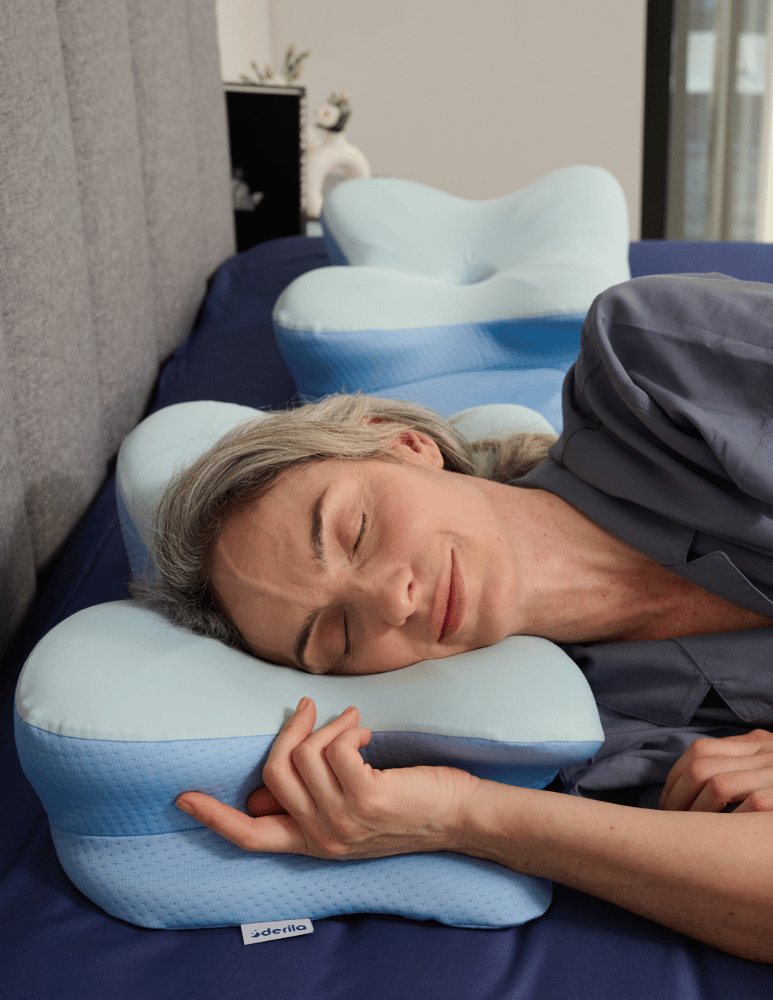
- Pillow: side sleepers need the most height. On a softer bed the Derila’s 12 cm wings settle into range.
Mostly on your back.
- Firmness: medium-firm, so your hips do not sink below your shoulders.
- Types that suit: hybrid, latex or a firmer memory foam.
- Pillow: about 8 to 10 cm under the neck. The Derila’s 9 cm center fits.
You change position during the night.
- Firmness: medium, with some bounce so turning over is easy.
- Types that suit: hybrid or latex; thick, slow memory foam can feel like turning in sand.
- Pillow: two heights in one, so you roll from center to wing.
Mostly on your front.
- Firmness: firm, so your hips stay level with your shoulders.
- Types that suit: innerspring, firm hybrid or latex.
- Tip: stomach sleeping is hard on the neck. A pillow with comfortable side wings makes moving onto your side easier.
What the Research Says About Firmness
For years people were told that a firm, hard mattress was best for the back. It was tested.
- The Lancet, 2003: 313 adults with chronic low back pain were randomly given either a firm or a medium-firm mattress. After 90 days, the medium-firm group had less pain in bed, less pain on rising and less disability.
- Sleep Health, 2015: a review of 24 controlled trials concluded that medium-firm mattresses, and self-adjustable ones, were best for sleep comfort, sleep quality and spinal alignment.
- Journal of Chiropractic Medicine, 2009: 59 people with beds that averaged 9.5 years old slept better and had less back discomfort within four weeks of switching to new medium-firm beds.
So medium-firm is the sensible default. From there, adjust a little softer for side sleeping or a lighter frame, and a little firmer for stomach sleeping or a heavier frame.
Firmness by Body Weight
| Body weight | Usually feels best | Why |
|---|---|---|
| Under about 130 lb (59 kg) | Medium to medium-soft | A light body sinks less, so a firm bed feels hard and presses on shoulders and hips. |
| About 130 to 230 lb (59 to 104 kg) | Medium-firm | The research default; enough give for the shoulder, enough support for the hips. |
| Over about 230 lb (104 kg) | Firm or medium-firm with a strong core | A heavier body sinks further, so it needs more support to keep the spine level. |
These are rules of thumb, not medical standards. Your own comfort over a few weeks is the real test.
The Main Types in One Line Each
- Memory foam: hugs and relieves pressure; can sleep warm and make turning slower.
- Innerspring: bouncy, cool and usually cheaper; less pressure relief.
- Hybrid: foam comfort layers over coils; a good middle ground for most people.
- Latex: springy, durable and cooler than memory foam; usually costs more.
- Airbed: you set the firmness, and each side can differ.
Our full mattress types comparison goes through each one, with who it suits.
What Is Worth Paying For, and What Is Not
Worth it
- A long home trial and clear return terms.
- A solid support core: good coils or dense base foam, which decide how long it keeps its shape.
- The right firmness for your position and weight.
Usually not
- Invented technology names with no explanation.
- “Was $3,000, now $999” pricing that never ends.
- Extra thickness for its own sake.
When to Replace Your Mattress
- It sags or has a dip where you sleep.
- You wake stiffer than you went to bed, and it eases as you move around.
- You sleep better in a hotel or on the sofa.
- It is old: in the study above, beds averaging 9.5 years old were the ones people improved on.
Do Not Forget the Pillow
A mattress holds up your body; the pillow holds up your head. Change one and the other has to match. On your side, the pillow fills the gap between your head and the mattress, and that gap depends on how far your shoulder sinks: less on a soft bed, more on a firm one. That is why a new mattress so often comes with a new stiff neck.
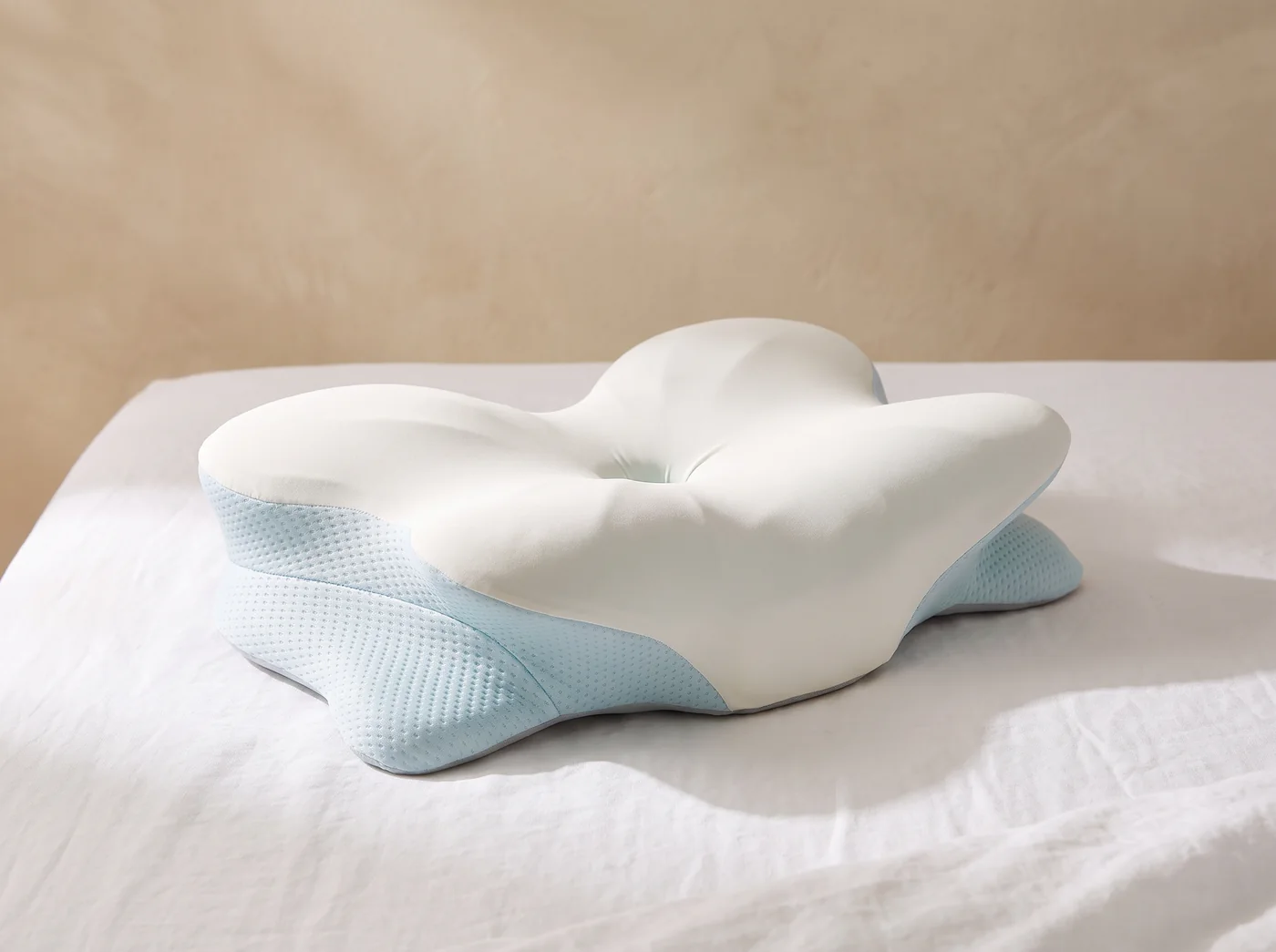
The Derila Ergo solves that with two heights in one pillow: about 9 cm in the center for back sleeping and 12 cm in the wings for side sleeping. Here is how it fits each mattress type:
| Mattress | How it feels | Derila zone for side sleeping | Back sleeping |
|---|---|---|---|
| Memory foam | Soft to medium, you sink in | Wings settle into range; narrow frames use the center | 9 cm center |
| Innerspring | Firmer and bouncier | 12 cm wings; very broad frames add a folded towel | 9 cm center |
| Hybrid (foam over coils) | Medium to medium-firm | 12 cm wings for most | 9 cm center |
| Latex | Springy, you sink less | 12 cm wings; very broad frames add a folded towel | 9 cm center |
| Pillow-top or plush | Soft top layer | Wings settle; narrow frames use the center | 9 cm center |
| Airbed (adjustable) | Whatever you set | Follow the matching row above | 9 cm center |
| Adjustable base, head raised | Upper body propped up | Not usually slept on the side when raised | 9 cm center, chin level |
That is the point of a two-height pillow: whatever the mattress does to your shoulder, one of the Derila’s zones lands in range. The memory foam settles a little under your head, which covers the softer beds, and a folded hand towel underneath adds about 1 cm for the firmest setups. It works on every common mattress type.
Our Pillow Pick: The Derila Ergo
- Two heights in one: about 9 cm (3.5 in) in the center for back sleeping, and about 12 cm (4.7 in) in the side wings for side sleeping.
- Butterfly shape: the curved sides leave room for your shoulder, so it does not get pushed under the pillow.
- Medium-firm memory foam: it settles a little under your head and then holds that height through the night.
- Removable, washable cover.
- 60-day money-back guarantee.
I have slept on it myself. On price, the official page lists $59.99 for one, $99.98 for two ($49.99 each) and $149.96 for four (three plus one free, $37.49 each). Shipping is calculated at checkout, and US delivery usually takes 8 to 12 business days. The brand holds a 4.1 out of 5 rating on Trustpilot. The seller sets the price, so check the current figure before you order. For more detail, see our full Derila pillow review.
Match Your Pillow to Your Mattress
Two heights that fit every mattress type, with a 60-day money-back guarantee.
We earn a commission if you buy through our links, at no extra cost to you.
If you still wake up stiff, our guide on how to stop waking up with neck pain covers the other common causes.
When to See a Doctor
A better bed helps ordinary aches. MedlinePlus advises contacting a health care provider if neck pain has not improved after a week of self-care, or if you notice any of the following:
- Numbness, tingling or weakness in your arm or hand
- Pain that gets worse when you lie down or wakes you at night
- A lump or swollen glands in your neck
- Trouble swallowing or breathing along with the neck pain
- Trouble walking or keeping your balance, or loss of bladder or bowel control
Get emergency care right away if you have a fever and headache with a neck so stiff you cannot touch your chin to your chest. Do the same if neck, jaw, shoulder or arm pain comes with shortness of breath, sweating or nausea, because that can be the heart, or if the pain followed a fall or a blow.
Frequently Asked Questions
How do I choose the right mattress?
Start with how you sleep and your body weight, which decide the firmness. Then choose a type you like the feel of: memory foam, innerspring, hybrid or latex. Buy with a home trial so you can judge it over a few weeks, and match your pillow to the new mattress.
What firmness is best?
For most adults, medium-firm. In a randomized trial of 313 adults with chronic low back pain published in The Lancet, people on medium-firm mattresses had less pain in bed and on rising than people on firm ones. Side sleepers and lighter people often prefer a little softer; heavier people a little firmer.
Is a firm mattress better for your back?
Not necessarily. The old advice that firmer is better was tested in that Lancet trial, and medium-firm beat firm for back pain. A 2015 review of 24 trials also found medium-firm mattresses best for comfort, sleep quality and spinal alignment.
How often should I replace my mattress?
When it sags, you wake stiff, or you sleep better elsewhere. In one study, people whose beds averaged 9.5 years old slept better and had less back discomfort within four weeks of switching to new medium-firm beds.
Do I need a new pillow with a new mattress?
Often, yes. Your mattress changes how far your shoulder sinks, which changes the pillow height you need on your side. A two-height pillow such as the Derila Ergo adapts to any mattress type.
The Bottom Line
Choose your mattress by sleep position and weight, start from medium-firm, buy with a home trial, and replace a sagging bed. Then match the pillow: the Derila Ergo’s two heights fit every mattress type, with 60 days to try it at home.
Try the Derila Ergo for 60 Days
If it does not suit your bed, the money-back guarantee covers you.
Related: mattress types compared, best mattress for neck pain and the Derila pillow on every mattress.
Sources
- Kovacs FM et al. Effect of firmness of mattress on chronic non-specific low-back pain: randomised, double-blind, controlled, multicentre trial. The Lancet, 2003. DOI
- Radwan A et al. Effect of different mattress designs on promoting sleep quality, pain reduction, and spinal alignment in adults with or without back pain: systematic review of controlled trials. Sleep Health, 2015. DOI
- Jacobson BH, Boolani A, Smith DB. Changes in back pain, sleep quality, and perceived stress after introduction of new bedding systems. Journal of Chiropractic Medicine, 2009. DOI
- MedlinePlus, US National Library of Medicine: Neck pain
More Pillow Guides
Recommended for Pain-Free Sleep
🛌 Derila Ergonomic Memory Foam Pillow
Contoured design that holds your cervical spine in neutral for the full night. Works for side and back sleepers. Backed by a 60-day money-back guarantee on the official store.
- ✓ Memory foam contour
- ✓ Side & back sleeper design
- ✓ 60-day money-back guarantee