
How to Sleep After Giving Birth: Positions, Pillows and the First Six Weeks
The short version: after a vaginal birth, most women sleep best on their side with a pillow between the knees, because it takes pressure off stitches and a sore pelvic floor. Back sleeping is fine again too. The real problem in the first six weeks is not how many hours you get but how broken they are, so the aim is to fall back asleep fast: get comfortable quickly, keep the baby’s bed within arm’s reach, and trade night shifts if you can. Never sleep with the baby on a sofa or armchair.
Nobody sleeps well with a newborn. But there is a difference between tired and wrecked, and a lot of it comes down to the forty minutes you waste after every feed trying to find a position that does not hurt. Stitches sting when you lie one way, your breasts ache when you lie another, and your back and neck complain about all of it.
This guide is about getting comfortable faster. It covers what your body is dealing with at night, the positions that help each problem, where the pillows go, and how to handle night feeds safely. It is written for recovery after a vaginal birth. If you had a caesarean, start with our guide to the best pillows after a C-section instead.
You Are Probably Getting More Sleep Than It Feels Like
A study in the American Journal of Obstetrics and Gynecology tracked new mothers with wrist monitors from week 2 to week 16 after birth. They averaged 7.2 hours of sleep a night, and that figure barely changed across the four months. What was wrong with their sleep was that it was shattered. The researchers compared the pattern to that of people with sleep disorders that break sleep into fragments.
That finding changes what you should aim for. You cannot stop the wake-ups. A newborn commonly feeds 8 to 12 times in 24 hours. What you can change is how long it takes to get back to sleep after each one, and how deep the sleep in between is. Both depend on being comfortable the moment you lie down.
One thing you can fix today: side sleeping needs a pillow that keeps your head level, and hours of looking down at a baby make a poor pillow hurt more. The one we recommend is the Derila Ergo, with a 60-day guarantee.
What Your Body Is Dealing With at Night
| What | When it is worst | What helps in bed |
|---|---|---|
| Sore stitches or a bruised pelvic floor | First one to two weeks | Side lying, pillow between the knees, cold pack before bed in the first days |
| Afterpains (cramps as the womb shrinks) | First few days, stronger during feeds | Knees bent, warmth on the stomach, the pain relief your midwife advised |
| Full, sore breasts | Days 2 to 5 as milk comes in, then on and off | Back or side sleeping, a small pillow hugged to stop the top breast pulling |
| Night sweats | First few weeks | Layers you can throw off, a towel on the sheet, water by the bed |
| Aching back, hips and neck | Builds over the first weeks | Knee pillow, and a head pillow that keeps your neck straight |
Bleeding after birth continues for a few weeks and can last up to about six, so protect the mattress and keep spare pads within reach. None of this needs special equipment. It needs three or four pillows in the right places.
Pick the Position for What Hurts Most
Tap the thing that is keeping you awake.
Lie on your side. It keeps your weight off the sore area completely.
- A pillow between your knees, running from knee to ankle, so your top leg does not pull on the stitches.
- A pillow behind your back so you can lean into it and not roll flat.
- A head pillow tall enough to keep your head level with your spine.
- Swap sides through the night if one side gets sore.
Back, or side with support. Stomach sleeping can wait until your breasts settle.
- On your back: a pillow under your knees and a low pillow under your head.
- On your side: hug a small pillow to your chest. It props the top breast so it does not drag.
- Sleep in a soft, non-wired bra if it is more comfortable, and keep a towel under you for leaks.
- A breast that is hot, red and painful, with a fever, needs a call to your midwife or doctor.
Keep your hips and spine in one line. The ligaments loosened by pregnancy take months to firm up again.
- On your side: a pillow between your knees so your top hip does not roll forward.
- On your back: a pillow under your knees to flatten the arch in your lower back.
- If the mattress sags, sleep nearer the edge where it is firmer.
- Roll onto your side and push up with your arms to get out of bed.
More on this: sleeping with a pillow between your knees.
Give your neck the night off. It spends the day bent over the baby.
- Use a pillow with a raised edge that fills the curve of your neck, not one that only lifts your head.
- On your side it should fill the gap between ear and mattress. On your back it should be lower.
- Do not fall asleep propped against the headboard with your chin on your chest.
- During feeds, bring the baby up to you with pillows so you are not hunching down.
More on this: breastfeeding neck and back pain.
The Best Sleeping Positions After Birth
On your side
The most comfortable position for most women in the first weeks. It keeps pressure off stitches and a swollen pelvic floor, and it is the easiest position to get up from. The details matter: knees slightly bent, a pillow between them, and your head level so your neck is not bent toward the mattress or the ceiling.
On your back
After months of being told not to, you can sleep on your back again. It is the kindest position for sore breasts. Put a pillow under your knees and keep the head pillow low. If you have stitches, back sleeping may feel sore at first, so try it again after a week.
On your stomach
There is no rule against it after a vaginal birth. Most women find their breasts decide the matter for the first few weeks. When it feels comfortable, it is fine.
Propped upright
Useful for feeding, poor for sleeping. Dozing upright against the headboard drops your head forward and is the fastest way to a stiff neck. It is also how babies end up asleep on a sleeping parent. If you are that tired, lie down.
Where the Pillows Go
- Between or under your knees: any medium pillow. This one does more for comfort than anything else.
- Behind your back: a spare bed pillow or the long side of a pregnancy body pillow, so you can rest on your side without holding yourself there.
- To sit on: a soft pillow or folded towel takes the sting out of sitting up to feed. Ask your midwife before buying a ring cushion, because advice on them varies.
- Under your head: the one pillow you use all night, every night, in every position. It is worth getting right.
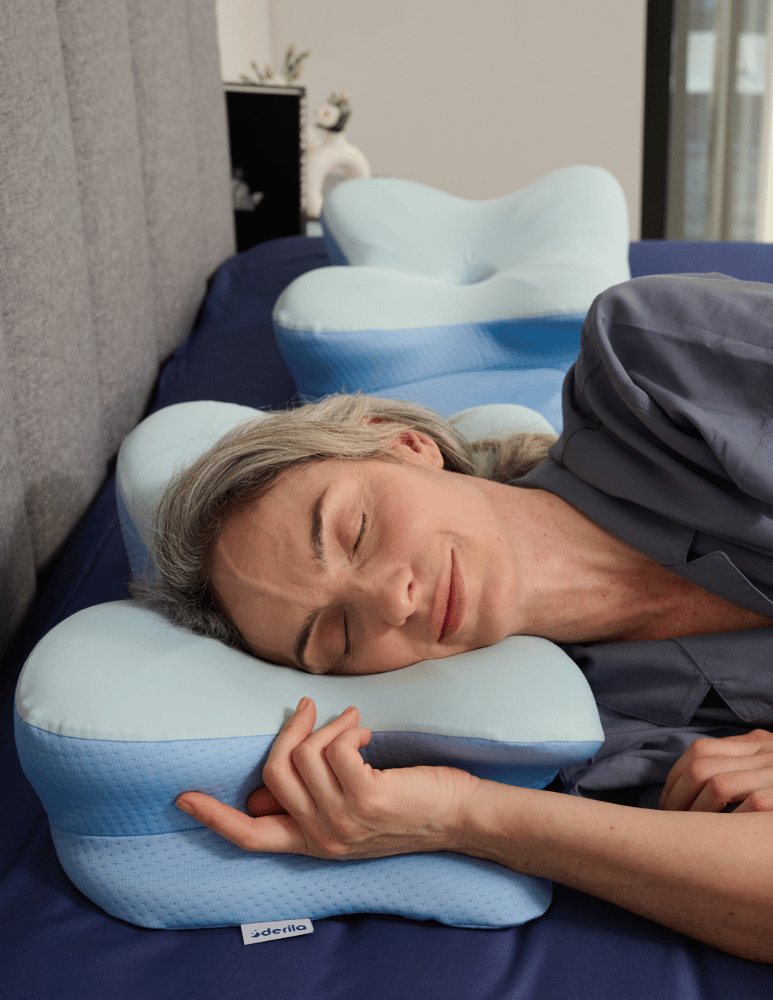
Our pick for the head pillow: Derila Ergo
The Derila Ergo is a contoured memory foam pillow. It has a low center for back sleeping, a raised roll that supports the curve of your neck, and taller wings at each side for when you turn onto your side. That matters after birth because you will be switching between side and back all night, and an ordinary pillow is the right height for only one of them.
The foam is medium firm, so it keeps its shape. It costs $59.99 for one or $99.98 for two, with shipping worked out at checkout, and has a 60-day money-back guarantee. I have slept on it myself. It is not the right choice if you sleep mainly on your stomach.
A pillow eases the ache; it does not treat the cause. If the pain is severe or getting worse, or comes with fever, heavy bleeding, a hot or swollen leg, or low mood that will not lift, call your midwife or doctor first.
We earn a commission if you buy through this link, at no extra cost to you. Full details in our Derila pillow review.
Night Feeds: The One Rule
In a 2024 University of Virginia study, more than 28% of new mothers said they had fallen asleep while feeding their baby in the previous two weeks. It is common, and it is where the real danger of this period lies.
The American Academy of Pediatrics says the risk of sleep-related infant death is up to 67 times higher when a baby sleeps with an adult on a sofa or armchair. Its 2022 guidance adds a practical point: if there is a chance you will nod off during a feed, your bed is less hazardous than a sofa or armchair. Clear pillows and loose covers away from the baby first, and move the baby to their own sleep space as soon as you wake.
- Keep the bassinet or crib right beside your bed, within arm’s reach.
- After every feed, the baby goes down on their back, on a firm flat surface with nothing else in it.
- If you feel yourself going during a feed on the sofa, move to the bed or hand the baby over.
Getting More Sleep Out of the Same Night
- Trade shifts. (Full schedules in our guide to newborn night shifts.) If someone else can cover one stretch of the night, even with a single bottle or by bringing the baby to you and settling them afterwards, you get one longer block of sleep. One unbroken block does more for you than the same hours in pieces.
- Go to bed early. The first stretch after the baby settles in the evening is often the longest. Do not spend it on the dishes.
- Set up before dark. Water, pads, a snack, burp cloths and pain relief within reach, so a feed does not turn into a walk around the house.
- Keep the lights low. A dim, warm night light for feeds and changes makes it easier for both of you to fall asleep again.
- Nap once, properly. One real daytime nap in bed with the curtains closed beats several half-naps on the sofa.
- Ask before taking sleep aids. If you are breastfeeding, check any sleep supplement or medicine with your doctor or pharmacist first.
When It Is More Than Tiredness
Broken sleep is normal. Some things are not, and a better pillow will not fix them. Speak to your midwife or doctor if you cannot sleep even when the baby is asleep and someone else is in charge, if your mood stays low or anxious for more than two weeks, or if pain is getting worse instead of better.
The CDC lists urgent warning signs that apply for a full year after birth. Get medical help straight away for bleeding that soaks through a pad in an hour, a fever of 100.4°F or higher, a headache that will not go away, changes in your vision, chest pain or trouble breathing, a painful swollen leg, or thoughts of harming yourself or your baby.
Frequently Asked Questions
What is the best position to sleep in after giving birth?
For most women, on the side with a pillow between the knees and the head level. It takes pressure off stitches and the pelvic floor and is easy to get up from. Back sleeping with a pillow under the knees is a good second choice, especially for sore breasts.
Can I sleep on my back after giving birth?
Yes. The advice to avoid back sleeping applies to late pregnancy, not to the weeks after birth. A pillow under your knees and a low head pillow make it more comfortable.
How can I sleep comfortably with stitches after birth?
Lie on your side with a pillow between your knees and another behind your back, and switch sides when one gets sore. A cold pack before bed helps in the first few days. Sit on a soft pillow or folded towel when you feed.
How much sleep do new mothers actually get?
About seven hours a night on average in one study that tracked mothers for the first four months, but in short pieces. That is why falling back asleep quickly matters more than going to bed earlier.
Which pillow helps most after giving birth?
Two do most of the work: a pillow between your knees for your hips and stitches, and a contoured head pillow that keeps your neck straight on your side and your back. The knee pillow can be any spare one. The head pillow is worth choosing well because you use it all night.
The Bottom Line
You will be woken. The win is in getting back to sleep quickly and sleeping deeply in between. Lie on your side, put a pillow between your knees, keep the baby’s bed within arm’s reach, and give your neck a pillow that fits both positions you will be using.
Related: best pillows after a C-section, breastfeeding neck and back pain and best pillow for pregnancy.
Sources
- Montgomery-Downs HE, Insana SP, Clegg-Kraynok MM, Mancini LM. Normative longitudinal maternal sleep: the first 4 postpartum months. American Journal of Obstetrics and Gynecology, 2010.
- UVA Health: Many moms fall asleep while feeding, 2024.
- American Academy of Pediatrics: A parent’s guide to safe sleep, and the 2022 safe sleep recommendations.
- CDC Hear Her campaign: Urgent maternal warning signs.