
How Do Police Officers Sleep?
The short version: Many police officers sleep short and at the wrong times, squeezed between night shifts, overtime and daytime court dates. In the largest study of its kind, 40.4% of 4,957 officers screened positive for at least one sleep disorder, most of them never diagnosed, and 26.1% said they fell asleep at the wheel at least once a month. Night shifts are linked to poorer sleep and higher injury rates, and daytime court between night shifts is linked to more citizen complaints. What helps most: a protected anchor sleep, a plan for court days, smart caffeine timing, a dark bedroom, and getting checked for sleep apnea.
Police work has a sleep problem built into it. Someone has to patrol at 3 a.m., court runs on daytime hours, and overtime fills the gaps that staffing leaves. Officers end up sleeping in short blocks, in daylight, with a radio or phone never far away.
This guide pulls together the best research on police sleep, from the landmark 2011 JAMA study to work on night shifts and injuries, and turns it into practical steps for officers on nights, on rotation, or heading to court after a night shift.

What the research says
These figures come straight from the published studies.
| Finding | Number | Source |
|---|---|---|
| Officers who screened positive for at least one sleep disorder | 40.4% of 4,957 | Rajaratnam et al., JAMA 2011 |
| Screened positive for obstructive sleep apnea | 33.6% | Rajaratnam et al., 2011 |
| Shift work disorder among officers working nights | 14.5% | Rajaratnam et al., 2011 |
| Fell asleep while driving at least once a month | 26.1% | Rajaratnam et al., 2011 |
| Poor sleep quality, by shift (day / afternoon / night) | 44% / 60% / 69% | Fekedulegn et al., 2016 |
| Injury rate on the midnight shift vs the day shift | 72% higher | Violanti et al., 2012 |
| Long-term injury (90+ days off), night vs day shift | 3.12 times the rate | Violanti et al., 2013 |
A note on reading this table: “screened positive” means likely, not diagnosed, and the injury studies come from one urban department’s payroll records, so they show a link with night work rather than proof of why. Still, the studies all point the same way.
Key facts you can quote
- 40.4% of 4,957 North American police officers screened positive for at least one sleep disorder, most never diagnosed (Rajaratnam et al., JAMA 2011).
- 33.6% of officers screened positive for obstructive sleep apnea (Rajaratnam et al., 2011).
- 26.1% of officers reported falling asleep while driving at least once a month (Rajaratnam et al., 2011).
- 69% of night-shift officers had poor sleep quality, compared with 44% on day shift (Fekedulegn et al., 2016).
- The injury rate on the midnight shift was 72% higher than on the day shift in one urban department (Violanti et al., 2012).
Free to quote with a link to this page.
Sleeping in daylight after a night tour? A pillow that keeps your neck straight on your side or back helps you settle faster when the house is bright and noisy.
The 2011 JAMA study, in plain English
The biggest study of police sleep was led by researchers at Brigham and Women’s Hospital in Boston and published in JAMA in December 2011. It screened 4,957 officers in the United States and Canada for common sleep disorders between 2005 and 2007, then followed 3,545 of them with monthly surveys for up to two years.
Four in ten screened positive for at least one sleep disorder. Sleep apnea, where the airway keeps closing during sleep, was by far the most common at 33.6%. Moderate to severe insomnia came in at 6.5%, and shift work disorder at 5.4% overall, rising to 14.5% among officers who worked nights. Most of these officers had never been diagnosed.
The follow-up surveys are where it gets serious. Compared with officers who screened negative, those who screened positive were more likely to report:
- a serious administrative error (17.9% vs 12.7%),
- falling asleep while driving (14.4% vs 9.2%),
- an error or safety violation they put down to fatigue (23.7% vs 15.5%),
- uncontrolled anger toward a suspect (34.1% vs 28.5%),
- absenteeism (26.0% vs 20.9%), and
- falling asleep in meetings (14.1% vs 7.0%).
They also reported more diabetes, depression and heart disease. The outcomes are self-reported, but the officer-safety message is clear.
The sleep problems that are specific to police work
Permanent nights
Officers on a fixed night shift have one advantage: a predictable pattern. The trouble is that many go back to daytime living on days off, which drags the body clock back and forth every week. In the Buffalo police study, 69% of night-shift officers had poor sleep quality, against 44% on days.
Rotating shifts
Rotating rosters mean the body clock never fully settles. Each change of shift is a small dose of jet lag, and the first nights after a switch are often the hardest. In a study of one urban police department’s payroll records from 1994 to 2010, the injury rate on the first day back on the midnight shift was 69% higher than on the day shift.
Court after a night shift
This one is almost unique to policing. An officer finishes a night shift at 7 a.m., is due in court at 9, waits for hours, then has a few hours to sleep before the next night. Researchers at Washington State University and Central Queensland University looked at 379 officers and 32,712 shifts across four US departments. They found citizen complaints were most common on night shifts, and that daytime court appearances between night shifts pushed the odds of a complaint up further. They linked it to lost sleep and called for court scheduling to take officers’ rosters into account.
Overtime and long shifts
Overtime eats the time that would otherwise go to sleep. A randomised trial in Detroit and Arlington, Texas, run by the Police Foundation (now the National Policing Institute) with Justice Department funding, compared 8, 10 and 12 hour shifts in 275 officers. Officers on 10-hour shifts got significantly more sleep than those on 8-hour shifts, and 8-hour officers worked more than five times as much overtime as 10-hour officers. Officers on 12-hour shifts reported more sleepiness and lower alertness at work than those on 8-hour shifts.
Advice for your schedule
Tap the situation that is closest to yours.
On permanent nights, keep your days off close to your work days.
- Sleep in one main block soon after you get home, in a fully dark room.
- On days off, go to bed a few hours later than a day worker would, instead of flipping right back to a normal schedule.
- Wear dark glasses on the drive home so the morning sun does not wake your body clock up.
- Stop caffeine in the second half of the shift so it has worn off by bedtime.
On rotating shifts, protect an anchor block and plan each switch.
- Choose a four-hour block you can sleep in on most days, whatever the shift, and guard it.
- Before your first night, take a long afternoon nap rather than staying up all day.
- After your last night, sleep a short block in the morning, then get up into daylight so you can sleep that evening.
- Be extra careful on the first night back. In one department, injury rates on the first day back on midnights were 69% higher than on day shift.
On a court day after nights, split your sleep and plan the gap.
- If court is late morning, try a short sleep straight after shift, even an hour, before you go in.
- After court, go straight home to sleep. Skip errands; your next shift starts sooner than it feels.
- Ask whether you can be placed on call, or given a time slot, instead of waiting in the building all day.
- Do not drive drowsy between the station, court and home. Take a nap first or get a lift.
Practical strategies that work in policing
Build your week around an anchor sleep
A block of sleep at roughly the same time on most days, with naps around it, gives the body clock a steady cue. Put your shift times into our free shift-work sleep planner to find a block that works with your roster and court dates.
Use naps on purpose
NIOSH, the US workplace safety agency, says short naps of 15 to 30 minutes and longer naps can both raise alertness. Sleep gets deepest after about an hour, and waking from deep sleep leaves you groggiest, so a short nap ending around 20 minutes is the safer choice before you drive or go back on patrol. NIOSH says this grogginess usually lasts no more than 30 minutes, but longer if you are already short of sleep, so give yourself that time before anything critical.
Time your caffeine
Caffeine works, but it lasts. A coffee late in a night shift can still be in your system when you try to sleep in the morning. Front-load it early in the shift or before a known slump. Our caffeine and sleep guide goes into timing.
Make the bedroom a daytime sleep room
Blackout blinds or curtains, a cool room, and steady background noise such as a fan cover most of what daytime sleep needs. A pillow that keeps your head level with your spine matters more than people think, especially if you carry a duty belt and vest all shift and wake with a stiff neck. Our guide to waking up with neck pain covers that.
Respect the drive home
NIOSH names shift work and long hours as key risk factors for sleep-related crashes, and says most drowsy-driving crashes and near misses happen between 4 and 6 a.m. It also cites research showing that sleeping under 5 hours raises crash risk four to five times. With 26.1% of officers in the JAMA study nodding off at the wheel monthly, this is an officer-safety issue.
Push for better schedules
Habits only go so far. The research supports asking about court scheduling around night shifts, overtime limits and sleep disorder screening.
What can help you sleep faster after a shift
No pillow fixes a bad roster. But when you get into bed at 8 a.m. with court at 2 p.m., falling asleep fast is worth a lot.
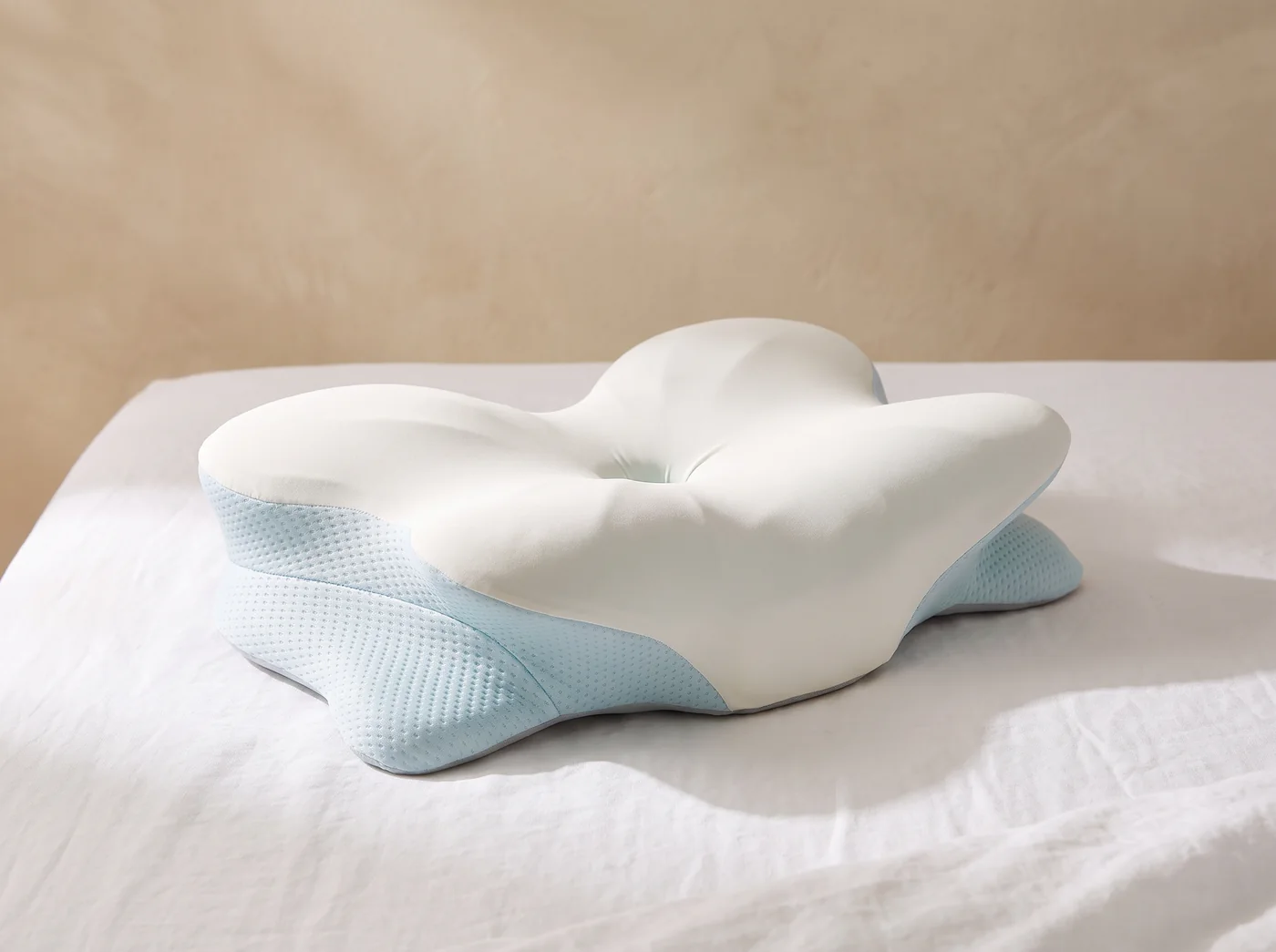
The Derila Ergo is a contoured memory-foam pillow with a low center (about 9 cm), taller side wings (about 12 cm) and a raised neck roll. It is medium-firm and is made for side and back sleepers; it does not suit stomach sleepers. The shape keeps your neck in line, which helps when you are trying to settle in daylight and for neck and shoulder strain after long hours in a vest and duty belt. I have slept on it myself. It costs $59.99 for one, $99.98 for two, or $149.96 for four (three plus one free), with shipping calculated at checkout and a 60-day money-back guarantee.
We earn a commission if you buy through this link, at no extra cost to you. Full details in our Derila pillow review.
If your neck or back already has a diagnosis. Long shifts in a patrol car, a heavy duty belt and body armor take a toll over the years. If a doctor has named the problem, our condition guides give the pillow height that fits it: the best pillow for a herniated disc in the neck, the best pillow for cervical stenosis, and the best pillow for spinal stenosis.
We do not suggest sleep supplements or sleep aids in this guide. Officers carry weapons, drive at speed and make split-second decisions, and anything that can leave you drowsy needs to go through your doctor and your department’s fitness-for-duty policy first.
When it is more than tiredness
Some signs mean it is time to see a doctor rather than just push through:
- Loud snoring, gasping or pauses in breathing at night, morning headaches, or dozing whenever you sit still. With a third of officers in the JAMA study screening positive for sleep apnea, this is worth checking. Our sleep apnea and snoring guide explains what happens next.
- Insomnia or heavy sleepiness that lasts for weeks and tracks your shifts. This can be shift work disorder, which doctors can diagnose and treat.
- Nodding off while driving. Treat it as a warning, not a joke.
- Nightmares, irritability, low mood, or drinking to get to sleep. These are common after hard calls and are a reason to reach out.
If you are struggling or thinking about ending your life, call or text 988 (the Suicide and Crisis Lifeline in the US), any time. CopLine at 1-800-267-5463 is a confidential, 24/7 line answered by retired law enforcement officers. Many departments also have peer support and an employee assistance program. If a racing mind is what keeps you awake, see our guide to nighttime anxiety and a racing mind.
Common questions
How many hours do police officers sleep?
It varies by shift, and many sleep less than they need. Shift length matters: in a randomised trial in two departments, officers on 10-hour shifts got significantly more sleep than officers on 8-hour shifts, partly because they worked far less overtime. Night-shift officers also report poorer sleep quality than day-shift officers.
Are sleep disorders common in police officers?
Yes. In the 2011 JAMA study of 4,957 officers, 40.4% screened positive for at least one sleep disorder, and 33.6% for obstructive sleep apnea. Most had never been diagnosed. If you snore loudly or are sleepy despite enough time in bed, ask your doctor about a sleep study.
Is it better to work permanent nights or rotating shifts?
Both are hard on sleep. Permanent nights give a steadier pattern, but many officers switch back to days on their days off. Rotating shifts mean frequent body-clock changes. Whichever you work, an anchor sleep block, a dark bedroom and a plan for shift changes make the biggest difference.
How do you sleep before court after a night shift?
Split your sleep. Take a short sleep right after shift if court allows, go straight home to sleep after court, and avoid driving drowsy in between. A dark, quiet room and a comfortable pillow, such as the Derila Ergo for side and back sleepers, help you fall asleep fast in the daytime gap.
Does fatigue affect officer safety?
The research says yes. Officers who screened positive for a sleep disorder reported more fatigue-related errors and safety violations and more falling asleep while driving, and one urban department saw a 72% higher injury rate on the midnight shift than on days. Better sleep is officer-safety equipment.
The bottom line
Nights, rotating rosters, overtime and court all compete with an officer’s sleep, and the research links that lost sleep to more errors, injuries, drowsy driving and complaints. Protect an anchor sleep, plan your court days, time your caffeine, darken your bedroom, and get checked for sleep apnea.
Getting to sleep fast between shifts and court? A contoured pillow for side and back sleepers keeps your neck straight so you can settle quickly in a bright, noisy day.
Related: How do firefighters sleep? · How do paramedics and EMTs sleep? · How do truck drivers sleep? · Resetting your circadian rhythm
Sources
- Rajaratnam SMW, Barger LK, Lockley SW, et al. Sleep disorders, health, and safety in police officers. JAMA. 2011;306(23):2567-2578.
- Violanti JM, Fekedulegn D, Andrew ME, et al. Shift work and the incidence of injury among police officers. American Journal of Industrial Medicine. 2012;55(3):217-227.
- Violanti JM, Fekedulegn D, Andrew ME, et al. Shift work and long-term injury among police officers. Scandinavian Journal of Work, Environment & Health. 2013;39(4):361-368.
- Fekedulegn D, Burchfiel CM, Charles LE, et al. Shift Work and Sleep Quality Among Urban Police Officers: The BCOPS Study. Journal of Occupational and Environmental Medicine. 2016;58(3):e66-e71.
- National Institute of Justice. 10-Hour Shifts Offer Cost Savings and Other Benefits to Law Enforcement Agencies (Amendola et al., Police Foundation shift length experiment). 2012.
- Washington State University. Forced court appearances make cops more tired, generate more citizen complaints. June 2018.
- NIOSH (CDC). Work Hour Training, Module 11: Drowsy Driving.
- NIOSH (CDC). Work Hour Training, Module 7: Nap Duration and Sleep Inertia.
- CopLine. copline.org. 988 Suicide and Crisis Lifeline. 988lifeline.org.