
How Do Paramedics and EMTs Sleep?
The short version: Paramedics and EMTs sleep in pieces: at the station between calls on 24-hour shifts, in the daytime after 12-hour nights, and in whatever gaps a rotating roster leaves. More than half of EMS clinicians are fatigued, and fatigued crews report about twice the odds of injury and of medical error. The 2018 national fatigue guidelines for EMS recommend shifts shorter than 24 hours, the chance to nap on duty, access to caffeine, fatigue education and regular fatigue checks. On your side of it, the biggest wins are protecting one solid anchor sleep, napping early and short, and treating the drive home as part of the shift.
Ask a medic how they sleep and you usually get a laugh first. The honest answer is “badly, and in bits.” A 24-hour shift might bring four hours of broken sleep in a station bunk, or none. A run of 12-hour nights means sleeping through the brightest part of the day. Then the days off arrive, and you try to be a normal person again.
This guide covers what the research shows about EMS sleep, what the national fatigue guidelines say agencies should do, and the habits that help most when you cannot simply “get more sleep.”

What the research says
Much of the EMS fatigue research comes from a team at the University of Pittsburgh. These numbers come straight from the published papers.
| Finding | Number | Source |
|---|---|---|
| EMS workers classed as fatigued | 55% of 547 surveyed | Patterson et al., 2012 |
| Average sleep quality score | 6.9, above the cut-off for poor sleep | Patterson et al., 2012 |
| Odds of injury, fatigued vs not fatigued | 1.9 times higher | Patterson et al., 2012 |
| Odds of a medical error or adverse event | 2.2 times higher | Patterson et al., 2012 |
| Odds of safety-compromising behavior | 3.6 times higher | Patterson et al., 2012 |
| Injury risk on shifts over 16 and up to 24 hours, vs 8 to 12 hours | 60% higher | Weaver et al., 2015 (966,082 shifts) |
| Injury risk on shifts of 8 hours or less, vs 8 to 12 hours | 30% lower | Weaver et al., 2015 |
One honest limit: the 2012 survey used self-reported outcomes, and its authors called the result preliminary evidence of an association, not proof. The 2015 study used real schedules and injury reports from 14 large agencies, which makes the shift-length finding harder to dismiss.
Key facts you can quote
- 55% of EMS workers in a 547-person survey were classed as fatigued (Patterson et al., 2012).
- Fatigued EMS workers had 1.9 times the odds of injury and 2.2 times the odds of a medical error or adverse event (Patterson et al., 2012).
- Across 966,082 EMS shifts, injury risk was 60% higher on shifts over 16 and up to 24 hours than on 8 to 12 hour shifts (Weaver et al., 2015).
- The 2018 national EMS fatigue guidelines make 5 recommendations, including shifts shorter than 24 hours and the chance to nap on duty (Patterson et al., 2018).
- A review of 13 experimental studies found on-shift naps reduced end-of-shift sleepiness in shift workers (Martin-Gill et al., 2018).
Free to quote with a link to this page.
What the national EMS fatigue guidelines recommend
In 2018 an expert panel published the first evidence-based guidelines for fatigue risk management in EMS, in the journal Prehospital Emergency Care. The work came out of the Fatigue in EMS Project, supported by the National Highway Traffic Safety Administration. The panel reviewed the research on seven questions and made five recommendations:
- Measure fatigue. Agencies should use fatigue or sleepiness surveys to monitor their people.
- Keep shifts under 24 hours. The panel recommends EMS personnel work shifts shorter than 24 hours.
- Allow caffeine. Crews should have access to caffeine as a fatigue countermeasure.
- Allow naps on duty. Personnel should have the opportunity to nap while on duty.
- Teach it. Staff should receive education and training on fatigue and fatigue-related risks.
On two other questions the panel made no recommendation because the evidence was too thin, so these five are what the evidence could actually support. If your service still runs 24s, that makes the guideline a useful, published document to bring to a labour-management meeting about naps, bunk rooms and shift design.
The sleep problems that are specific to EMS
Sleeping with one ear open
On a 24-hour shift, you lie down knowing the tones can drop at any moment. Even on a quiet night, station sleep tends to be lighter and more watchful than sleep at home, and it often comes in pieces.
Waking straight into a call
Being woken by the tones and driving lights and siren a minute later is one of the hardest things the body is asked to do. The groggy, slow feeling right after waking from deep sleep is called sleep inertia: your brain is awake enough to move but not yet sharp. NIOSH, the US workplace safety agency, says it usually lasts no longer than 30 minutes, though it can last longer when you are already sleep deprived. Those are exactly the minutes when you are reading the address and pulling out of the bay. Bright light, cold water and talking the call through with your partner help.
The 24/48 rotation
A common rota is 24 hours on, 48 off. The first day off goes to recovery sleep, the second to normal life. For some people the swing between a broken night at the station and a long lie-in at home leaves the body clock never quite sure what time it is.
12-hour nights and daytime sleep
Night-shift medics have to sleep when daylight, traffic and family life are at their loudest, and daytime sleep is usually shorter and lighter than night sleep.
Holdover and overtime
A late call can turn 12 hours into 14, and staffing gaps turn days off into shifts. The 2015 study is a reminder that those extra hours carry real injury risk.
Advice for your schedule
Tap the schedule that is closest to yours.
On 24s, sleep is something you grab, so make it easy to grab.
- Lie down early in the evening if the station is quiet. A sleep banked at 9 p.m. is worth more than hoping for 2 a.m.
- Keep daytime naps short (15 to 30 minutes) so you are less likely to wake up groggy into a call.
- On the morning off, sleep a few hours, then get up and get daylight. Keep the second day off close to your normal times.
- Bring your own pillow to the bunk room if allowed, so you settle faster in a strange bed.
On 12-hour nights, the daytime bedroom is your most important piece of kit.
- Black out the room fully, edges included.
- Wear sunglasses on the drive home and go to bed soon after you arrive, before errands.
- Stop caffeine in the second half of the shift so it is not still working when you lie down.
- Put the phone on do-not-disturb and tell family your sleep hours. White noise covers daytime traffic.
On a rotating roster, protect one fixed “anchor” block of sleep.
- Pick a four-hour window (for example 3 a.m. to 7 a.m., or 10 a.m. to 2 p.m.) you can sleep in on most days, whatever the shift.
- Rotate forward where you have a choice: days, then evenings, then nights is easier on the body than the reverse.
- Plan the switch day: a long nap before your first night, and a short sleep after your last night before getting up into daylight.
- Write your sleep windows on the same calendar as your shifts, so family plans fit around them.
Practical strategies that fit EMS rules
Nap on duty when you are allowed to
A 2018 review of 13 experimental studies, done for the EMS guidelines, found that planned naps during shift work reduced end-of-shift sleepiness, though the effect on reaction time was small. NIOSH notes that sleep reaches its deepest stage after about an hour, and waking from it causes the most grogginess. Waking at about 20 minutes, or at about 90 minutes at the end of a sleep cycle, leaves you less foggy. On a busy truck, the short nap is the safer bet.
Time your caffeine
Caffeine is in the guidelines because it works. Use it early in the shift or before a known low point, not as a constant drip, because a late coffee can still be working at bedtime. Our caffeine and sleep guide has the timing in more detail.
Use an anchor sleep and plan it
Whatever your schedule, try to keep one block of sleep at roughly the same time on most days. It gives your body clock something steady to hold on to. Put your shift times into our free shift-work sleep planner to see where your anchor block and naps can go.
Make the bunk and the bedroom work for you
You often cannot change the bunk room, but you can bring eye shades, earplugs and your own pillow if allowed. At home, aim for dark, cool and quiet. After a day of lifting stretchers, a pillow that keeps your head level with your spine matters; our pillow height calculator helps you find the right height.
Treat the drive home as part of the shift
NIOSH names shift work and long hours as key risk factors for sleep-related crashes, and says most drowsy-driving crashes and near misses happen between 4 and 6 a.m. It also cites research showing that sleeping under 5 hours raises crash risk four to five times. After a bad night, take a short nap before you drive, get a lift, or use a ride service. Yawning, drifting out of your lane and missing your exit are signs to stop, not push on.
What can help you sleep faster on odd hours
No product fixes a 24-hour shift. But when your sleep comes in short, unpredictable windows, getting comfortable fast is worth something.
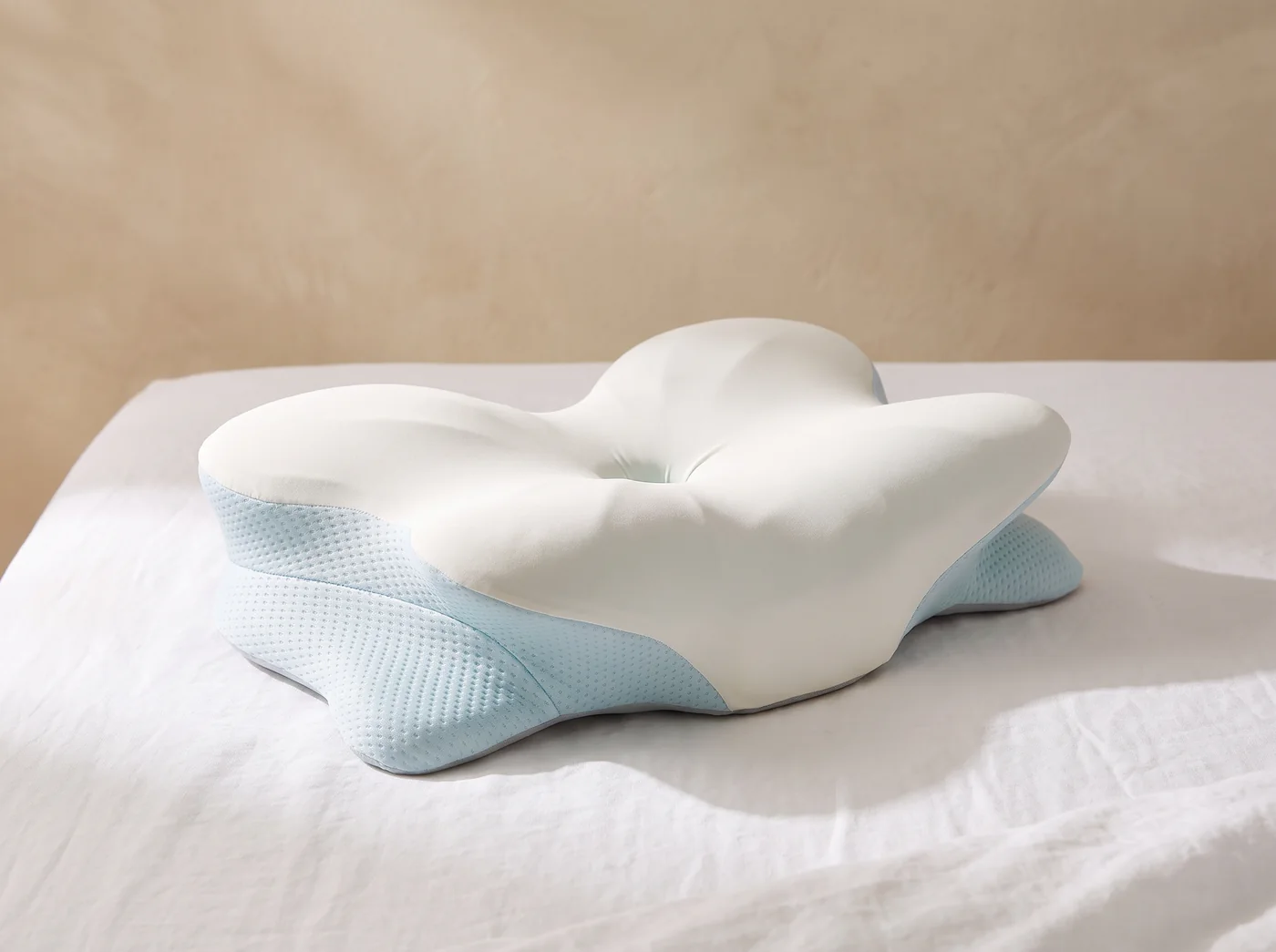
The Derila Ergo is a contoured memory-foam pillow with a low center (about 9 cm) and taller side wings (about 12 cm), plus a raised neck roll. It is medium-firm. The shape holds your neck in line when you sleep on your side or back, which is useful when you are lying down in the daytime or in a station bunk and want to settle quickly. It does not suit stomach sleepers. I have slept on it myself. It costs $59.99 for one, $99.98 for two, or $149.96 for four (three plus one free), with shipping calculated at checkout and a 60-day money-back guarantee.
Want our pillow pick? See our Derila Ergo review.
We earn a commission if you buy through this link, at no extra cost to you. Full details in our Derila pillow review.
If your neck or back already has a diagnosis. Lifting patients and stretchers, often in awkward positions, takes a toll over a career. If a doctor has named the problem, our condition guides give the pillow height that fits it: the best pillow for a herniated disc in the neck, the best pillow for spinal stenosis, and the best pillow for occipital neuralgia for headaches that start at the base of the skull.
If you consider a sleep supplement, keep it to days off: EMS crews drive and make clinical decisions.
For days off only: YU SLEEP
YU SLEEP is a liquid sleep supplement with red tart cherry, 5-HTP, vitamins B6 and B2, magnesium glycinate, apigenin, lemon balm, L-theanine, GABA and a low 0.9 mg of melatonin. We have not tested it ourselves. It comes with a 60-day guarantee. Never take it before driving, within the hours before a shift, or while on duty or on call. Follow your agency’s policy and your medical director.
Want our sleep-supplement pick? See why we chose YU SLEEP.
Do not take it with antidepressants (SSRIs, SNRIs, MAOIs) or other serotonin medicines, because it contains 5-HTP. If you take regular medication, are pregnant or breastfeeding, check with a doctor or pharmacist first.
When it is more than tiredness
Shift work makes almost everyone tired. Some signs point to something a doctor should look at:
- Loud snoring, gasping or stopping breathing in your sleep, or waking with headaches. These can be signs of sleep apnea, which is treatable and very common. Our sleep apnea and snoring guide explains the next steps.
- Insomnia or sleepiness that lasts for weeks and is clearly tied to your schedule. Doctors call this shift work disorder, and it can be diagnosed and treated.
- Nodding off while driving or on scene. Tell your supervisor and your doctor.
- Nightmares, flashbacks, low mood, or using alcohol to get to sleep. These are common after hard calls, and they are a reason to talk to someone, not a weakness.
If you are struggling or thinking about ending your life, call or text 988 (the Suicide and Crisis Lifeline in the US), any time, day or night. Many agencies also have peer support or an employee assistance program, and the Code Green Campaign keeps a mental health resource database. If racing thoughts are what keep you up, our guide to nighttime anxiety and a racing mind may help.
Common questions
Do paramedics sleep on 24-hour shifts?
Often, yes, when the call volume allows. Many services with 24-hour shifts have bunk rooms, and crews sleep between calls. How much sleep they get depends entirely on how busy the night is. The 2018 national EMS fatigue guidelines recommend that personnel have the opportunity to nap on duty.
Is a 24-hour shift safe for EMS?
The research points to more risk. A study of 966,082 EMS shifts found injury risk was 60% higher on shifts over 16 and up to 24 hours than on 8 to 12 hour shifts, and the 2018 guidelines recommend shifts shorter than 24 hours. Agencies that keep 24s can reduce the risk with on-duty naps, fatigue monitoring and education.
What is the best nap length on shift?
Short naps of about 15 to 30 minutes boost alertness with less grogginess, according to NIOSH, because you wake before reaching deep sleep. A nap of about 90 minutes can also work, since it ends near the end of a sleep cycle. The review behind the EMS guidelines found naps reduced end-of-shift sleepiness, but said more research is needed on ideal timing and length.
How can paramedics sleep better during the day?
Make the room fully dark, cool and quiet, go to bed soon after getting home, and stop caffeine well before the end of the shift. A pillow that keeps your neck straight, such as the Derila Ergo for side and back sleepers, can help you settle faster in daytime light and noise.
Can EMS workers take sleep supplements?
Only with care, and only on days off. Never take anything that causes drowsiness before driving, within the hours before a shift, or on call, and follow your agency’s policy. If you consider YU SLEEP, do not take it with antidepressants (SSRIs, SNRIs, MAOIs) or other serotonin medicines, because it contains 5-HTP. If you take regular medication, are pregnant or breastfeeding, check with a doctor or pharmacist first.
The bottom line
Paramedics and EMTs sleep in pieces, and tired crews get hurt more and make more mistakes. Agencies hold the biggest levers: shorter shifts, naps, caffeine, education and fatigue checks. On your side, protect one anchor sleep, nap short, time your caffeine, and never let the drive home be the most dangerous part of your day.
Sleeping in a station bunk or in daylight? A contoured pillow that keeps your neck straight on your side or back helps you settle fast when every minute of sleep counts.
Related: How do firefighters sleep? · How do night shift nurses sleep? · How do police officers sleep? · Resetting your circadian rhythm
Sources
- Patterson PD, Higgins JS, Van Dongen HPA, et al. Evidence-Based Guidelines for Fatigue Risk Management in Emergency Medical Services. Prehospital Emergency Care. 2018;22(sup1):89-101.
- Patterson PD, Weaver MD, Frank RC, et al. Association between poor sleep, fatigue, and safety outcomes in emergency medical services providers. Prehospital Emergency Care. 2012;16(1):86-97.
- Weaver MD, Patterson PD, Fabio A, et al. An observational study of shift length, crew familiarity, and occupational injury and illness in emergency medical services workers. Occupational and Environmental Medicine. 2015;72(11):798-804.
- Martin-Gill C, Barger LK, Moore CG, et al. Effects of Napping During Shift Work on Sleepiness and Performance in EMS Personnel and Similar Shift Workers: A Systematic Review and Meta-Analysis. Prehospital Emergency Care. 2018;22(sup1):47-57.
- Martin-Gill C, Higgins JS, Van Dongen HPA, et al. Proposed Performance Measures and Strategies for Implementation of the Fatigue Risk Management Guidelines for EMS. Prehospital Emergency Care. 2018;22(sup1):102-109.
- Studnek JR, Infinger AE, Renn ML, et al. Effect of Task Load Interventions on Fatigue in EMS Personnel and Other Shift Workers: A Systematic Review. Prehospital Emergency Care. 2018;22(sup1):81-88.
- NIOSH (CDC). Work Hour Training, Module 11: Drowsy Driving.
- NIOSH (CDC). Work Hour Training, Module 7: Nap Duration and Sleep Inertia.
- 988 Suicide and Crisis Lifeline. 988lifeline.org.