
Best Pillow for Men Over 50 With Neck Pain: Height, Snoring and Fit
The short version: after 50, a stiff neck in the morning often comes from the pillow. Most men need about 11 to 13 cm (4.25 to 5 in) of height on their side with the head on the pillow, and about 8 to 10 cm (3.25 to 4 in) on their back. If you snore, the side is the better place to be. Our pick is the Derila Ergo: 12 cm wings for side sleeping and a 9 cm center for your back, in one medium-firm pillow.
Plenty of men over 50 put up with a stiff neck every morning and blame it on age. Some of it is age. But a lot of it is the eight hours before you got up, spent on a pillow that is the wrong height, gone flat, or built for someone half your shoulder width.
The good news is that this is the easiest part to fix. This guide covers the height that suits a male frame, what changes after 50, what snoring has to do with it, and the pillow we recommend.
Short on time? Our pick is the Derila Ergo, a contoured memory foam pillow with two heights and a 60-day money-back guarantee. Pick your sleep position below to see how it fits.
The Quick Decision Table
| How you sleep | Height under your head | Derila Ergo fit |
|---|---|---|
| On your side, average frame | 11 to 13 cm (4.25 to 5 in) | Great. Use a 12 cm wing. |
| On your side, broad frame, firm mattress | 13 to 14 cm (5 to 5.5 in) | Great with a folded towel underneath. |
| On your back | 8 to 10 cm (3.25 to 4 in) | Great. Use the 9 cm center. |
| You snore | Your side height, and stay on your side | Great. The wings make side sleeping comfortable. |
| On your stomach | Very thin, or none | Move toward your side; the wings make it easy. |
What Changes for Men After 50
The neck
MedlinePlus, the US National Library of Medicine’s health site, says the main risk factor for wear in the neck joints, called cervical spondylosis, is aging, and that by age 60 most people show signs of it on x-ray. Many men never feel it. Those who do often notice stiffness and pain that is worse at night, sometimes running into the shoulder or causing headaches at the back of the head. A neck like that is less forgiving of a bad night. Our guide to the best pillow for cervical spondylosis goes further.
The shoulders
Shoulder width sets your side pillow height. The CDC’s national health survey measured it in thousands of American men. The average man was 41.1 cm (16.2 in) across the shoulders, about 4 cm wider than the average woman. That is why pillows sold as “one size” or “slim” often leave a man’s head dropping toward the mattress on his side.
The same survey shows shoulders narrowing slowly with age: an average of 41.0 cm in the 50s, 40.5 cm in the 60s and 39.7 cm in the 70s. The change is small, but it means the pillow that was perfect at 40 is worth rechecking now.
The nights
Sleep gets lighter with age. MedlinePlus notes that older people wake an average of 3 or 4 times a night and often get up to use the bathroom. Every waking means a turn, and a pillow that suits only one position is wrong part of every night. A pillow with a back zone and side zones fixes that.
Snoring
MedlinePlus lists a large neck size among the risk factors for obstructive sleep apnea, giving 17 inches (43 cm) or more as the mark for men, along with being overweight. It also says sleeping on your back can block or narrow the airway, and advises people with sleep apnea to avoid back sleeping. For a lot of men over 50, getting comfortable on the side is the single most useful change, for the neck and for whoever shares the bed. Our pillow guide for snorers has more.
Pick Your Setup
How do you sleep most of the night? Tap one and the plan changes.
Side sleeper.
- Target height: about 11 to 13 cm (4.25 to 5 in) with your head on the pillow for an average male frame. Broad shoulders on a firm bed: up to 14 cm.
- Check: lie on your side and have someone look from behind. Your neck should run straight from the middle of your back.
- Derila fit: a great match. The 12 cm wings sit right in this range. Very broad and on a firm mattress? A folded towel underneath adds a centimeter.
Back sleeper.
- Target height: about 8 to 10 cm (3.25 to 4 in) under your neck, so your chin is not pushed toward your chest.
- Check: your face points straight at the ceiling.
- Derila fit: a great match. The 9 cm center sits in this range, and the wings are there when you turn.
Snorer.
- Make your side your home. MedlinePlus says back sleeping can narrow the airway in sleep apnea and advises people with it to avoid it.
- Use a side height that feels good, about 11 to 13 cm for most men, so you are happy to stay there. A pillow behind your back stops you rolling over.
- Derila fit: the 12 cm wings make side sleeping comfortable, and the center is there for the times you end up on your back. Loud snoring with gasping deserves a doctor’s visit too.
Is a contoured pillow actually your answer?
Three questions, then a loft number and a straight yes or no — including the times the answer is no.
How to Measure Your Shoulder
This takes one minute and a tape measure. A second person makes it easier, but you can do it in a mirror.
- Stand up straight with your arms relaxed at your sides.
- Find the base of your neck on one side, the spot where the side of your neck meets the top of your shoulder.
- Find the tip of your shoulder: the bony point at the outer edge, just above the top of your arm.
- Measure straight across between the two points, along the top of the shoulder. Do not follow the curve down the arm.
Write the number down in centimeters or inches. That is your shoulder measure for the table below.
The Loft Numbers by Shoulder Measure
Loft is the height of the pillow with your head resting on it, not the height on the box. These are our starting points for a medium mattress. They are a rule of thumb, not a medical standard. Most men land in the bottom two rows.
| Shoulder measure (neck base to tip) | Side sleeping | Back sleeping |
|---|---|---|
| Under 11.5 cm (4.5 in) | 8 to 9 cm (3 to 3.5 in) | 7 to 8 cm (2.75 to 3.25 in) |
| 11.5 to 13 cm (4.5 to 5 in) | 9 to 10 cm (3.5 to 4 in) | 7 to 9 cm (2.75 to 3.5 in) |
| 13 to 15 cm (5 to 6 in) | 10 to 12 cm (4 to 4.75 in) | 8 to 9 cm (3.25 to 3.5 in) |
| Over 15 cm (6 in) | 12 to 14 cm (4.75 to 5.5 in) | 8 to 10 cm (3.25 to 4 in) |
Adjust for your mattress. On a soft mattress your shoulder sinks in, so take about 1 cm off the side number. On a firm mattress, add about 1 cm.
A 2021 review of pillow studies in Clinical Biomechanics found that a pillow’s shape and height affect neck alignment more than what it is filled with. For your own number, our pillow height calculator works it out in about thirty seconds.
Positions That Help
On your side: the best all-rounder
A 2019 scoping review in BMJ Open found that side lying was generally linked to fewer waking spinal symptoms than other positions, though the authors said good studies were few. Keep your head and neck on the pillow and your shoulder just in front of it. A pillow between your knees keeps your hips level, and one behind your back stops you rolling onto it. See the best ergonomic pillow for side sleepers for the full setup.
On your back: fine if you do not snore
Fill the curve behind your neck and let the back of your head rest slightly lower. A pillow under your knees eases the lower back. Our guide for back sleepers with neck pain goes deeper.
On your stomach: the one to retire
Face down, your head has to turn close to 90 degrees and stay there all night. A comfortable side setup is the easiest way to leave it behind.
What to Look for
1. Enough height for a man’s shoulders
Start with the table above. Slim and low-profile pillows suit narrow frames, not most men.
2. Two heights for a broken night
A lower center for your back and higher sides for your side keep you supported through every turn.
3. Medium-firm foam that holds up
A heavier head flattens fiber and feather pillows by the early hours. Medium-firm memory foam holds its height until morning.
4. Room for your shoulder
A butterfly shape lets a broad shoulder sit in front of the pillow instead of pushing into it.
5. A guarantee long enough to test it
A trial or money-back guarantee of at least a month lets you judge a new height properly.
Our Pick: The Derila Ergo
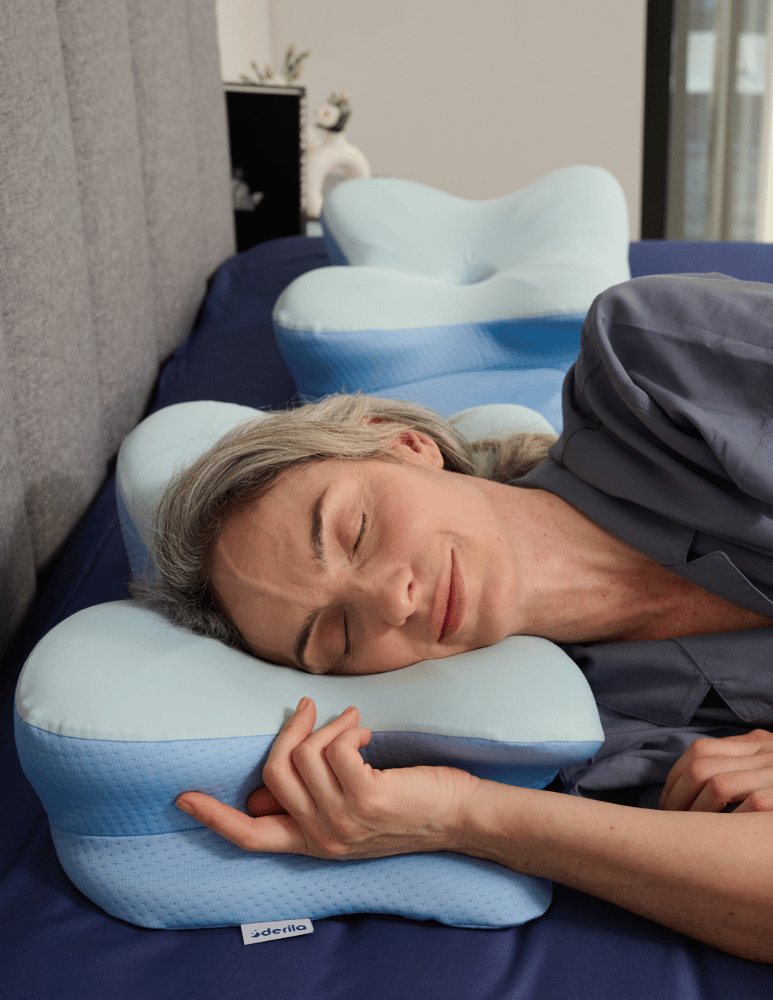
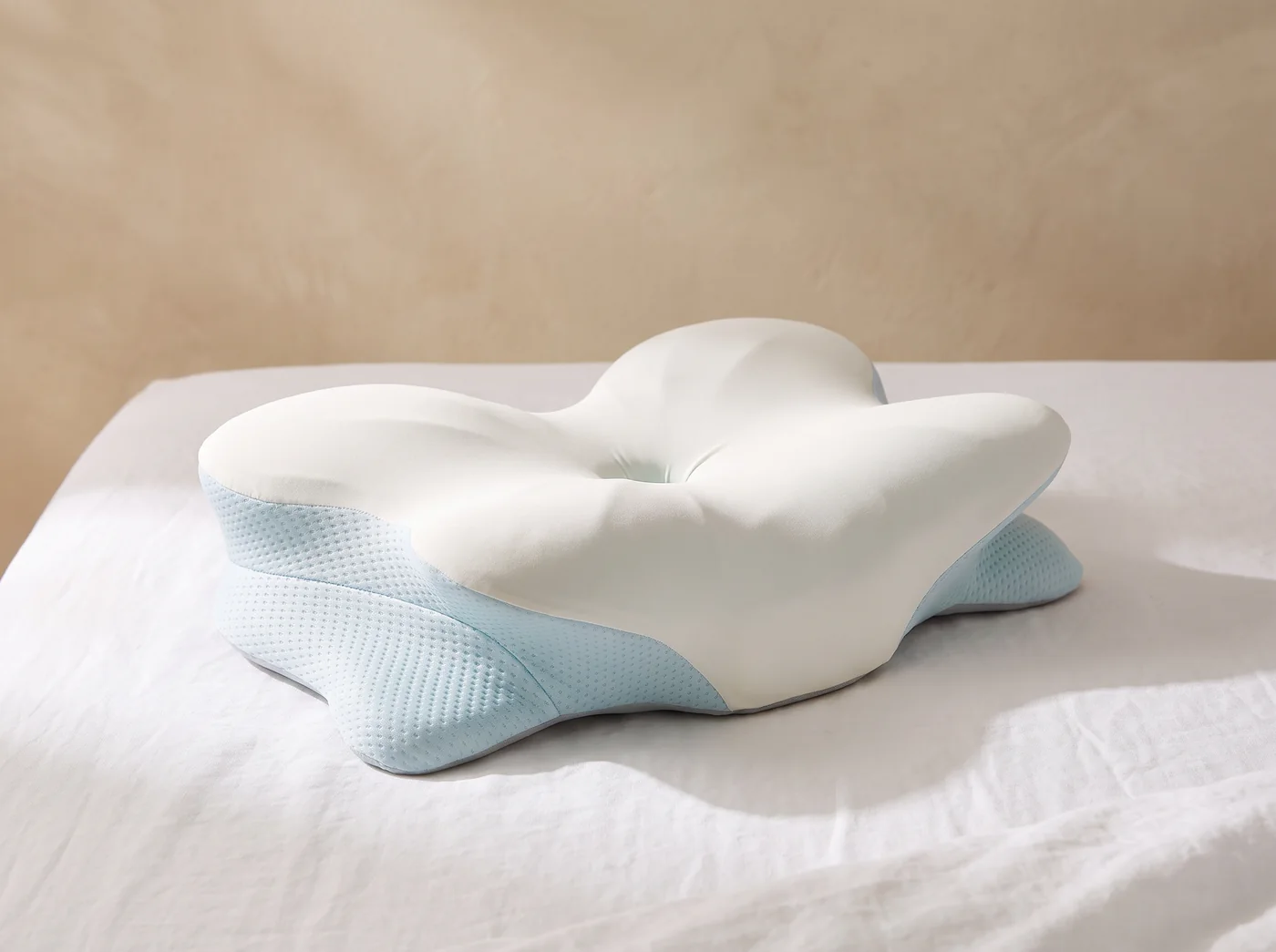
The Derila Ergo is the pillow we recommend for most men over 50 with neck pain. It gives a male frame the side height it needs and a proper back zone in the same pillow.
- Two heights in one: about 9 cm (3.5 in) in the center for back sleeping, and about 12 cm (4.7 in) in the side wings for side sleeping.
- Butterfly shape: the curved sides leave room for your shoulder, so it does not get pushed under the pillow.
- Medium-firm memory foam: it settles a little under your head and then holds that height through the night.
- Removable, washable cover.
- 60-day money-back guarantee.
Who it suits best
Side sleepers with average male shoulders are a perfect match for the 12 cm wings. Back sleepers get a 9 cm center that sits right in the target range. Snorers get side wings comfortable enough to stay on. Very broad shoulders on a firm mattress? Slide a folded hand towel under the pillow for the extra centimeter. And the 60-day guarantee means you find out on your own bed.
I have slept on it myself. On price, the official page lists $59.99 for one, $99.98 for two ($49.99 each) and $149.96 for four (three plus one free, $37.49 each). Shipping is calculated at checkout, and US delivery usually takes 8 to 12 business days. The brand holds a 4.1 out of 5 rating on Trustpilot. The seller sets the price, so check the current figure before you order. For more detail, see our full Derila pillow review.
Ready to Try the Derila Ergo?
12 cm wings for your side, a 9 cm center for your back, and a 60-day money-back guarantee.
We earn a commission if you buy through our links, at no extra cost to you.
Getting Used to It
- Give it two weeks. Your neck has been used to a different height. Judge it by your mornings.
- Use the right zone. Neck on the center when you are on your back, head on a wing when you are on your side.
- Keep your arm out from under it. At the right height you will not need it.
- Snorer? Put a pillow behind your back for the first couple of weeks so you stay on your side.
If you still wake up stiff, our guide on how to stop waking up with neck pain covers the other common causes.
What a Pillow Can and Cannot Do
A pillow that fits takes the night’s strain off your neck, which is often what turns a stiff morning into a normal one. It is not a medical device: it will not change arthritis, a disc problem or a pinched nerve, and it does not treat sleep apnea. The 2021 Clinical Biomechanics review found that some pillow designs reduced neck pain and waking symptoms, while noting that good studies are still few.
When to See a Doctor
Morning stiffness from a poor pillow usually eases as you move around. MedlinePlus advises contacting a health care provider if neck pain has not improved after a week of self-care, or if you notice any of the following:
- Numbness, tingling or weakness in your arm or hand
- Pain that gets worse when you lie down or wakes you at night
- A lump or swollen glands in your neck
- Trouble swallowing or breathing along with the neck pain
- Trouble walking or keeping your balance, or loss of bladder or bowel control
Get emergency care right away if you have a fever and headache with a neck so stiff you cannot touch your chin to your chest. Do the same if neck, jaw, shoulder or arm pain comes with shortness of breath, sweating or nausea, because that can be the heart, or if the pain followed a fall or a blow.
Loud snoring with gasping or choking, or feeling very sleepy in the day, are also worth raising with your doctor.
Frequently Asked Questions
What is the best pillow for a man over 50 with neck pain?
One that matches your shoulders on your side and fills the curve of your neck on your back. Most men over 50 need about 11 to 13 cm with the head on the pillow on their side, and 8 to 10 cm on their back. A contoured pillow with two heights, such as the Derila Ergo with its 9 cm center and 12 cm wings, covers both.
Why do I wake up with a stiff neck now when I never used to?
Wear in the neck joints is very common by this age; MedlinePlus says that by 60 most people show signs of it on x-ray. Sleep also gets lighter and more broken with age. Put together, a neck that is less forgiving spends more of the night shifting on a pillow that may not fit. Getting the height right removes one of the main causes.
Does my pillow affect snoring?
Position matters more than the pillow itself. MedlinePlus says sleeping on your back can cause the airway to become blocked or narrowed in obstructive sleep apnea, and advises people with it to avoid back sleeping. A side pillow at the right height makes side sleeping comfortable enough to stay there. Loud snoring with gasping or daytime sleepiness is worth raising with your doctor.
Do men need a taller pillow than women?
On the side, usually yes. CDC measurements put the average man about 4 cm wider across the shoulders than the average woman, which is about 2 cm more gap on each side. That means a taller side pillow. On the back the difference is small.
Should I replace my pillow as I get older?
If it has gone flat, yes, and it is worth rechecking the height. Shoulder width narrows slightly with age; CDC averages for men go from 41.0 cm in the 50s to 39.7 cm in the 70s. Many men also change mattresses over the years, which changes the height they need.
Is the Derila Ergo good for men over 50?
Yes, for most. Its 12 cm wings match the side height an average man needs, and its 9 cm center suits back sleeping. On a very firm mattress with broad shoulders, a folded hand towel under the pillow adds the extra centimeter. It has a 60-day money-back guarantee.
The Bottom Line
Most men over 50 need about 11 to 13 cm of pillow on their side and 8 to 10 cm on their back. Get both in one pillow, keep it medium-firm so it holds up all night, and if you snore, make your side your home.
The Derila Ergo is our pick because it does all of that in one pillow, with 60 days to try it at home.
Try the Derila Ergo for 60 Days
If it does not suit you, the money-back guarantee covers you.
Related: best pillow for broad shoulders, best pillow for neck arthritis and best pillow for neck pain.
Sources
- McDowell MA, Fryar CD, Ogden CL. Anthropometric reference data for children and adults: United States, 1988–1994. Vital and Health Statistics, Series 11, No. 249. National Center for Health Statistics, 2009. Tables 54 and 55, biacromial breadth. CDC (PDF)
- MedlinePlus: Cervical spondylosis
- MedlinePlus: Aging changes in sleep
- MedlinePlus: Obstructive sleep apnea, adults
- MedlinePlus, US National Library of Medicine: Neck pain
- Pang H, Tsang M, Fu S. The effects of pillow designs on neck pain, waking symptoms, neck disability, sleep quality and spinal alignment in adults: a systematic review and meta-analysis. Clinical Biomechanics, 2021. PubMed
- Cary D, Briffa K, McKenna L. Identifying relationships between sleep posture and non-specific spinal symptoms in adults: a scoping review. BMJ Open, 2019. PMC
More Pillow Guides
Recommended for Pain-Free Sleep
🛌 Derila Ergonomic Memory Foam Pillow
Contoured design that holds your cervical spine in neutral for the full night. Works for side and back sleepers. Backed by a 60-day money-back guarantee on the official store.
- ✓ Memory foam contour
- ✓ Side & back sleeper design
- ✓ 60-day money-back guarantee