
How Do Offshore and Oil Rig Workers Sleep?
The short version: Offshore and oil rig workers usually work 12-hour shifts for about two weeks, then go home for two to four weeks. They sleep in cabins on the installation, often shared with a colleague on the opposite shift, between noise, vibration and alarms. Most crews adapt to nights within one to two weeks, but switching back to days, whether mid-hitch on a swing shift or at home afterwards, is slower and harder. About 23% of shift workers on one North Sea rig met the criteria for shift work disorder.
Offshore work packs a fortnight of long days into one place you cannot leave. You work, eat and sleep a few decks apart, and the only commute is the helicopter at each end of the trip. That makes sleep both simpler and harder than onshore shift work: no school run or traffic, but no escape from the platform either.
This guide covers how offshore rotations are built, what the North Sea and other research says about sleep on them, what the UK regulator says about cabins and hot-bunking, and practical ways to sleep better on the hitch and back home. Every figure is sourced at the end.

What the research says
Most of what we know comes from Norwegian and UK studies of North Sea crews, pulled together in a 2013 systematic review by researchers at the University of Bergen. More recent work from drillships in the Gulf of Mexico and offshore wind farms in the German North Sea adds to it.
| Finding | The number | Source |
|---|---|---|
| Standard offshore shift length | 12 hours | Fossum et al., 2013 |
| Typical rotation | 2 weeks on, 4 off (Norway); 2 on, 2 off (UK) | Fossum et al., 2013 |
| Common swing shift | 7 nights, then 7 days | Fossum et al., 2013 |
| Rig shift workers with shift work disorder | 23.3% (24 of 103) | Waage et al., 2009 |
| Time to adapt to night work offshore | Usually 1 to 2 weeks | Fossum et al., 2013 |
| Night-adapted workers fully readapted within a week of going home | 6 of 19 | Gibbs et al., 2007, in Fossum et al. |
| Offshore wind workers who said they sleep worse offshore | 47.9% of 268 | Velasco Garrido et al., 2018 |
| Extra accident risk at night on one installation | 51% higher, 18:01 to 05:59 | Rodrigues et al., 2001, in Fossum et al. |
The accident figure comes from 17 accidents on a single unit, so it is a small study. Other offshore studies found no clear day-night difference in injuries. The safe reading is that night work can raise risk and needs managing, not that every night shift is dangerous.
Key facts you can quote
- Offshore shifts are typically 12 hours, with rotations of two weeks on and four off in Norway or two on and two off in the UK (Fossum et al., 2013).
- 23.3% of shift workers on a North Sea oil rig met the criteria for shift work disorder (Waage et al., Sleep, 2009).
- Offshore workers usually adapt to night shifts within one to two weeks, but readapting to days is slower (Fossum et al., 2013).
- UK regulator HSE says no one offshore should be required to share a bed, which it defines as hot-bunking (Operations Notice 82, 2026).
- 47.9% of offshore wind workers in the German North Sea said they sleep worse offshore than onshore (Velasco Garrido et al., BMJ Open, 2018).
Free to quote with a link to this page.
The sleep problems that come with offshore work
Twelve-hour days, fourteen in a row
A 12-hour shift plus handover, meals and a shower leaves around ten hours for everything else, sleep included, every day for two weeks. In Siri Waage’s University of Bergen research, sleep quality and insomnia complaints got worse across the two-week trip for both swing-shift and day workers. Her conclusion was that the long working days seemed to matter as much as the shift system itself. A 2021 review of 90 studies of rotation workers in mining, offshore oil and gas and construction found the same pattern: more sleep problems during work periods than on days off.
The swing shift
A swing shift means working nights for the first week and days for the second, so your body clock has to turn around mid-hitch. Studies disagree on how hard that is. One Norwegian study found sleep was shorter during swing shifts; another found more people with insomnia among swing workers than day workers by the end of the trip. On the other hand, swing workers sometimes settle back faster at home, because they finish the hitch already on days. The 2013 review did not name a clear winner between fixed and swing schedules.
Coming off nights at the end of the hitch
Many offshore crews adapt to nights within a week or two, perhaps helped by having no daylight commute or family timetable pulling them back. The flip side is the trip home. In one study only 6 of 19 night-adapted workers had fully readapted to days within a week of getting home, and on fixed nights, body-clock markers had still not readapted a week later. In the 2009 rig study, workers with shift work disorder still slept worse during their four weeks at home.
Shared cabins and hot-bunking
Cabins are often shared by two people, sometimes one on days and one on nights, so the cabin is never fully yours. The UK Health and Safety Executive (HSE) says no person should be required to share a bed. It counts changing the mattress or bedding so two people can use the same bunk as hot-bunking. HSE calls single or double cabins good practice, will not accept “2+1” cabins (two day workers plus one night worker) for new installations, and warns that overcrowding can disturb rest and sleep and increase fatigue. Cabins under 9 square meters can still house one person on days and one on nights.
Noise, vibration and air
Generators, compressors, drilling, cranes, helicopters and the sea itself are always there. In the German offshore wind study, more exposure to noise, vibration and poor air quality was linked to sleep problems, and sharing a cabin was linked to trouble staying asleep. That was wind farm staff, not oil and gas crews, but the platform conditions are similar.
Tiredness you do not notice
On two Gulf of Mexico drillships, researchers followed 70 workers through their hitch. Total sleep time held steady, yet reaction-time scores got worse over the trip on day, night and swing shifts alike. You can feel fine and still be slowing down by the second week.
Choose your situation
Tap the one closest to your rotation.
Fixed nights: commit to it
- Go to bed at the same time every morning, straight after your post-shift meal, and keep it the same all hitch.
- Make the cabin fully dark: eye mask, curtain clips, tape over standby lights.
- Agree quiet rules with your day-shift cabin mate: no lights or alarms during your sleep window.
- Wear sunglasses on the walk to the cabin if it is light outside, to help your body clock stay on nights.
Swing shift: manage the turnaround
- On the changeover day, take a short sleep after your last night, then stay up until a normal bedtime.
- Get bright light in the morning of your first day shifts and dim light in the evening.
- Expect a few rough days and keep caffeine to early in the shift so it does not wreck the first day-shift nights.
- Watch yourself and your crew for slips in the first days after the swap.
Home after the hitch: give it a week
- Do not plan a long drive straight after a night-shift trip and an early flight; get a sleep first.
- Go outside in morning daylight for the first few days to pull your clock back to days.
- Expect it to take around a week if you came off nights; tell your family that too.
- Keep your bedroom dark and cool so the first nights at home count.
What actually helps
One fixed sleep window
HSE notes that night workers’ daytime sleep tends to be lighter, shorter and more easily disturbed, and that meeting the Working Time Regulations alone is not enough to manage fatigue. Your sleep window is the part you can control. Pick it on day one and defend it: same time to bed, same time up, the whole hitch. Put your shift times into our free shift-work sleep planner to find where it fits best around meals and handovers.
Use light on purpose
Light is one of the main signals your body clock follows. On nights, keep light bright during the shift and dim on the way to bed. On a swing, flip that: bright light in the morning, dim in the evening. Our guide to resetting your circadian rhythm explains how.
Caffeine early, not late
Coffee is everywhere offshore and it helps on a 12-hour shift. Keep it to the first half of the shift so it has worn off before your sleep window. Our caffeine and sleep guide has the details.
Ask about the cabin
If you share a cabin, ask to be paired with someone on the opposite shift who keeps the same quiet rules. If you are on a UK installation, HSE’s accommodation guidance and your elected safety representative are the route for concerns about hot-bunking or overcrowding.
Make the bunk yours
Earplugs or a white-noise app, an eye mask and a pillow you know help a strange bunk feel like your bed. Check what your operator allows you to bring in your luggage.
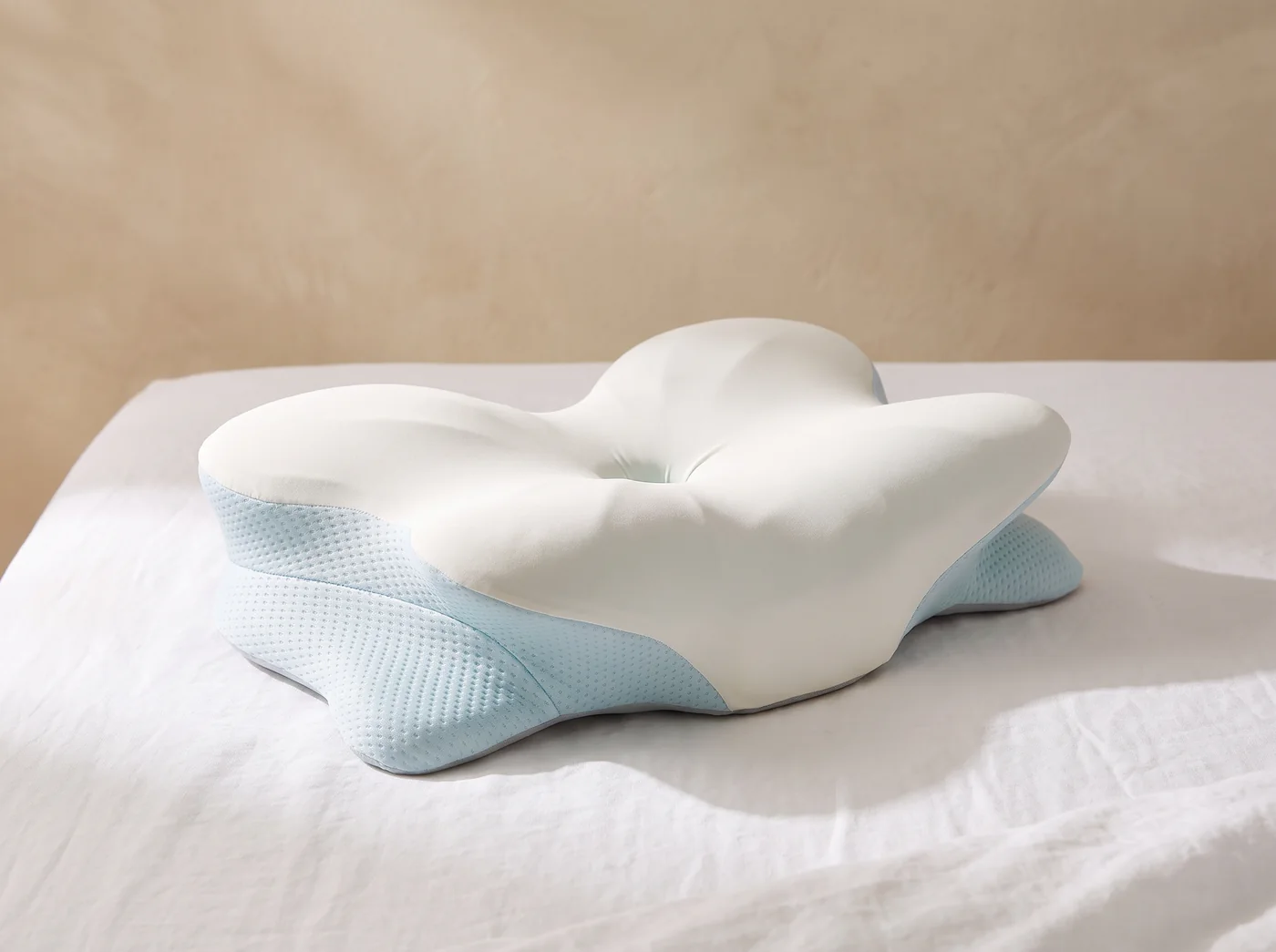
The pillow we suggest for day sleep and odd hours
The Derila Ergo is a contoured memory-foam pillow with a lower center (about 9 cm), a raised neck roll and taller side wings (about 12 cm). It is medium-firm and suits side and back sleepers; it is not a good fit if you sleep on your stomach. I have slept on it myself.
Why it fits offshore life: when you are sleeping in daylight or in the middle of a swing, getting comfortable quickly matters, and a pillow that keeps your neck in line helps with the neck and shoulder strain heavy work can leave. It works just as well for the first week back home, when your sleep is still finding its way back to nights.
It costs $59.99 for one, $99.98 for two, or $149.96 for four (three plus one free). Shipping is calculated at checkout, and there is a 60-day money-back guarantee.
We earn a commission if you buy through this link, at no extra cost to you. Full details in our Derila pillow review.
If your neck or back already has a diagnosis. Heavy lifting and long rotations of hard physical work add up over the years. If a doctor has named the problem, our condition guides give the pillow height that fits it: the best pillow for a herniated disc in the neck, the best pillow for spinal stenosis, and the best pillow for cervical stenosis.
For aching shoulders and backs after a heavy hitch, some workers use a topical pain reliever once home. ArcticBlast is an over-the-counter topical for adults; its FDA label lists menthol 10% and camphor 3% as the active ingredients, applied no more than three to four times a day.
When it is more than tiredness
- Insomnia or sleepiness that lasts into your time at home. If you are still sleeping badly a week or more after the hitch, that may be shift work disorder, a body-clock problem caused by working against your natural sleep time. It is treatable, so talk to your doctor or the installation medic.
- Loud snoring, gasping, or a cabin mate who says you stop breathing. These are signs of sleep apnea. Our sleep apnea and snoring guide explains the next steps.
- Nodding off at work or at the wheel. Report it. It is a safety issue, not a weakness.
- Low mood, anxiety or drinking to sleep. Time away from home is hard. Free, 24-hour lines: Samaritans 116 123 (UK and Ireland), Mental Helse 116 123 (Norway), Lifeline 13 11 14 (Australia), and 988 (US).
Common questions
How long are shifts on an oil rig?
Usually 12 hours. Workers typically do about two weeks of 12-hour shifts, then go home for two weeks (common in the UK) or four weeks (common in Norway).
What is a swing shift offshore?
A swing shift means working nights for part of the hitch and days for the rest, most often seven nights then seven days. Your body clock has to turn around in the middle of the trip.
Do oil rig workers share rooms?
Often, yes. Many cabins hold two people, frequently one on days and one on nights. In the UK, HSE says no one should be required to share a bed, and it treats single or double cabins as good practice.
How long does it take to adjust after an offshore hitch?
Around a week for many people coming off nights, sometimes longer. Studies found readapting to days is slower than adapting to nights, and in one study only 6 of 19 workers had fully readapted within a week.
What helps you sleep in a cabin on a rig?
A fixed sleep window, full darkness, earplugs, quiet rules with your cabin mate, early caffeine only, and a pillow that keeps your neck in line. We suggest the Derila Ergo for side and back sleepers.
The bottom line
Offshore workers sleep in shared cabins on 12-hour, two-week rotations, and most bodies cope with nights better than people expect. The hard parts are the swing in the middle, the long days stacking up, and the trip home. Protect one sleep window, use light deliberately, keep caffeine early, give yourself a week back home, and get help if poor sleep follows you onshore.
Sleep well on the hitch and at home. A contoured pillow helps you settle fast when you sleep at odd hours. 60-day money-back guarantee.
Related: How truck drivers sleep · How firefighters sleep · Resetting your circadian rhythm · Best pillow for shoulder pain
Sources
- Fossum IN, Bjorvatn B, Waage S, Pallesen S. Effects of shift and night work in the offshore petroleum industry: a systematic review. Industrial Health, 2013.
- Waage S, Moen BE, Pallesen S, et al. Shift work disorder among oil rig workers in the North Sea. Sleep, 2009.
- University of Bergen / Science Norway. Poor sleep in the North Sea (on Siri Waage’s thesis, Shift work, sleep and health in the petroleum offshore industry), 2013.
- Health and Safety Executive. Guidance on the provision of accommodation on offshore installations, Operations Notice 82 (Rev 4), 2026.
- Health and Safety Executive. Human factors: fatigue.
- Velasco Garrido M, Mette J, Mache S, et al. Sleep quality of offshore wind farm workers in the German exclusive economic zone: a cross-sectional study. BMJ Open, 2018.
- Kang J, Payne SC, Sasangohar F, Mehta RK. Field-based longitudinal evaluation of multimodal worker fatigue assessments in offshore shiftwork. Applied Ergonomics, 2024.
- Asare BY, Kwasnicka D, Powell D, Robinson S. Health and well-being of rotation workers in the mining, offshore oil and gas, and construction industry: a systematic review. BMJ Global Health, 2021.