

How to Sleep When Pregnant: A Trimester-by-Trimester Guide
The short version: in the first trimester sleep however you are comfortable. In the second, start building the side-sleeping habit and add a pillow between your knees. From 28 weeks, go to sleep on your side, either side, every time you settle down, including naps. If you wake up on your back, do not worry, just roll over. Pillows do most of the work: one between the knees, one under the bump, one behind your back, and a head pillow tall enough for side sleeping.
Pregnancy changes your sleep three times. The first trimester makes you exhausted but restless. The second is usually the calm in the middle. The third brings a bump that will not get comfortable, heartburn, a bladder with no patience and legs that will not keep still. Each stage needs a slightly different setup.
This guide goes through the three trimesters in order: what is disturbing your sleep, which position to use, and where the pillows go. It is general information. Your midwife or doctor knows your pregnancy, so their advice comes first.
How Common Is Poor Sleep in Pregnancy?
Common enough to count as normal. A 2021 analysis in the Journal of Sleep Research pooled 24 studies covering 15,564 pregnant women and found that 38.2% had insomnia symptoms. The rate climbed as pregnancy went on.
| Trimester | Insomnia symptoms | Restless legs | Main things keeping you awake |
|---|---|---|---|
| First (weeks 1 to 13) | 25.3% | 8% | Nausea, sore breasts, toilet trips, daytime sleepiness |
| Second (weeks 14 to 27) | 27.2% | 16% | Early heartburn, leg cramps, a growing bump |
| Third (weeks 28 to 40) | 39.7% | 22% | Bump weight, heartburn, back and hip ache, toilet trips, baby’s movements |
Insomnia figures: Sedov and colleagues, 2021. Restless legs figures: a 2017 meta-analysis of pregnancy studies.
Side sleeping for months needs the right head pillow. One that is too low lets your head drop and your shoulder take the weight. We recommend the Derila Ergo, a contoured pillow with raised sides for side sleepers and a 60-day guarantee.
Pick Your Trimester
Tap where you are now for tonight’s setup.
Weeks 1 to 13: any position that is comfortable.
- Position: back, side or stomach are all fine at this stage.
- Chest: if your breasts are sore, hug a soft pillow on your side to stop the top one pulling.
- Nausea: raise your upper body slightly and keep plain crackers by the bed for the morning.
- Head pillow: if you are not a side sleeper yet, now is the time to get a pillow that makes it comfortable.
Weeks 14 to 27: practise side sleeping.
- Position: mostly on your side, so it is a habit before week 28.
- Knees: a pillow between them keeps your hips level and eases your lower back.
- Bump: once it shows, a small pillow or folded towel under it stops it pulling on your back.
- Heartburn: raise your head and shoulders and eat earlier in the evening.
Weeks 28 to 40: fall asleep on your side, every time.
- Position: either side. Settle on your side for the night, for naps and when you go back to sleep after waking.
- Behind your back: a firm pillow, so that if you roll you land half on your side, not flat.
- Knees and ankles: a long pillow between them, from knee to foot.
- Bump: a wedge or small pillow under it.
- Head: a pillow tall enough to fill the space between ear and mattress, so your shoulder is not carrying your head.
First Trimester: Tired but Awake
Rising progesterone makes you sleepy during the day, yet nights are broken by nausea, tender breasts and the first extra trips to the toilet. There is no position rule yet. Sleep on your back, side or front, whichever works.
- Nap, but early. A short nap before mid afternoon takes the edge off without stealing from the night.
- Drink more in the morning, less in the evening. Keep your total up, just shift it earlier.
- Eat little and often. An empty stomach makes nausea worse, at night as well as in the morning.
- Keep caffeine under 200 mg a day, the limit advised in pregnancy, and have it before lunch.
Second Trimester: Build the Habit
For most women this is the easiest stretch. Nausea fades and the bump is still small. Use it to get ready for the third trimester, because habits are easier to form when you are comfortable.
Start settling on your side with a pillow between your knees. If you have always slept on your back, put a pillow behind you so that side lying feels supported, not like balancing. Leg cramps often start now. Stretch your calves before bed by pulling your toes up toward your shins, and if a cramp wakes you, do the same stretch and walk a few steps.
Heartburn tends to begin in this trimester too. Eat your evening meal earlier, keep the last few hours before bed for small snacks only, and raise your head and shoulders with a wedge or an extra pillow under the first.
Third Trimester: Side Sleeping Matters Now
From 28 weeks the advice becomes specific: go to sleep on your side. It comes from research into late stillbirth. The MiNESS study in the UK found that women who went to sleep on their back after 28 weeks had 2.3 times the risk of late stillbirth compared with those who went to sleep on their side. A 2019 analysis led from the University of Auckland, which combined the individual data from several such studies, put the figure at 2.6 times.
Three points from that research make the advice easier to live with:
- Either side is fine. The combined analysis found left and right equally safe. You do not have to stay on your left.
- It is the position you fall asleep in that counts. That is the one you hold longest. Nobody controls how they move once asleep.
- Waking on your back is not a reason to panic. Roll onto your side and go back to sleep. The overall risk is low, and this is one simple thing that lowers it further.
A pillow tucked firmly behind your back is the practical trick. It does not stop you turning, but it means that when you roll you end up tilted, not flat.
The other third-trimester problems
- Restless legs. About one in five pregnant women get the crawling urge to move their legs at night, most often in the third trimester. Mention it to your midwife, because low iron is a common and treatable cause. Stretching and a short walk before bed can help.
- Hip and pelvic pain. A full-length pillow between knees and ankles keeps your top leg level with your hip. If turning over is what hurts, see our guide to sleeping with pelvic girdle pain.
- Breathlessness. Propping your upper body on a wedge while lying on your side gives your lungs more room.
- A racing mind. Write tomorrow’s list down before bed and keep the same wind-down each night. Ask your midwife before taking any sleep aid or supplement.
Where the Pillows Go
| Pillow | Job | From when |
|---|---|---|
| Between knees and ankles | Keeps hips level, eases back and pelvis | Second trimester |
| Under the bump | Stops the weight pulling on your back | When the bump shows |
| Behind your back | Keeps you tilted if you roll | Week 28 at the latest |
| Wedge under the upper body | Heartburn and breathlessness | When either starts |
| Head pillow | Keeps your neck straight on your side | Every night |
A pregnancy body pillow can do the first three jobs in one piece. Our guide to the best pillow for pregnancy compares the shapes. None of them replaces the head pillow.
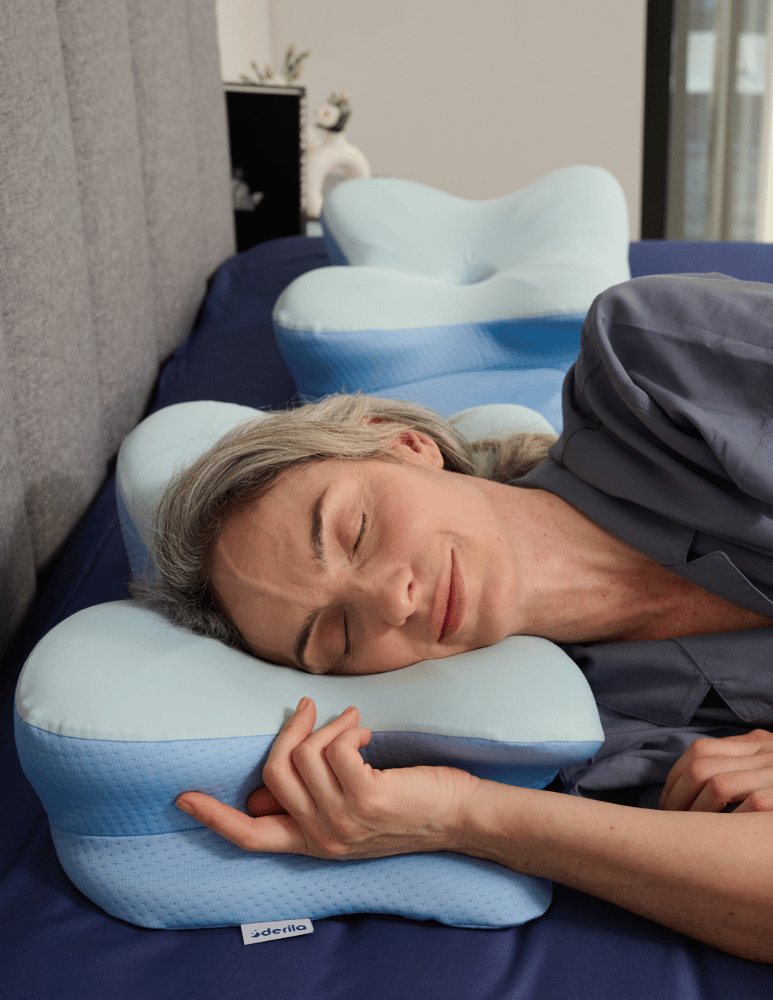
Our pick for the head pillow: Derila Ergo
If you spend six months on your side, the pillow under your head decides whether your neck and shoulder cope. The Derila Ergo is a contoured memory foam pillow with raised wings at each side for side sleeping, a roll that supports the curve of your neck, and a lower center for the times you are propped on your back. The foam is medium firm, so it does not flatten by 3am.
I have slept on it myself. It costs $59.99 for one or $99.98 for two, with shipping worked out at checkout, and it has a 60-day money-back guarantee. Memory foam holds a little more warmth than a fibre pillow, so if you run hot, use a cotton pillowcase.
A pillow eases the ache; it does not treat the cause. If the pain is severe or getting worse, or comes with bleeding, fever, a hot or swollen leg, or numbness, call your midwife or doctor first.
We earn a commission if you buy through this link, at no extra cost to you. Full details in our Derila pillow review.
When to Call Your Midwife or Doctor
Poor sleep is expected. These are not, and they need a call the same day: your baby’s movements slowing down or changing, a headache that will not go away, changes in your vision, sudden swelling of your face or hands, severe itching, or bleeding. Also mention loud snoring with pauses in breathing, since sleep apnea becomes more common in pregnancy and is treatable.
Frequently Asked Questions
Which side should I sleep on when pregnant?
Either. A 2019 analysis combining several studies found the left and right sides equally safe in late pregnancy. What matters from 28 weeks is going to sleep on your side and not on your back.
What happens if I wake up on my back?
Nothing to worry about. Roll onto your side and go back to sleep. The research is about the position you fall asleep in, because that is the one you hold longest. A pillow behind your back helps you stay tilted.
When should I stop sleeping on my back in pregnancy?
The advice applies from 28 weeks. It helps to start practising side sleeping in the second trimester so it is already a habit.
Can I sleep on my stomach while pregnant?
Yes, for as long as it is comfortable. The bump usually makes it impossible by the middle of the second trimester.
What pillows do I need for sleeping while pregnant?
One between your knees, one under the bump, one behind your back, and a head pillow tall enough for side sleeping. A body pillow can cover the first three. The head pillow is separate.
The Bottom Line
First trimester: sleep how you like. Second: practise your side. Third: fall asleep on your side every time, with a pillow behind you. Build the pillow setup as the bump grows, and give your neck a pillow made for side sleeping, because that is where you will be for months.
Related: best pillow for pregnancy, sleeping with pelvic girdle pain and how to sleep after giving birth.
Sources
- Sedov ID and colleagues. Insomnia symptoms during pregnancy: a meta-analysis. Journal of Sleep Research, 2021.
- Prevalence of restless legs syndrome during pregnancy: a systematic review and meta-analysis, 2017.
- Heazell AEP and colleagues. Association between maternal sleep practices and late stillbirth (MiNESS). BJOG, 2018.
- Cronin RS and colleagues. Individual participant data meta-analysis of maternal going-to-sleep position and late stillbirth. EClinicalMedicine, 2019. Summary: University of Auckland.