
How Do Pilots and Flight Attendants Sleep?
The short version: In hotel rooms, crew bunks and their own beds, at whatever hour the schedule allows. US airline pilots must get at least 10 hours of rest before duty, with an 8-hour chance to sleep built in. Flight attendants also get at least 10 hours of rest, but their rule does not promise a sleep window. On long flights with extra pilots, crews take turns in bunks, though bunk sleep is lighter and more broken than hotel sleep. The hardest nights are early report times and trips across many time zones.
Most people picture pilot fatigue as a long-haul problem: 15 hours over the Pacific, body clock somewhere over Alaska. That is real. But some of the shortest sleep in aviation happens on short-haul trips, when the alarm goes at 3:30 for a 4:45 report.
This guide covers what the rules require, how crews sleep on the aircraft and on layovers, what the research shows, and what helps. Every number links to a source at the end.
What the rules say
US airline pilots fly under 14 CFR Part 117, the FAA’s flight, duty and rest rules for airline crews. Before any flight duty period or reserve, a pilot must get at least 10 consecutive hours of rest, including 8 uninterrupted hours of sleep opportunity. If a pilot can see the rest period will not give 8 hours to sleep, they must tell the airline, and cannot report until they get a proper rest. The 10 hours start at release, so the hotel shuttle and check-in come out of them.
Part 117 also requires at least 30 consecutive hours free from all duty in any 168 hours. A pilot who crosses more than 60 degrees of longitude and is away from base for more than 168 hours must get 56 hours of rest at home, covering three “physiological nights”.
Flight attendants fall under 14 CFR 121.467. After a scheduled duty of up to 14 hours, they must get at least 10 consecutive hours of rest, and it cannot be reduced. Duty days of up to 16, 18 or 20 hours are allowed only when the airline adds extra flight attendants. Unlike the pilot rule, it does not spell out an 8-hour sleep window.
What the research says
| What was measured | Finding | Source |
|---|---|---|
| Pilot rest before duty (US) | 10 consecutive hours, including 8 uninterrupted hours of sleep opportunity | 14 CFR 117.25 |
| Flight attendant rest (US) | At least 10 consecutive hours after a scheduled duty of up to 14 hours | 14 CFR 121.467 |
| Sleep before a 04:00 to 05:00 report | 5.4 hours in the 12 hours before duty, against 6.6 hours for a 09:00 to 10:00 start | Roach et al., 2012 (70 short-haul pilots) |
| Sleep in the crew bunk | 70% sleep efficiency in flight against 88% in the layover hotel; 7.7 awakenings an hour against 4.6 | Signal et al., 2013 |
| Planned cockpit nap (NASA study) | 40-minute nap chance; pilots fell asleep in about 5 minutes and slept 26 minutes on average | Flight Safety Foundation review |
| Microsleeps at the controls | 76.8% of about 7,200 European pilots reported at least one in the previous four weeks (voluntary survey) | European Cockpit Association, 2026 |
| Flight attendant health | 2 to 5.7 times more sleep disorders, depression and fatigue than the general population | McNeely et al., 2014 (4,011 flight attendants) |
Key facts you can quote
- US airline pilots must get 10 consecutive hours of rest before duty, including 8 uninterrupted hours of sleep opportunity (14 CFR 117.25).
- Short-haul pilots slept 5.4 hours before 04:00 to 05:00 starts, losing about 15 minutes of sleep for every hour the report moved earlier than 09:00 (Roach et al., 2012).
- Sleep in on-board crew bunks was 70% efficient, against 88% in a layover hotel (Signal et al., 2013).
- 76.8% of about 7,200 European pilots reported at least one microsleep while operating an aircraft in the previous four weeks (ECA, 2026).
- US flight attendants reported 2 to 5.7 times more sleep disorders, depression and fatigue than the general population (McNeely et al., 2014).
Free to quote with a link to this page.
The sleep problems crews actually face
Early report times
The Roach study tracked 70 short-haul pilots with sleep diaries and wrist monitors. Sleep before duty fell by about 15 minutes for every hour the report moved before 09:00, and pilots felt most tired at the start of the earliest duties. You cannot fall asleep at 19:00 just because the alarm is set for 03:30. The body clock is not ready, so the night gets cut short at both ends.
Sleeping in the bunk
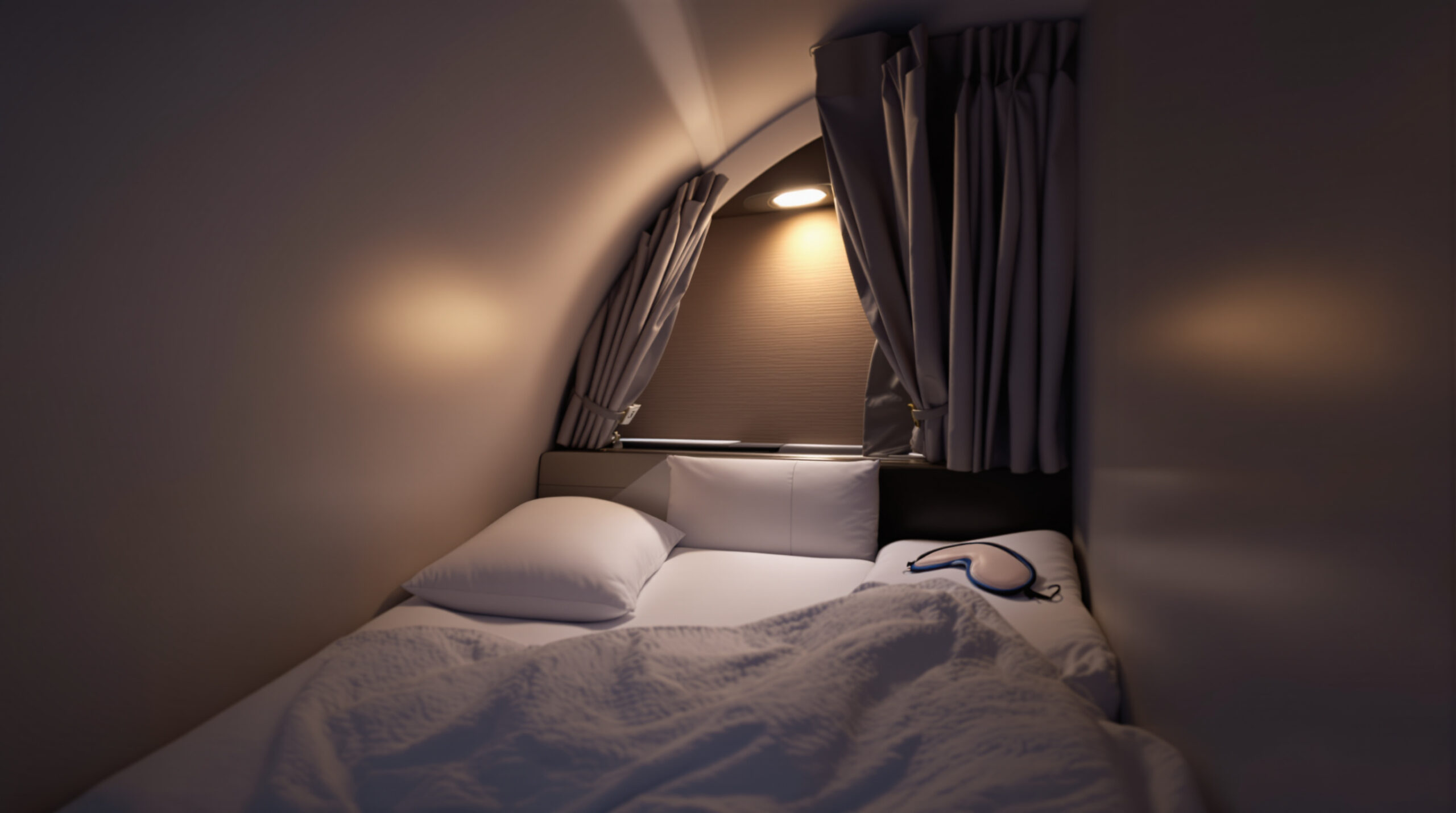
On long flights with an augmented crew (extra pilots, so they can rotate), Part 117 grades the rest areas. The best, Class 1, is a flat bunk separate from the flight deck and cabin, with control of light and temperature. Class 3, the lowest, is a seat that reclines at least 40 degrees. The pilot who will fly the landing must get a 2-hour break in the second half of the duty.
Even a good bunk is not a hotel bed. In the Signal study, recorded with sleep-lab equipment on flights averaging 15.7 hours, pilots woke far more often in the bunk, and almost none of their sleep was deep sleep (a median of 0.5%). Bunk sleep is a top-up, not a full night.
Naps on the flight deck
Here Europe and the US part ways. EASA publishes guidance for “controlled rest”: a short, planned nap in the seat during quiet cruise while the other pilot flies. The procedures reviewed by the Flight Safety Foundation mostly cap it at 30 to 45 minutes, start it only after top of climb, and require at least 20 minutes afterwards to shake off grogginess.
The FAA does not allow it for US airlines. Its fatigue advisory circular states that although some foreign airlines authorize in-seat cockpit naps, the FAA does not. Controlled rest was considered when Part 117 was written and left out of the final rule.
Jet lag and layovers
The CDC puts the body clock’s catch-up rate at about 1.5 hours a day after flying west and about 1 hour a day after flying east. A 24-hour layover nine time zones away is nowhere near enough, which is why the CDC advises that for trips of less than two days you should not try to adapt at all, and keep sleep and meals on home time.
Flight attendants: the least protected sleep
Cabin crew cross the same time zones, with a rest rule that guarantees time off but not a sleep window. A study that tracked 45 flight attendants and 25 teachers with activity monitors found the flight attendants slept longer in total, but were about twice as likely to fall in the worst group for sleep efficiency (time asleep while in bed) and about three times as likely to get the smallest share of their sleep at night.
Find your situation
Many time zones, a bunk break
- If you can choose, take the later break. In the Signal study, crews slept less when their break fell in the first half of the flight.
- On layovers under two days, stay on home time, as the CDC advises.
- Make the hotel room dark, cool and quiet. Pack clips for curtain gaps.
- Use the 56-hour home rest for three real nights in your own bed.
The 04:00 report
- Expect to lose sleep: about 15 minutes for each hour the report moves before 09:00.
- Shift bedtime earlier over several days before a run of earlies, not all at once.
- If a late release or slow shuttle means no 8-hour sleep window, Part 117 says you must tell the airline.
- An early-afternoon nap can cover part of the gap without pushing bedtime later.
Cabin crew on mixed trips
- Know your floor: 10 consecutive hours of rest after a scheduled duty of up to 14 hours, never reduced.
- The commute eats into those 10 hours, so protect the middle of them for sleep.
- On quick international turns, eat and sleep on home time when you can.
- If you sleep long but wake a lot, and it lasts, raise it with a doctor.
What helps, within the rules
Plan the sleep, not just the trip. Before a run of duties, mark where the 8-hour windows fall and what will eat into them. Put your report times into our free shift-work sleep planner to see where your anchor sleep (one block at the same home time each day) should go.
Caffeine with a cut-off. Use it early in the duty and stop several hours before you plan to sleep. Our caffeine and sleep guide explains how long it lasts.
Light as a tool. The CDC notes that bright morning light pulls the body clock earlier (useful after flying east) and evening light pushes it later (useful after flying west). On a short layover where you stay on home time, avoid bright light at the “wrong” hours.
Fatigue calls are part of the system. Under Part 117, a pilot who reports too fatigued to fly safely cannot be assigned or kept on that duty.
Sleep aids: what the FAA actually says
- The FAA’s guide for medical examiners allows occasional or limited use of sleep aids, such as for body-clock disruption in airline flying. Daily or nightly use is not allowed, whatever the reason. It warns that all current sleep aids, prescription and over the counter, can impair thinking and reaction time even when you feel awake.
- After a prescription sleep aid, pilots must wait at least five times the drug’s maximum half-life. The FAA’s examples: 24 hours for Ambien (zolpidem), 12 hours for Sonata (zaleplon), 30 hours for Lunesta (eszopiclone), 72 hours for Restoril (temazepam).
- The FAA’s over-the-counter medication guide puts melatonin in its “generally safe to fly” column, warning that taking it at the wrong time can worsen jet lag and cause daytime drowsiness. It puts diphenhydramine (ZzzQuil, Benadryl) and doxylamine (Unisom) in the “avoid” column, and notes most “PM” painkillers contain diphenhydramine.
- Never fly after taking any new medication for the first time until at least 48 hours have passed with no side effects.
- Conditions that keep interfering with sleep, such as insomnia or sleep apnea, are disqualifying until dealt with, whether or not you use a sleep aid. Talk to your Aviation Medical Examiner (AME) before using anything.
Because of these rules, we do not recommend any sleep supplement to pilots. If you want to try melatonin, start with the FAA guide and your AME.
A better pillow for the sleep you do control
Crews cannot choose their hotel bed, their bunk or their report time. The sleep they fully control is at home: the nap before a red-eye, the early night before a 04:00 report, the recovery days after a long trip. When sleep happens at odd hours, getting comfortable fast matters.
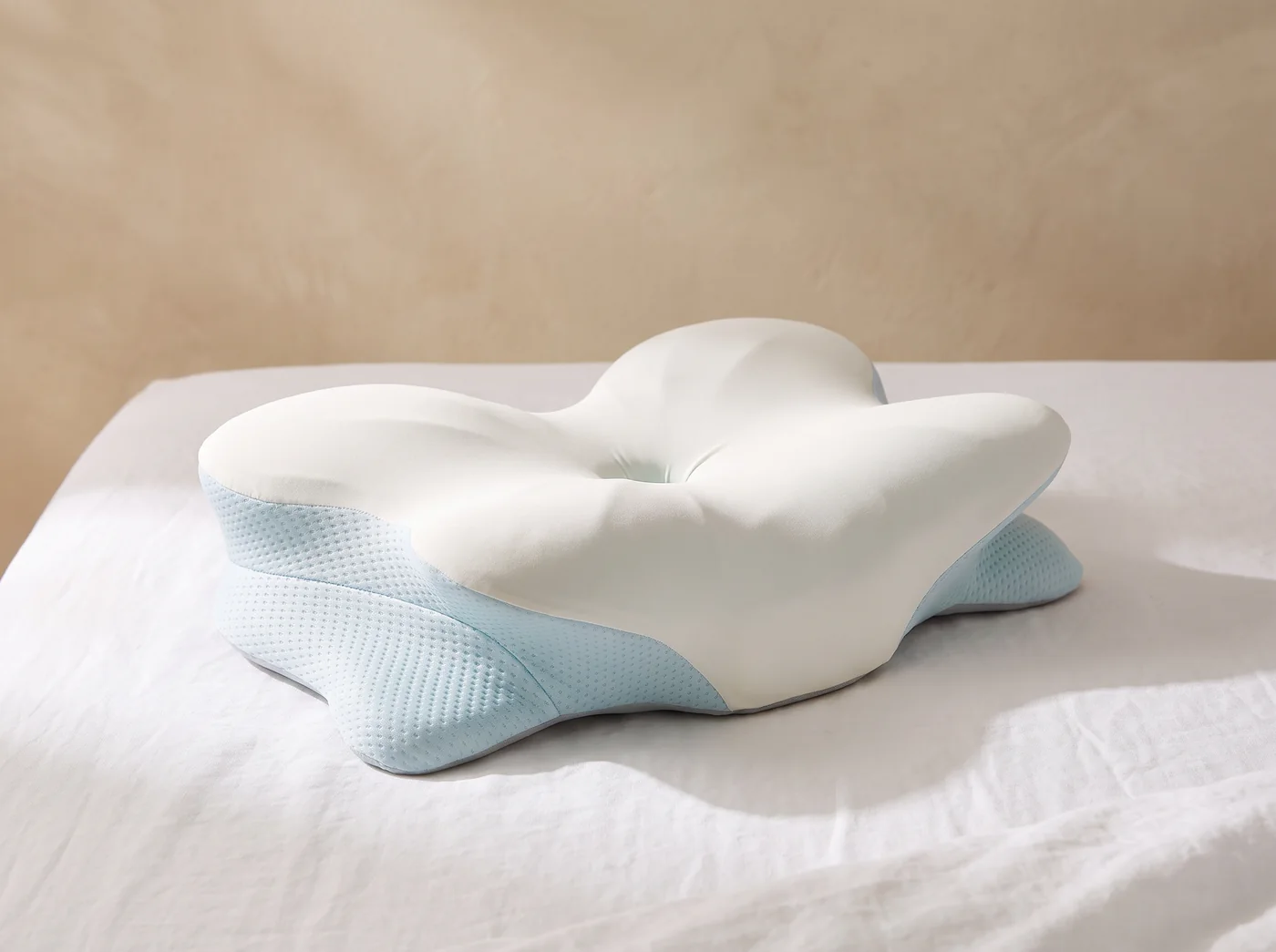
The pillow we recommend for this is the Derila Ergo, a medium-firm contoured memory-foam pillow with a lower center (about 9 cm) for back sleeping, a raised neck roll, and taller side wings (about 12 cm) for side sleeping. It suits side and back sleepers, not stomach sleepers. I have slept on it myself. It is full-size, not a travel pillow, so it belongs in your own bed or crash pad, and it suits anyone whose neck is sore after a week of hotel pillows. It costs $59.99 for one, $99.98 for two, or $149.96 for four (three plus one free), with a 60-day money-back guarantee. Shipping is calculated at checkout.
We earn a commission if you buy through this link, at no extra cost to you. Full details in our Derila pillow review.
If your neck already has a diagnosis. Long hours in a cramped seat, headsets and sleeping upright on layovers are hard on the neck. If a doctor has named the problem, our condition guides give the pillow height that fits it: the best pillow for a herniated disc in the neck, the best pillow for cervical stenosis, and the best pillow for occipital neuralgia for headaches that start at the base of the skull.
When it is more than tiredness
Tiredness after a hard trip is normal. Tiredness that does not lift after days off is not. See a doctor, and tell your AME, if any of these fit:
- Loud snoring, gasping, or waking unrefreshed. These are signs of sleep apnea, where breathing stops briefly in sleep. It is treatable. Our sleep apnea and snoring guide explains the signs.
- Insomnia on days off as well as on trips. Sleep problems that persist on a normal schedule may point to a sleep disorder, stress, anxiety or depression.
- Low mood or anxiety that is building. Your AME can explain how treatment works alongside your medical certificate.
If you are in crisis or thinking about suicide in the US, call or text 988 (the Suicide and Crisis Lifeline). In an emergency, call 911.
Common questions
How many hours of rest do airline pilots get between flights?
Under US Part 117, at least 10 consecutive hours before any flight duty period, including 8 uninterrupted hours of sleep opportunity, plus at least 30 consecutive hours off duty in every 168 hours.
Do pilots sleep during long flights?
Yes, on flights with an augmented crew. Extra pilots let the crew rotate through breaks in bunks or lie-flat seats while a qualified pilot stays at the controls. Bunk sleep helps but is lighter than hotel sleep.
Can pilots take melatonin?
The FAA’s over-the-counter medication guide lists melatonin as generally safe to fly, but warns that the wrong timing can worsen jet lag and cause daytime drowsiness. Never fly within 48 hours of first use, and check with your AME, since nightly sleep aid use is not allowed.
Are pilots allowed to nap in the cockpit?
It depends on the regulator. Europe’s EASA has guidance for short, planned controlled rest in the seat during cruise. The FAA does not authorize in-seat cockpit naps for US airlines.
How do flight attendants deal with jet lag?
Many stay on home time during short layovers, as the CDC advises for trips under two days, and time light and meals to match. US rules give at least 10 consecutive hours of rest after a scheduled duty of up to 14 hours.
The bottom line
Pilots and flight attendants sleep wherever the roster puts them, and the rules set a floor, not a guarantee. Early starts and eastbound trips cost the most sleep. Protect the hours you control, plan your anchor sleep, follow the FAA’s sleep aid rules to the letter, and make your own bed the best sleep of the trip.
We earn a commission if you buy through this link, at no extra cost to you. Full details in our Derila pillow review.
Related: How do firefighters sleep? · How do night shift nurses sleep? · How do truck drivers sleep? · Resetting your circadian rhythm
Sources
- Electronic Code of Federal Regulations. 14 CFR Part 117, Flight and duty limitations and rest requirements: flightcrew members (sections 117.3, 117.5, 117.17, 117.25).
- Electronic Code of Federal Regulations. 14 CFR 121.467, Flight attendant duty period limitations and rest requirements.
- Federal Aviation Administration. Guide for Aviation Medical Examiners: Sleep Aids (last updated May 2025).
- Federal Aviation Administration. Over-the-Counter (OTC) Medications Reference Guide (version 08/28/2024).
- Flight Safety Foundation, Fatigue Countermeasures Working Group. Controlled Rest on the Flight Deck: A Resource for Operators (2018).
- Roach GD, Sargent C, Darwent D, Dawson D. Duty periods with early start times restrict the amount of sleep obtained by short-haul airline pilots. Accident Analysis and Prevention, 2012.
- Signal TL, Gander PH, van den Berg MJ, Graeber RC. In-flight sleep of flight crew during a 7-hour rest break: implications for research and flight safety. Sleep, 2013.
- European Cockpit Association. Pilot fatigue: the numbers speak (survey analyzed by Baines Simmons, 2026).
- McNeely E, Gale S, Tager I, et al. The self-reported health of U.S. flight attendants compared to the general population. Environmental Health, 2014. Also: Grajewski B, et al. Sleep disturbance in female flight attendants and teachers. Aerospace Medicine and Human Performance, 2016.
- Centers for Disease Control and Prevention. CDC Yellow Book: Jet Lag Disorder.