
How Do Medical Residents and Junior Doctors Sleep?
The short version: Medical residents sleep in whatever gaps the rota leaves. In the US, the rules allow up to 80 hours a week (averaged over four weeks) and shifts of 24 hours plus up to 4 more for handover, so sleep comes in short call-room naps and long recovery sleeps after call. Junior doctors in England work under different limits: a 48-hour average week, 13-hour shifts and no more than four nights in a row. The research is clear that extended shifts raise error rates and the risk of crashing on the drive home. What helps most is protecting the post-call sleep, napping on purpose, and never driving when you are fighting to stay awake.
Residency is the one stretch of a medical career where sleep loss is built into the timetable. Interns and residents in the US, and junior doctors (now called resident doctors) in the UK, rotate through day shifts, night float blocks and long on-call shifts, often in the same month. After a night on call, many drive home on broken sleep and then try to recover in a bright, noisy afternoon.
This guide sets out what the rules say, what the big studies found, and what residents can do inside a schedule they do not control. Every figure is sourced at the end.

Sleeping in daylight after call? When you only get a few hours, falling asleep fast matters. The Derila Ergo is a contoured pillow for side and back sleepers, shaped to support the neck.
The rules: how long can a resident work?
In the US, residency hours are set by the Accreditation Council for Graduate Medical Education (ACGME), the body that accredits training programs. The current limits are in Section 6 of its Common Program Requirements. In England, limits are written into the 2016 terms and conditions for resident doctors, and the BMA publishes them in its rota checker.
| Rule | US (ACGME) | England (2016 contract) |
|---|---|---|
| Weekly hours | 80 hours, averaged over four weeks (some specialties can apply for up to 88) | 48-hour average; no more than 72 hours in any 7 days |
| Longest shift | 24 hours of scheduled clinical work, plus up to 4 hours for handover and education | 13 hours (on-call periods up to 24 hours) |
| Rest after the longest shift | At least 14 hours free after 24 hours of in-house call | 46 hours off after a run of night shifts |
| Rest between shifts | Should have 8 hours off | At least 11 hours |
| Days off | One day in seven, averaged over four weeks | No more than 7 shifts in a row; at most 1 weekend in 2 |
| Nights and call | In-house call no more often than every third night (averaged) | No more than 4 nights in a row |
Two things stand out. The US limits are averaged, so one week can run well over 80 hours if the month evens out. And the US still allows a single shift of up to 28 hours. The ACGME also requires programs to provide “adequate sleep facilities and safe transportation options” for residents too tired to get home safely, and to teach fatigue management, including strategic napping and careful use of caffeine.
The US rules may change again. In 2026 the ACGME proposed a major revision that would cut the rest after 24-hour call from 14 hours to 12 and drop the 8-hours-between-shifts rule, with changes expected from July 2028. The consumer group Public Citizen has formally objected.
What the research says
These are the studies that shaped the rules.
| Study | Who | What it found |
|---|---|---|
| Landrigan et al., NEJM 2004 | Interns in two intensive care units | On a traditional schedule with extended shifts, interns made 35.9% more serious medical errors and 5.6 times as many serious diagnostic errors |
| Barger et al., NEJM 2005 | 2,737 interns reporting monthly | After an extended shift, the odds of a car crash were 2.3 times higher and of a near-miss 5.9 times higher |
| FIRST trial, NEJM 2016 | 117 general surgery programs, 4,330 residents | Flexible hours did not change death or serious complications (9.1% vs 9.0%); residents on flexible hours were somewhat more often dissatisfied with their well-being (14.9% vs 12.0%) |
| iCOMPARE trial, NEJM 2019 | 63 internal medicine programs; sleep measured in 398 interns | 30-day patient mortality was similar under both rule sets. Interns slept 6.85 hours per 24 hours on flexible schedules vs 7.03 on standard ones, but the trial could not show alertness was as good |
| Weaver et al., Am J Med 2020 | 15,276 first-year residents | After work-hour limits cut 24-hour shifts from 3.9 to 0.2 a month, crash risk fell 24% and needlestick-type injuries fell more than 40% |
Put plainly: the patient-safety trials (FIRST and iCOMPARE) found that giving programs more flexibility over shift length did not raise patient deaths or serious complications. But the studies of residents themselves, their attention, their injuries and their drive home, keep finding harm from long shifts. Both findings can be true at once.
Key facts you can quote
- US residents can work up to 80 hours a week averaged over four weeks, and shifts of 24 hours plus up to 4 more (ACGME).
- Interns on schedules with extended shifts made 35.9% more serious medical errors (Landrigan et al., NEJM 2004).
- After an extended shift, interns had 2.3 times the odds of a car crash and 5.9 times the odds of a near-miss (Barger et al., NEJM 2005).
- When 24-hour shifts were cut from 3.9 to 0.2 a month, residents’ crash risk fell 24% (Weaver et al., 2020).
- About 28.8% of resident physicians have depression or depressive symptoms (Mata et al., JAMA 2015).
Free to quote with a link to this page.
The sleep problems residents actually face
Call-room sleep is broken sleep
On 24-hour call, sleep happens in an on-call room between pages, in fragments. Each page drops you into sleep inertia, the groggy spell after waking from deep sleep, just when you must make a decision.
Night float flips the body clock
Night float means a block of consecutive night shifts. Your body clock rarely shifts fully in that time, so you try to sleep in the late morning while your brain signals “awake”. Then the block ends and you have to flip back.
The drive home
The most dangerous part of a 24-hour shift may come after it ends. In the Barger study, each extended shift in a month raised that month’s crash risk by 9.1%. A familiar commute makes it easy to underestimate how impaired you are.
Sleep debt, burnout and depression
On a schedule that can average 80 hours a week, the one day off often goes on errands and studying, and sleep is what gives. A 2015 JAMA meta-analysis of 17,560 residents found 28.8% had depression or depressive symptoms. A 2019 meta-analysis of 22,778 residents put burnout at 51.0%. Poor sleep and low mood feed each other.
Find your situation
Tap the option that matches your week for the advice that fits.
On 24-hour call
- Sleep the moment the list is quiet. Do not wait for a “real” break that may never come.
- Keep naps either short (about 20 minutes) or long enough to cover a full cycle, and give yourself a minute to wake properly before acting on a page.
- Bring your own eye mask and earplugs to the call room. Call-room bedding is rarely made for comfort.
- If you are too tired to drive, use the sleep room or the transport your program must provide. That is what the rule is for.
On a night float block
- Sleep as soon as you get home. Wear sunglasses on the commute so morning light does not wake your body clock up further.
- Make the bedroom fully dark, cool and quiet. Blackout blinds and a fan or white noise are worth the money.
- Keep the same sleep window across the whole block, and tell housemates or family it is off limits.
- Plan the flip back: on your first day off, sleep a shorter morning and go to bed at a normal time that night.
On days off and post-call recovery
- After call, sleep a solid block but wake by mid-afternoon so you can sleep that night.
- Get outdoor light in the afternoon and evening to pull your body clock back towards a normal day.
- If you use a sleep supplement, use it only on nights when you are not working or driving the next morning, and never before a shift.
Do not take it with antidepressants (SSRIs, SNRIs, MAOIs) or other serotonin medicines, because it contains 5-HTP. If you take regular medication, are pregnant or breastfeeding, check with a doctor or pharmacist first.
Practical strategies that work inside the rules
Protect the post-call sleep. The ACGME’s own guidance says residents are “encouraged to prioritize sleep over other discretionary activities” in the 14 hours after call. Eat, shower and go straight to bed with your phone on do-not-disturb.
Nap on purpose. Strategic napping is one of the fatigue strategies the ACGME lists by name. A planned nap before a night shift or a 24-hour call is not lazy; it is how you arrive at 3am with something left in the tank.
Time caffeine. Use it early in the shift and in the first half of the night, then stop. Caffeine in the last hours before you sleep makes the recovery sleep lighter. Our guide to caffeine and sleep explains the timing.
Use an anchor sleep. When your schedule rotates, keep a few hours of sleep at the same time of day across shifts. That “anchor” gives your body clock something steady. Put your shift times into our free shift-work sleep planner to work out where your anchor should sit.
Make the bedroom a cave. Blackout curtains, a cool room, earplugs or white noise, and a pillow that lets you settle quickly all help daytime sleep.
Have a no-drive plan. Decide before the shift what you will do if you are too tired to drive: the sleep room, a taxi or a lift. Heavy eyelids and drifting out of your lane mean stop.
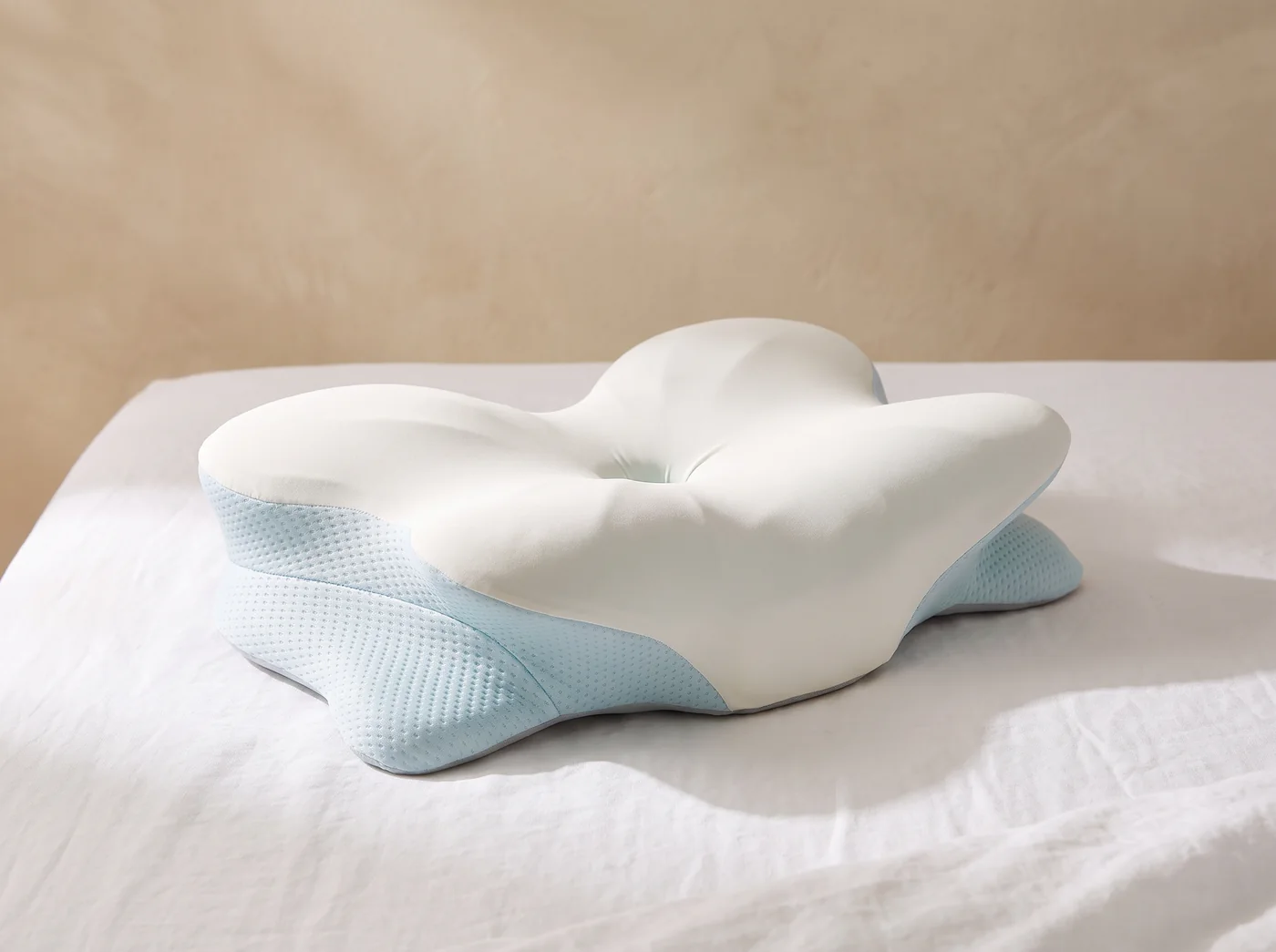
What can help you sleep after a shift
No product fixes a 28-hour shift. But when you get to bed in the middle of the day, getting comfortable fast matters, and so does not waking with a stiff neck.
The Derila Ergo is a contoured memory-foam pillow with a lower center (about 9 cm) for back sleeping and taller side wings (about 12 cm) for side sleeping, with a raised neck roll and a medium-firm feel. It suits side and back sleepers, not stomach sleepers. I have slept on it myself. It costs $59.99 for one, $99.98 for two or $149.96 for four, with shipping calculated at checkout and a 60-day money-back guarantee.
Want our pillow pick? See our Derila Ergo review.
We earn a commission if you buy through this link, at no extra cost to you. Full details in our Derila pillow review.
If your neck already has a diagnosis. Hours bent over patients, screens and the operating table are hard on the neck. If a doctor has named the problem, our condition guides give the pillow height that fits it: the best pillow for a dowager’s hump, the best pillow for occipital neuralgia, and the best pillow for a herniated disc in the neck.
For days off and post-call recovery only: YU SLEEP
YU SLEEP is a liquid sleep supplement with Red Tart Cherry, 5-HTP, vitamins B6 and B2, Magnesium Glycinate, Apigenin, Lemon Balm, L-Theanine, GABA and a low 0.9 mg dose of melatonin. We have not tested it ourselves. If you try it, use it only on nights when you are not working, on call or driving the next morning, and never before a shift. It costs $138 for two months, $177 for three or $294 for six, with a 60-day guarantee. See our YU SLEEP guide for shift workers.
Want our sleep-supplement pick? See why we chose YU SLEEP.
Do not take it with antidepressants (SSRIs, SNRIs, MAOIs) or other serotonin medicines, because it contains 5-HTP. If you take regular medication, are pregnant or breastfeeding, check with a doctor or pharmacist first.
When it is more than tiredness
- Shift work disorder: if you still cannot sleep in the day or stay awake at night after weeks on a block, and it affects your work or mood, see your own doctor, not a colleague in the corridor.
- Sleep apnea: loud snoring, gasping at night, or sleepiness that does not lift on days off. See our sleep apnea and snoring guide.
- Depression and burnout: low mood most days, losing interest, or feeling numb at work are reasons to get help early.
If you are in the US and in crisis, call or text 988. The Physician Support Line (1-888-409-0141) offers free, confidential peer support from volunteer psychiatrists for physicians and medical students; it is not a crisis line. In the UK, the BMA runs a 24/7 counselling line on 0330 123 1245 for all doctors and medical students, members or not. In an emergency, call 999 or 911.
Common questions
How many hours a week can a medical resident work?
In the US, up to 80 hours a week averaged over four weeks under ACGME rules. In England, resident doctors on the 2016 contract average no more than 48 hours a week, with a cap of 72 hours in any 7 days.
How long is a 24-hour call shift?
Up to 24 hours of scheduled clinical work plus up to 4 hours for handover and education, so as long as 28 hours. Residents must then have at least 14 hours off.
Do residents get to sleep on call?
Sometimes, in short bursts. Programmes must provide sleep facilities, and the ACGME lists strategic napping as a fatigue strategy. How much you get depends on the specialty and the night.
Is it safe to drive home after a 24-hour shift?
Often it is not. Interns had 2.3 times the odds of a crash after an extended shift. If you feel drowsy, nap first or use the safe transport your program is required to offer.
How do UK junior doctor rota rules compare with US residency rules?
The English rules are tighter on single shifts: 13-hour maximum shifts, no more than 4 nights in a row, 46 hours off after a run of nights and 11 hours between shifts. US rules allow 24 hours plus 4.
The bottom line
Residents do not choose their hours, but they can choose what happens in the gaps. Sleep straight after call, nap on purpose, stop caffeine early, keep the bedroom dark, and plan the drive home. Long shifts take a toll on the doctor even when patient outcomes hold steady, so protecting your sleep is part of doing the job well.
Sleeping at odd hours? A contoured pillow that supports your neck on your side or back can help you settle faster when your body clock is fighting you.
Related: How do night shift nurses sleep? · How do paramedics sleep? · How do firefighters sleep? · Resetting your circadian rhythm
Sources
- ACGME. Guide to the Common Program Requirements (Residency), Version 5.2, June 2026 (Sections 6.15, 6.16, 6.20 to 6.27).
- ACGME. Summary of changes to Common Program Requirements Section VI (80-hour limit, 88-hour exceptions).
- Public Citizen. Comments regarding the proposed major revision of the ACGME Common Program Requirements, 2026.
- British Medical Association. BMA rota checker: 2016 TCS rota rules for resident doctors in England.
- Landrigan CP et al. Effect of reducing interns’ work hours on serious medical errors in intensive care units. N Engl J Med. 2004;351:1838-48.
- Barger LK et al. Extended work shifts and the risk of motor vehicle crashes among interns. N Engl J Med. 2005;352:125-34.
- Bilimoria KY et al. National cluster-randomized trial of duty-hour flexibility in surgical training (FIRST). N Engl J Med. 2016;374:713-27.
- Basner M et al. Sleep and alertness in a duty-hour flexibility trial in internal medicine. N Engl J Med. 2019;380:915-23; and Silber JH et al. Patient safety outcomes under flexible and standard resident duty-hour rules (iCOMPARE). N Engl J Med. 2019;380:905-14.
- Weaver MD et al. The association between resident physician work-hour regulations and physician safety and health. Am J Med. 2020;133(7):e343-e354.
- Mata DA et al. Prevalence of depression and depressive symptoms among resident physicians. JAMA. 2015;314(22):2373-83; and Low ZX et al. Prevalence of burnout in medical and surgical residents: a meta-analysis. Int J Environ Res Public Health. 2019;16(9):1479.