
Best Pillow for Plus-Size Side Sleepers: Getting the Height Right
The short version: a bigger body sinks further into the mattress, so the pillow height you need depends on your bed as much as your shoulders. On your side on a soft or medium mattress, most plus-size sleepers need about 11 to 13 cm (4.25 to 5 in) of height with the head on the pillow. On a firm mattress, about 13 to 15 cm (5 to 6 in). Choose medium-firm foam, because fiber goes flat under more weight. Our pick is the Derila Ergo. Its 12 cm wings suit plus-size side sleepers on a soft or medium mattress.
If you are a larger person who sleeps on your side, you may have found that pillows never quite work. A soft one is flat by midnight. A tall one feels like a wall. You wake with a stiff neck, a sore shoulder, or an arm folded under the pillow to make up the height.
The reason is simple once you see it. Two things decide your side pillow height: how far your shoulder holds you off the bed, and how far you sink into it. A larger frame changes both. This guide shows you how to find your number, what to look for in a pillow, and what to watch for if you snore.
Short on time? Our pick is the Derila Ergo, a medium-firm contoured memory foam pillow with two heights and a 60-day money-back guarantee. Pick your setup below to see whether its heights match.
The Quick Decision Table
| Your setup | Height under your head | Derila Ergo fit |
|---|---|---|
| Side, soft mattress or thick topper | 11 to 12 cm (4.25 to 4.75 in) | Good. Use a 12 cm wing. |
| Side, medium mattress | 12 to 13 cm (4.75 to 5 in) | Good. Use a 12 cm wing. |
| Side, firm mattress | 13 to 15 cm (5 to 6 in) | Great with a folded towel underneath. |
| On your back | 8 to 10 cm (3.25 to 4 in) | Good. Use the 9 cm center. |
| On your stomach | Very thin, or none | Not a fit. It is not made for stomach sleeping. |
Why Size Changes the Pillow You Need
The shoulder makes the gap
When you lie on your side, your shoulder holds your upper body off the mattress. Your head has to be held up the same distance, or your neck bends toward the bed. Broader shoulders make a bigger gap. The CDC’s national health survey found the average American man measured 41.1 cm across the shoulders (tip to tip) and the average woman 36.7 cm, with one man in twenty at 45 cm or more. Many larger people are at the broad end of those numbers.
The mattress closes it
A heavier body presses further into the mattress, and the shoulder sinks with it. Every centimeter the shoulder sinks is a centimeter less pillow you need. On a soft mattress, a broad frame and a deep sink can almost cancel out. On a firm mattress, they do not, and you need the tallest pillow of anyone.
This is why advice such as “big people need big pillows” goes wrong so often. The right answer is “it depends on your bed”, and the table above builds that in.
The pillow gets pressed harder
A larger head and more weight through the neck press a pillow harder all night. Fiber and down fills get pushed out from under you within hours. A pillow that measures 13 cm in the shop can be 8 cm at 3 a.m. That is why the fill matters as much as the height.
Snoring, Sleep Apnea and Your Position
MedlinePlus, the US National Library of Medicine’s health site, lists obesity and a large neck size among the risk factors for obstructive sleep apnea, a condition where the airway narrows or closes during sleep. It gives the neck size as 17 inches (43 cm) or more for men and 16 inches (41 cm) or more for women. It also says sleeping on your back can block or narrow the airway, and advises people with sleep apnea to avoid it.
So for many plus-size sleepers, side sleeping is worth getting right for more than the neck. A side pillow at the correct height makes side sleeping comfortable enough to stay there. If you snore loudly, wake gasping or are very sleepy in the day, see your doctor: sleep apnea is common, treatable and not something a pillow fixes on its own. Our pillow guide for snorers has more on position.
Is a contoured pillow actually your answer?
Three questions, then a loft number and a straight yes or no — including the times the answer is no.
Pick Your Setup
How do you sleep most of the night, and on what? Tap one and the plan changes.
Side sleeper, soft or medium mattress.
- Target height: about 11 to 13 cm (4.25 to 5 in) with your head on the pillow. Your shoulder sinks in, which takes some of the gap away.
- Check: lie on your side and have someone look from behind. Your neck should run straight from the middle of your back, with your nose in line with your chest.
- Derila fit: good. The 12 cm wings sit right in this range.
Side sleeper, firm mattress.
- Target height: about 13 to 15 cm (5 to 6 in). A firm bed keeps your shoulder up, so the gap is at its widest.
- Derila fit: a great match with one easy tweak: slide a folded hand towel under the pillow for the extra centimeter.
- Safety net: the 60-day money-back guarantee gives you time to find out on your own mattress.
Back sleeper.
- Target height: about 8 to 10 cm (3.25 to 4 in) under your neck, so your chin is not pushed toward your chest.
- A word on snoring: MedlinePlus says back sleeping can narrow the airway in sleep apnea. If you snore loudly or have been told you stop breathing in your sleep, try sleeping on your side and speak to your doctor.
- Derila fit: good. The 9 cm center sits in this range, and the wings are there when you turn.
How to Measure Your Shoulder
This takes one minute and a tape measure. A second person makes it easier, but you can do it in a mirror.
- Stand up straight with your arms relaxed at your sides.
- Find the base of your neck on one side, the spot where the side of your neck meets the top of your shoulder.
- Find the tip of your shoulder: the bony point at the outer edge, just above the top of your arm.
- Measure straight across between the two points, along the top of the shoulder. Do not follow the curve down the arm.
Write the number down in centimeters or inches. That is your shoulder measure for the table below.
The Loft Numbers by Shoulder Measure
Loft is the height of the pillow, measured with your head resting on it, not the height printed on the box. These are our starting points for a medium mattress and an average sink. They are a rule of thumb, not a medical standard.
| Shoulder measure (neck base to tip) | Side sleeping | Back sleeping |
|---|---|---|
| Under 11.5 cm (4.5 in) | 8 to 9 cm (3 to 3.5 in) | 7 to 8 cm (2.75 to 3.25 in) |
| 11.5 to 13 cm (4.5 to 5 in) | 9 to 10 cm (3.5 to 4 in) | 7 to 9 cm (2.75 to 3.5 in) |
| 13 to 15 cm (5 to 6 in) | 10 to 12 cm (4 to 4.75 in) | 8 to 9 cm (3.25 to 3.5 in) |
| Over 15 cm (6 in) | 12 to 14 cm (4.75 to 5.5 in) | 8 to 10 cm (3.25 to 4 in) |
Adjust for how far you sink. If you sink well into your mattress, as many larger people do on a soft or pillow-top bed, take 1 to 2 cm off the side number. On a firm mattress where you stay on top, add about 1 cm.
A 2021 review of pillow studies in Clinical Biomechanics found that a pillow’s shape and height affect neck alignment more than what it is filled with. So get the height right first. For a number built from your own position, build and mattress, our pillow height calculator works it out in about thirty seconds.
Positions to Use and Avoid
Side sleeping: the one to get right
A 2019 scoping review in BMJ Open found that side lying was generally linked to fewer waking spinal symptoms than other positions, though the authors said good studies were few. A few habits help a larger frame:
- Shoulder in front, not under. Only your head and neck go on the pillow.
- Roll slightly forward. Turning your chest a little toward the mattress takes weight off the point of the lower shoulder.
- A pillow between your knees. It stops your top leg pulling your hips and lower back out of line.
- A pillow to hug. It supports your top arm so it does not drop forward and drag the shoulder with it.
For the full side-sleeping setup, see the best ergonomic pillow for side sleepers.
Back sleeping: comfortable for some, not for snorers
On your back, fill the curve behind your neck without pushing your chin down. A pillow under your knees takes strain off your lower back. If you snore or have sleep apnea, the side is the better choice.
Stomach sleeping: the one to phase out
Face down, your head has to turn close to 90 degrees to breathe, and your chest presses into the mattress. A long body pillow on your side gives the same hugged feeling with a straight neck.
What to Look for in a Pillow for a Plus-Size Side Sleeper
1. A height matched to your bed
Use the table above with your own mattress in mind. The same person needs a different pillow on a soft bed and a firm one.
2. Medium-firm foam, not loose fill
Medium-firm memory foam or latex keeps its height under more weight. Fiber, down and shredded fills drift flat during the night.
3. Room for your shoulder
A butterfly or cut-out shape lets a broad shoulder sit in front of the pillow instead of pushing into it.
4. Two heights for turning over
A lower middle for the back and higher sides for the side means the pillow is right whichever way you turn, which helps if you are working on staying off your back.
5. A washable cover
Larger sleepers often run warmer at night. A cover that comes off and goes in the wash keeps the pillow fresh.
6. A guarantee long enough to test it
The mattress effect is hard to judge in a shop. A trial or money-back guarantee of at least a month lets you test it where it counts.
Our Pick: The Derila Ergo
Judged against the list above, the Derila Ergo is the pillow we recommend for most plus-size side sleepers on a soft or medium mattress. Here is what it offers, and who it fits best.
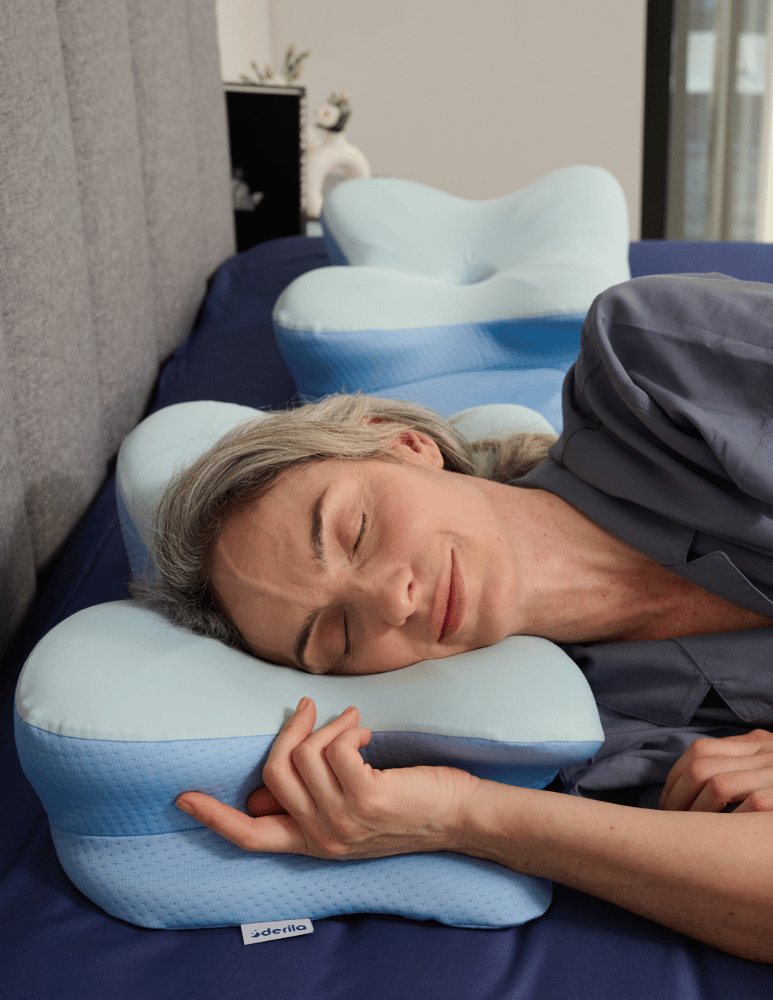
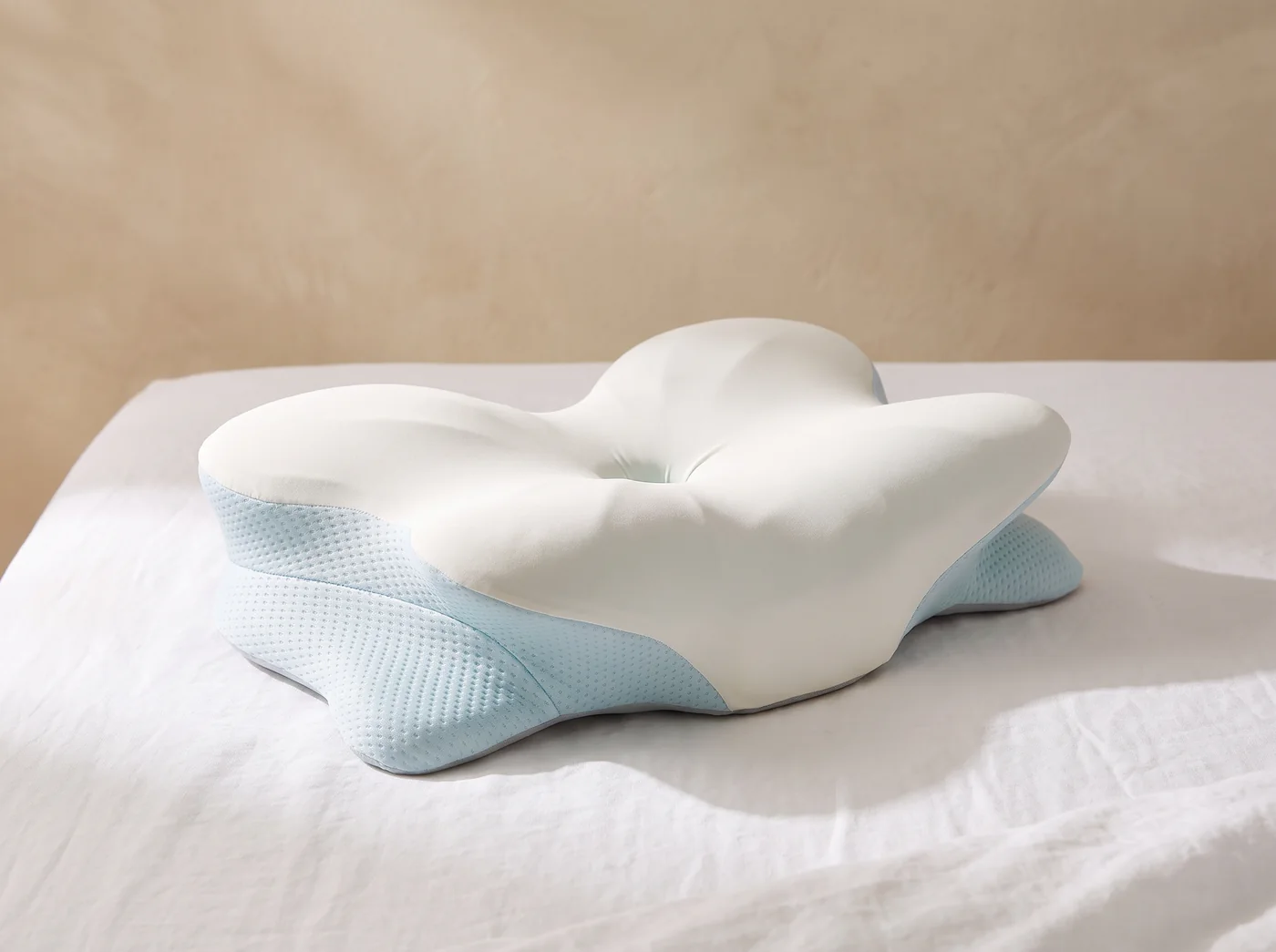
- Two heights in one: about 9 cm (3.5 in) in the center for back sleeping, and about 12 cm (4.7 in) in the side wings for side sleeping.
- Butterfly shape: the curved sides leave room for your shoulder, so it does not get pushed under the pillow.
- Medium-firm memory foam: it settles a little under your head and then holds that height through the night.
- Removable, washable cover.
- 60-day money-back guarantee.
Who it suits best
Side sleepers on a soft or medium mattress: the 12 cm wings are a good match, because your shoulder sinks in and takes some of the gap. Side sleepers on a firm mattress: slide a folded hand towel underneath for the extra centimeter. Back sleepers: the 9 cm center is a great match. Warm sleepers? Pair it with a breathable cotton pillowcase. Stomach sleepers should look elsewhere.
I have slept on it myself. On price, the official page lists $59.99 for one, $99.98 for two ($49.99 each) and $149.96 for four (three plus one free, $37.49 each). Shipping is calculated at checkout, and US delivery usually takes 8 to 12 business days. The brand holds a 4.1 out of 5 rating on Trustpilot. The seller sets the price, so check the current figure before you order. For more detail, see our full Derila pillow review.
Ready to Try the Derila Ergo?
Medium-firm foam with 12 cm wings, and a 60-day money-back guarantee.
We earn a commission if you buy through our links, at no extra cost to you.
Getting a New Pillow to Fit
- Give it two weeks. Your neck has been used to a different height. Judge the pillow by how you feel in the morning.
- Use the right zone. On your side, your head goes on a wing. On your back, your neck goes on the center.
- Fine-tune with a towel. If your head still tips toward the mattress after a week, fold a hand towel once and slide it under the pillow.
- Keep your arm out from under it. If the height is right, you will not need it.
If you still wake up stiff, our guide on how to stop waking up with neck pain goes through the other common causes.
What the Pillow Cannot Do
- It does not treat sleep apnea. It can make side sleeping easier, but diagnosis and treatment come from your doctor.
- It does not treat a condition. It is not a medical device. It removes nightly strain on the neck while other problems are treated.
- It cannot fix a mattress. A sagging mattress lets the hips and shoulders sink unevenly, and no pillow evens that out.
- The evidence is modest. The 2021 review in Clinical Biomechanics found that some pillow designs reduced neck pain and waking symptoms, but it did not find better overall sleep quality. Good pillow studies are few.
When to See a Doctor
Morning stiffness from a poor pillow usually eases as you move around. MedlinePlus advises contacting a health care provider if neck pain has not improved after a week of self-care, or if you notice any of the following:
- Numbness, tingling or weakness in your arm or hand
- Pain that gets worse when you lie down or wakes you at night
- A lump or swollen glands in your neck
- Trouble swallowing or breathing along with the neck pain
- Trouble walking or keeping your balance, or loss of bladder or bowel control
Get emergency care right away if you have a fever and headache with a neck so stiff you cannot touch your chin to your chest. Do the same if neck, jaw, shoulder or arm pain comes with shortness of breath, sweating or nausea, because that can be the heart, or if the pain followed a fall or a blow.
Loud snoring, gasping or choking in your sleep, or feeling very sleepy in the day, are reasons to ask your doctor about sleep apnea.
Frequently Asked Questions
What is the best pillow for a plus-size side sleeper?
One that fills the gap between your ear and the mattress once your shoulder has sunk in, and keeps that height all night. On a soft or medium mattress, most plus-size side sleepers need about 11 to 13 cm with the head on the pillow. On a firm mattress, 13 to 15 cm. A medium-firm contoured foam pillow with higher side wings, such as the Derila Ergo with its 12 cm wings, suits many plus-size side sleepers on a soft or medium bed.
Do heavier people need a thicker pillow?
Not always. Broader shoulders make a bigger gap on your side, but a heavier body also sinks further into the mattress, which closes some of that gap. On a soft mattress the two can nearly cancel out. That is why the mattress matters as much as your size when choosing a pillow height.
What sleep position is best if I snore or have sleep apnea?
MedlinePlus says sleeping on your back can cause the airway to become blocked or narrowed in obstructive sleep apnea, and advises people with it to avoid sleeping on their back. Side sleeping is the usual alternative. If you have been diagnosed with sleep apnea, follow your doctor’s treatment plan; a pillow does not replace it.
Why does my pillow go flat during the night?
A larger head and a heavier body press a pillow harder, and fiber or down fills get pushed aside within hours. Medium-firm memory foam or latex holds its height much better. If your pillow is flat by morning, it is the fill, not you.
Is the Derila Ergo good for plus-size side sleepers?
On a soft or medium mattress, yes for most. Its 12 cm wings sit in the 11 to 13 cm range most plus-size side sleepers need there. On a firm mattress, a folded hand towel under the pillow adds the extra centimeter. The 60-day money-back guarantee gives you time to test it on your own bed.
How do I stop my shoulder and hip hurting on my side?
Roll slightly forward so the point of the shoulder takes less weight, keep the shoulder in front of the pillow rather than under it, and put a pillow between your knees so your top leg does not pull your hips and back out of line. A mattress or topper soft enough to let the shoulder and hip sink in also helps.
The Bottom Line
For a plus-size side sleeper, the right pillow height depends on the mattress as much as the shoulders. On a soft or medium bed, aim for about 11 to 13 cm with your head on the pillow. On a firm bed, about 13 to 15 cm. Choose medium-firm foam that holds its height, and if you snore, make the side your home.
The Derila Ergo is our pick because its 12 cm wings suit plus-size side sleepers on a soft or medium mattress and its foam keeps its shape all night. The 60-day guarantee gives you time to be sure.
Try the Derila Ergo for 60 Days
If it does not suit you, the money-back guarantee covers you.
Related: best pillow for broad shoulders, best ergonomic pillow for side sleepers and best pillow for neck pain.
Sources
- McDowell MA, Fryar CD, Ogden CL. Anthropometric reference data for children and adults: United States, 1988–1994. Vital and Health Statistics, Series 11, No. 249. National Center for Health Statistics, 2009. Tables 54 and 55, biacromial breadth. CDC (PDF)
- MedlinePlus: Obstructive sleep apnea, adults
- MedlinePlus, US National Library of Medicine: Neck pain
- Pang H, Tsang M, Fu S. The effects of pillow designs on neck pain, waking symptoms, neck disability, sleep quality and spinal alignment in adults: a systematic review and meta-analysis. Clinical Biomechanics, 2021. PubMed
- Cary D, Briffa K, McKenna L. Identifying relationships between sleep posture and non-specific spinal symptoms in adults: a scoping review. BMJ Open, 2019. PMC
More Pillow Guides
Recommended for Pain-Free Sleep
🛌 Derila Ergonomic Memory Foam Pillow
Contoured design that holds your cervical spine in neutral for the full night. Works for side and back sleepers. Backed by a 60-day money-back guarantee on the official store.
- ✓ Memory foam contour
- ✓ Side & back sleeper design
- ✓ 60-day money-back guarantee